
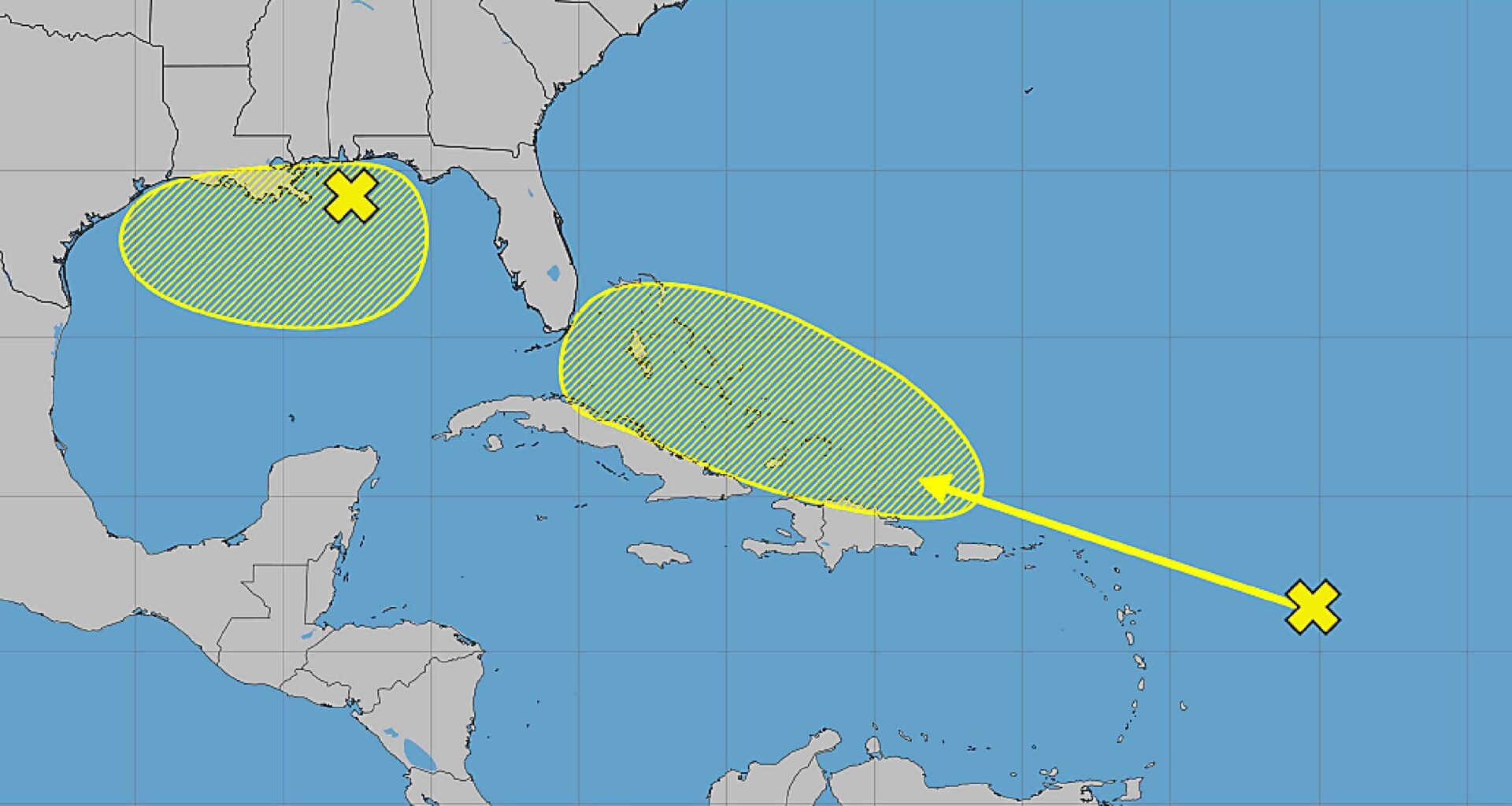
Tropical Storm Dolly may have turned back into just a tropical wave on Friday, but the National Hurricane Center continued Saturday to keep its eye on it as well as a Gulf system with chances to develop.
As of the NHC’s 8 a.m. tropical outlook, the remnants of Tropical Storm Dolly, which devolved after one day, were located several hundred miles east of the Caribbean’s Leeward Islands.
“Showers and thunderstorms have increased this morning in association with the remnants of Tropical Storm Dolly,” forecasters said. “However, there are no signs that the system is developing a closed circulation.”
The system, which is still unlikely to redevelop, continued to move at a fast pace headed west to west-northwest near 25 mph.
“The wave could bring locally heavy rains and gusty winds to portions of the Leeward Islands, the Virgin Islands and Puerto Rico over the next several days,” forecasters said.
The NHC still gave it a 10% chance to develop in the next seven days.
The projected path of the system, though, puts it on Florida’s doorstep after moving over the Greater Antilles.
The second system being tracked by the NHC was a weak area of low pressure with disorganized cloudiness and showers located in the northeastern and north-central Gulf centered about 100 miles south-southwest of Pensacola.
“Development, if any, of this system is expected to be slow while it drifts westward for the next few days,” forecasters said.
The NHC gave it a 10% chance to develop in the next seven days as well.
11 AM AST Fri Aug 28 (Advisory 5) Key Messages for Remnants of #Dolly. Latest info: https://t.co/GrztW6mQJV
11 AM AST viernes 28 de agosto (Aviso 5) Mensajes clave sobre los remanentes de #Dolly. Más información: https://t.co/GrztW6mQJV pic.twitter.com/TSHcmkjF5W
— National Hurricane Center (@NHC_Atlantic) August 28, 2026
After Dolly, the next name on the 2026 Atlantic hurricane list is Edouard.
Dolly had become the fourth named storm after tropical storms Arthur, Bertha and Cristobal.
Hurricane season began June 1 and runs through Nov. 30, but the height of hurricane season runs from mid-August through mid-October.
The National Oceanic and Atmospheric Administration earlier this month updated its seasonal forecast and now expects between seven and 13 named storms this year. Of those, two to six would become hurricanes. It also predicted that there might not be any major hurricanes this year, or at most two.
Already, 2026 was forecast to have lower-than-average storm generation, and that has been reduced even further with the latest forecasts from the NOAA and other weather groups.
An average year would see 14 named storms and seven hurricanes, with three of those growing to Category 3 strength or higher.