
Less than half of Florida’s kindergartners tested “ready” for school last year on the state’s early literacy exam, a worrisome statistic that the Florida Chamber of Commerce says needs business leaders’ attention.
Young students take the test during the first month of school, so a new group of 5-year-olds is taking it now.
Last year, 44% scored “ready” for kindergarten on the online assessment that gauges early literacy skills, including recognizing the ABCs, letter sounds and rhyming words. That’s a slight improvement from the 2024 score of 43% ready but still means many students lack the skills the state says are needed to do well when formal lessons begin in kindergarten.
The percentage of kindergartners testing ready for school varies by county and community, with youngers in higher-income areas faring far better, in part because they attended quality preschools, the Florida Chamber Foundation noted in a new report
The foundation, the business group’s charitable arm, says those kindergarten readiness scores are “one of the earliest, clearest indicators of whether a region is on track to meet its long-term workforce goals.”
In its report, the foundation says too many Florida families lack access to quality early learning programs that could help their children gain important preschool skills. That can be both because they cannot afford good programs or that none exist in their communities.
Businesses can help by donating to local groups working to improve or expand preschool options and creating other learning opportunities for needy youngsters, the foundation says.
“They need some very, very good interventions early on that are consistent year over year, which requires funding,” said Corrie Melton, a vice president at the foundation.
Without intervention, students who score poorly on the early literacy test are likely to struggle with reading and with school in the coming years, leaving them ill-prepared for the workforce even if they make it to high school graduation, the report says.
Experts agree.
“If kids don’t have the fundamental skills when they go in, it’s difficult for them to pick up new skills,” said Herman Knopf, senior research scientist at the University of Florida’s Anita Zucker Center for Excellence in Early Childhood Studies. “So they’re kind of always catching up, and it gets more difficult.”
In Lake and Orange counties last year, kindergartners did slightly better than the state average, at 48% and 47% ready, respectively, while in Osceola County they were below at 39%, and in Seminole County they were well above at 50%.
In Palm Beach County kindergartners were at the state average of 44%. In neighboring Broward County, they were slightly above the average at 45%.
Across Florida, youngsters who took part in Florida’s Voluntary Pre-Kindergarten Program, or VPK, did better than those who did not, with 55% testing ready when they started kindergarten.
“Being able to kind of create those building blocks over the first five years can be a game changer,” said Lisa Grant, vice president of education at KinderCare Learning Companies, which serves 900 VPK students in schools across the state. “Particularly for those children who come from under-resourced families, the earlier we can intervene, the better.”
Good preschools also help children learn other skills that benefit them in kindergarten, such as following teachers’ instructions, sitting still for lessons and regulating their emotions.
“I always like to say it’s like we’re teaching children how to learn,” Grant said.
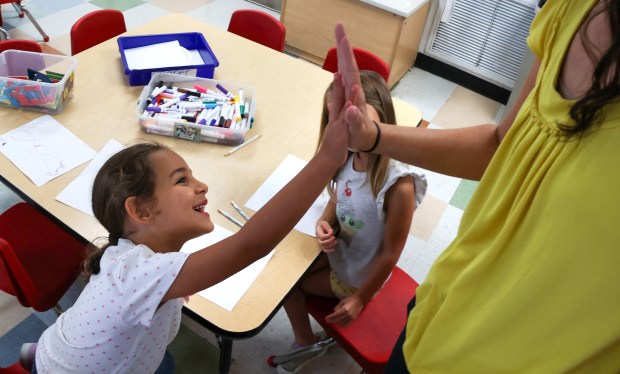 Four-year-old Gabriella Gallup gets a high-five from center director Jessica Lopez in the VPK class at Goldenrod Road KinderCare in Winter Park, Wednesday, Aug. 26, 2026. Florida’s VPK program has been linked to higher levels of kindergarten readiness. (Joe Burbank/Orlando Sentinel)
But not all families, particularly those with limited incomes, can access and pay for such programs.
Florida offers free VPK to all 4-year-olds in the state and relies largely on private preschools, like KinderCare, to administer the program. But the state only pays for three hours a day of learning, which experts say is not enough, especially for working families.
“The things we hear anecdotally from parents is, ‘How do I get them to and from a three-hour program while I’m working full-time?’” said Molly Grant, executive director of Florida’s Association of Early Learning Coalitions.
Most preschools offer a full day of VPK for a fee, usually between $150-200 a week. But not all families can afford the extra charge. And most preschools, which operate on tight margins, cannot afford to lower tuition.
“When you think about it, we’re pricing families out of early learning opportunities,” Molly Grant said.
The lowest readiness scores last year were in some of Florida’s poorest counties, including its rural ones. But, the chamber noted, even in some of Florida’s wealthiest counties, students from low-income neighborhoods started kindergarten without key skills.
Businesses and other private groups can help, it said.
The report highlights the Guadalupe Center in Collier County, which offers free or reduced-cost preschool to young children from low-income families living in a rural area, and after school tutoring once they reach kindergarten. Children in the program have an average kindergarten readiness rate of 95%.
The report also flags the success of an initiative in Pinellas County Schools that places academic coaches in primary grade classes to help elementary school teachers improve their lessons.
Founded in 2021, the program, funded by the Pinellas Education Foundation, targets schools with low readiness rates and has served 5,052 students in 32 schools. Those students, on average, have seen a 22% increase in reading proficiency, according to the nonprofit.
Both initiatives rely heavily on private donors to fill gaps because there isn’t enough public funding, Melton said.
“We’ve got to understand the issue and then all of us wrap our heads around it and come up with custom, localized solutions,” Melton said.
But for those solutions to work, they need funding, Molly Grant said.
“I hate to say it’s all about money,” she said. “But there’s so much in this service where it’s an access issue and the underlying issue with that is the funding.”