

Miami Killian Senior High School students Jamarquis Reid, 15, left, and Jayden Ramirez, 16, right, work on their design assignment during the Digital Design art class. Miami Killian has experienced the fastest-declining enrollment of any public school in Miami-Dade County, losing more than 80% of its students over the past 20 years.
Carl Juste
cjuste@miamiherald
Lisa Oberlander fondly recalls her time at Miami Killian Senior High in the 1980s. The school was bustling with a large, high-achieving and diverse student body. Its biggest issue back then was overcrowding.
The scene in her first year teaching a Digital Arts class at her alma mater has been somewhat different.
In the middle of one of the school’s cavernous “learning lab” spaces, eight students huddled in boxy armchairs, propping laptops on their knees and clicking through a design app. Surrounding them were dozens of empty desks in the darkened, unused parts of the room.
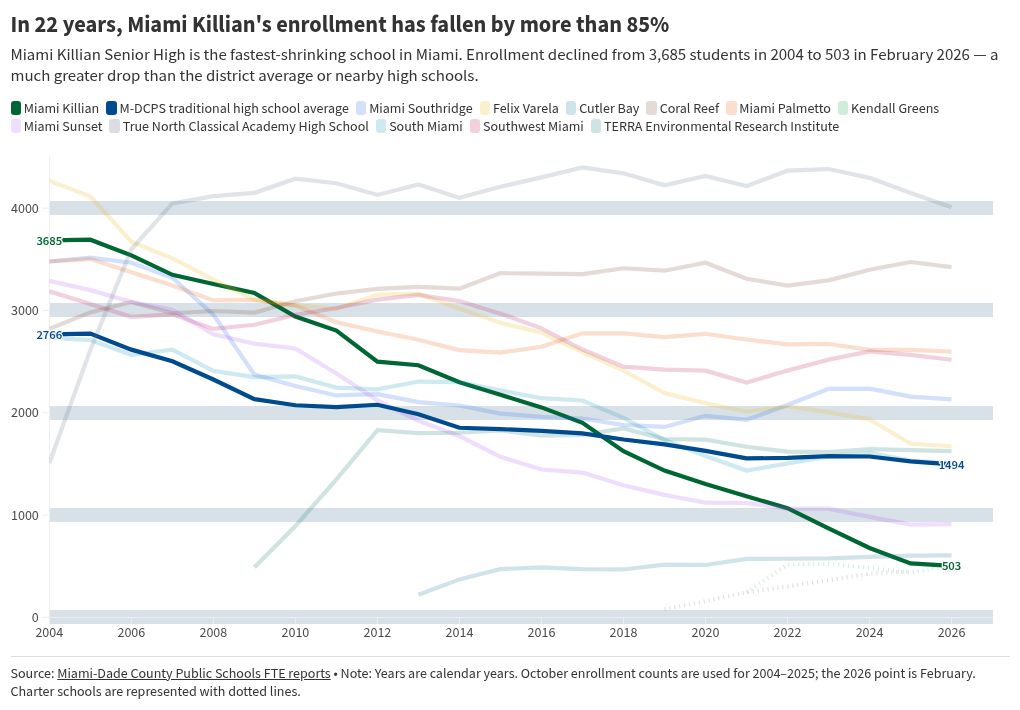
That’s every day at Killian — more space than the students could ever use. Going from 3,700 students in 2004 to just 430 to start this year, the school’s enrollment has declined more, and faster, than any other in Miami-Dade. The state estimates it’s using only 20% of its building’s total capacity.
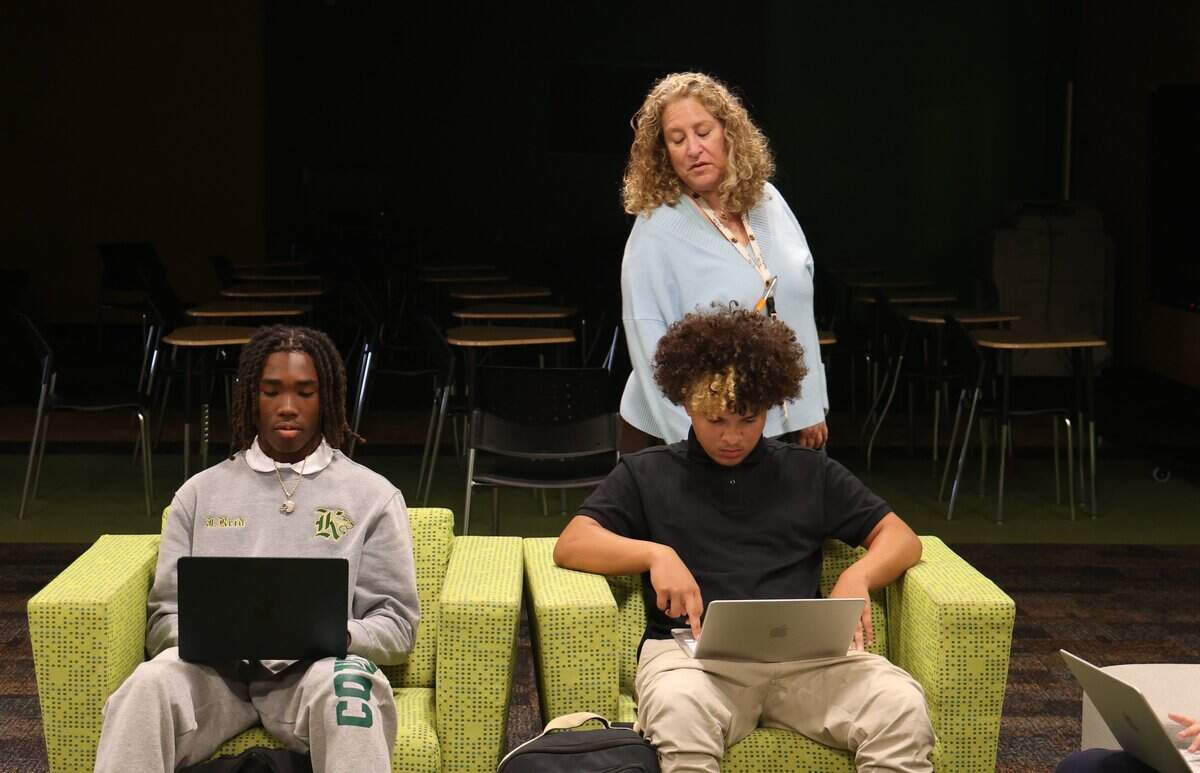 Miami Killian Senior High School teacher Lisa Oberlander, looks over the shoulders of Jamarquis Reid, 15, left, and Jayden Ramirez, 16, right, during the Digital Design art class. The school has lost 80 percent of its student body in the past two decades. Carl Juste cjuste@miamiherald
There are many theories as to how Killian got here. But an obvious, overarching answer is school choice. As Florida and Miami-Dade have increasingly given families the freedom to bypass their neighborhood school — whether it’s via charter schools, private school vouchers or open enrollment at other public schools — Killian has become the Kendall community’s odd man out.
Like many other public school districts in the country, Miami-Dade County Public Schools has been bleeding students in recent years, facing headwinds from lower birth and immigration rates as well as increased school choice initiatives. Traditional public school enrollment in the district is down from 352,000 in 2006-07 to about 217,000 to start this year.
While Killian is the starkest example of that decline, its survival now depends on school choice — a new sports magnet program that started this year.
Oberlander’s group is one of the founding classes for Killian’s “SportsPLEX” magnet program, the district’s Hail Mary effort to reverse the school’s enrollment woes. Leaning on Killian’s strong history in athletics, the program centers on the growing, multi-trillion-dollar business of sports.
By the end of the class, she said the students will be directly involved in promoting Killian athletics, designing their own shoes and even entire uniforms.
“Every Sunday when you’re watching TV, you’re watching billions of dollars in action that has nothing to do with the players. So, as they’re learning that, and they see the real, live people that are involved in that every day, you see the excitement,” Jorge Parra, the school’s new principal, told the Herald.
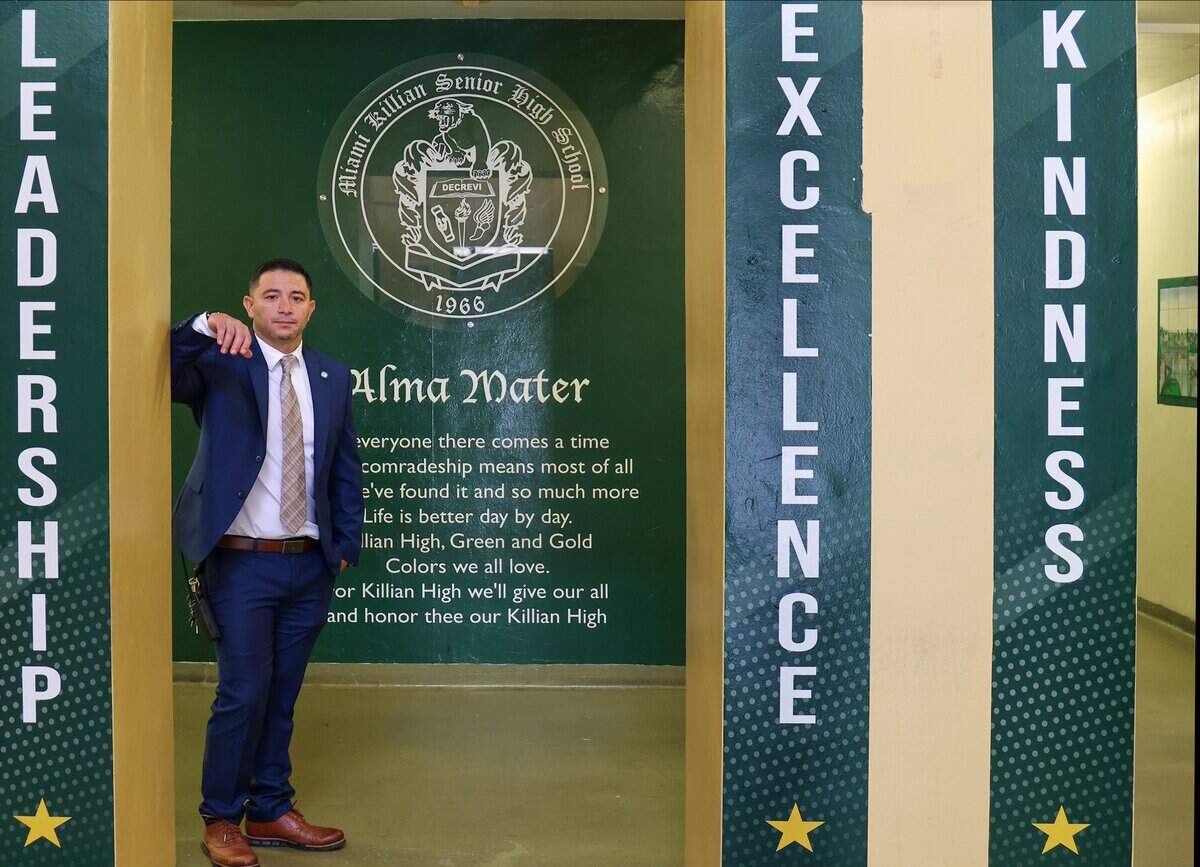 Miami Killian Senior High School Principal Jorge Parra at the entrance of the school. Killian has experienced the fastest-declining enrollment and has established a sports industry magnet program to try and increase enrollment. Carl Juste cjuste@miamiherald
If that excitement translates to enrollment, the program could point the district, and others around the country facing similar issues, toward one possible fix.
If it fails, Killian could join the many campuses shut down by the district. This summer, the school board OK’d plans to close nine schools, and leadership has indicated more are coming. Last year, Killian was on a list with other campuses that appear to be eyed for closure. This year, Killian didn’t appear in any district list for possible closures.
For now, the district is “steadfast committed” to SportsPLEX, according to Magda Pereira, a former Killian principal who is now the district’s top magnet official.
How did Killian get here?
Killian’s assigned attendance zone is not small.
Running through most of Kendall, it stretches from Sunset Drive all the way down to Palmetto Estates. There are rows upon rows of million-plus-dollar single family homes, two public libraries, the largest campuses for Miami Dade College and Baptist Health, three golf courses and a couple dozen public parks and green spaces.
A total of 3,175 high school students who attend public school or charter schools live there – likely hundreds more attend one of Miami-Dade’s growing private schools, though the data on them is unavailable.
Only a fraction of them — 323 — choose to attend Killian.
Administrators, community members and alumni have plenty of theories about why that is, but, according to Parra, it boils down to one word: choice.
“There are a lot more opportunities across the board – not just charters and private, but within our schools. [Parents] have so many choices that they can be selective and they become very educated on what they want for each child,” Parra said.
Indeed, Kendall parents have been selective.
Within the attendance boundary of Killian, 431 of the high-schoolers attend charter schools; 2,421 attend other public high schools.
Three different public high schools – Coral Reef Senior High, Terra Environmental Research Institute and Palmetto Senior High – each enroll more students from Killian’s boundary than Killian itself. All three high schools are operating at or above capacity.
Maria Linares-Hemelberg, an alum and former Killian teacher who was surplussed in 2020, saw the changes first hand.
The opening of Coral Reef Senior High, dubbed Miami’s “mega magnet” in the late 1990s within Killian’s attendance boundary, was the first hit, Linares-Hemelberg said. Before that, the two sought-after academic programs in South Dade were Killian and Palmetto. The new school pulled many students from the southern part of Kendall.
Then, in 2009, the school district opened Terra, another entirely magnet school that sits on the northern edge of Killian’s attendance boundary. While Killian’s enrollment decline is relatively steady across 22 years’ worth of data, it lost the most students shortly after Terra opened – 347 students in 2010-2011 and 304 the next year.
Coral Reef, Terra and Palmetto score above average on most tested subjects, per 10th grade results from state assessments. Terra and Coral Reef, both exclusively magnet schools, score particularly high.
Killian’s students recently posted below average test scores, but by the state’s school grading standards it is doing well. Last school year it received a “B” rating from the state, and the two years before that it got “A” ratings.
‘The school that got lost’
Though much has been made of the rise of “school choice” options like charter schools and vouchers in recent years, Killian’s current enrollment crisis has as much to do with the district and state’s own public “choice” models as anything else.
The first big policy change came in 2017, when the state required school districts to let families take advantage of an “open enrollment” system. In 2025, the school board passed a more flexible system that makes it even easier for parents to pick and choose their child’s school, bypassing their neighborhood school all together.
Chuck Todd, a journalist and former host of NBC’s “Meet the Press,” is one of several prominent Killian alums – alongside former University of Florida President Kent Fuchs and a roster’s worth of former MLB and NFL players.
Technically, Todd’s first national television appearance was as the Killian band’s drum major his senior year when they won a competition to lead the Orange Bowl parade.
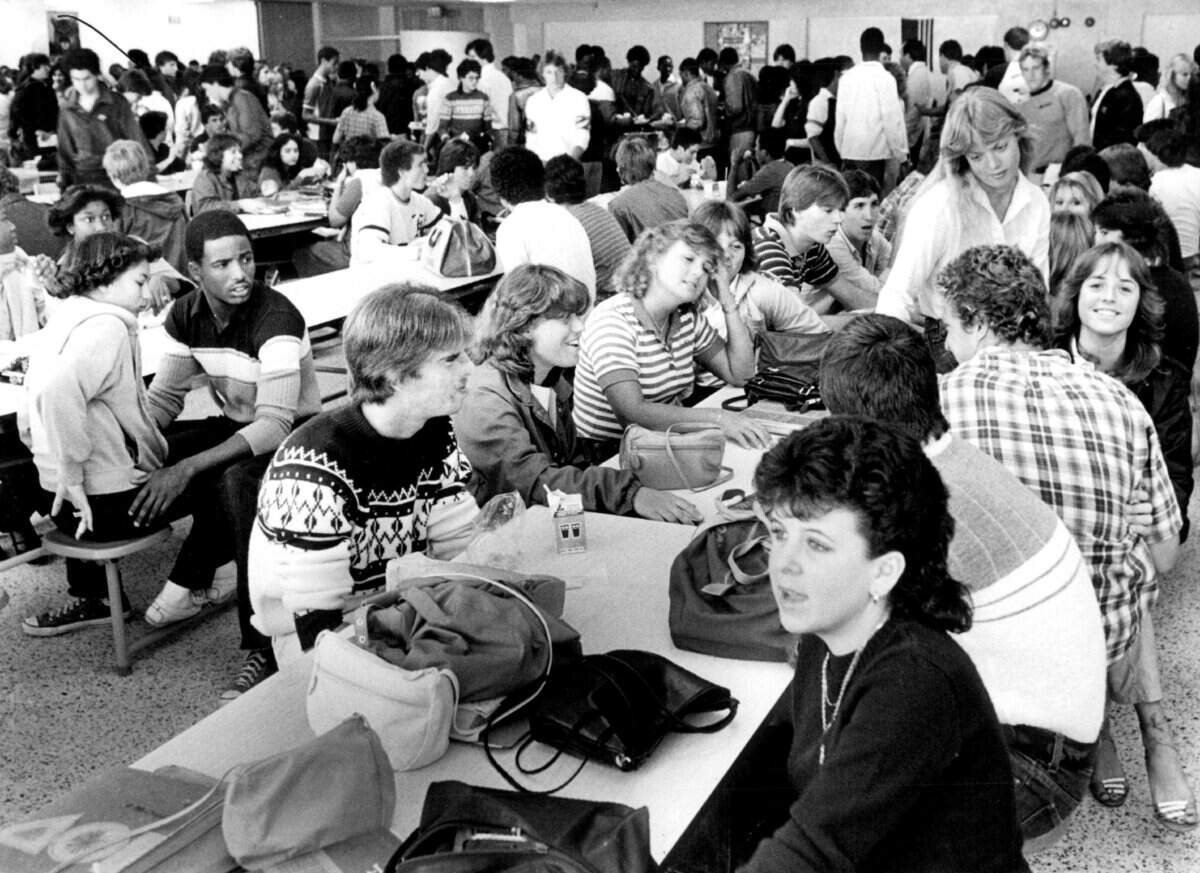 Herald archive image of students in Killian High’s cafeteria. Joe Rimkus, Jr. Miami Herald
He thinks the core issue has been a lack of leadership in navigating this new landscape. The “suspects with blood on their hands” are in Tallahassee and the district’s administrative office, he said.
“A lot of politicians have just pandered to parents without any foresight on how to do this the right way. Whatever you think of how Killian is now, this is a nice neighborhood. Why wouldn’t you want this school to succeed? How did this fail? How did this become the school that got lost,” Todd asked.
“If you were to tell me the neighborhood went to crap, and the school was down to 600. You’d be like, ‘Oh, okay, I know what happened,’” Todd said. “That’s not this.”
At a recent Killian football game, Chuck and Ann Tait, grandparents of a running back on the team, wore green “Killian vs. Everybody” shirts. The message is partly informed by Killian’s enrollment situation.
“A lot of kids from that area, they don’t come to Killian. It’s hard to draw them there,” Chuck Tait, a 69-year-old retired Miami-Dade police officer, said.
For their family, they said they like the small class sizes that Killian’s enrollment level affords. But they’re worried about charter schools potentially threatening the school’s future.
“Charter schools – I think they’re killing all public schools,” Chuck Tait said.
 Miami Killian Senior High football fans Ann Tait and Chuck Tait watch their grandson’s first football game of the season on Aug. 14. Austin Horn
But Linares-Hemelberg, who now is a teacher at private school Wesminster Christian, pointed out that as enrollment declined, the school’s reputation also took some hits. She said veteran teachers recalled a “snowball effect” after a high-profile violent incident. In 2015, a 17-year-old girl who was allegedly traumatized at her previous school stabbed 15-year-old football star Deandre Johnson in the school cafeteria.
“After that stabbing, I heard the school just went kind of downhill,” she said.
Bruce Baker, program director of the University of Miami’s Department of Teaching and Learning, said the decision of families to pull out of Killian can create a “reputational death spiral.”
“My guess is the families making those choices are higher income and more educated, leaving behind at Killian families with less agency to make those moves. That then becomes kind of a reputational death spiral. That is an inequity that the district really should be trying to figure out how to solve because these are all district schools,” Baker said.
As the years have passed, Killian’s percentage of students qualifying for free or reduced lunch, the closest proxy metric to wealth of student families, has increased. At 49% in February, that’s higher than all nearby high schools except Miami Southridge.
No high-profile violent incidents have occurred at Killian in several years, not since a freshman girl was beaten up in the cafeteria in 2018 – but a bad rap can be a tough thing to shake.
A viral Facebook post from Mark Barnett, the school’s activities director, rallied alumni of “the K” to support the school, insisting that no plans were in place to close it. It also highlighted school safety.
“It is clean, safe, and there is no chaos at all. The admin team that’s running the school has done an excellent job. Our students are in uniform, wearing their IDs, and behaving as well as any students in this country,” Barnett wrote.
“What we need now is our kids back.”
Alumni and community members shared the post more than 200 times.
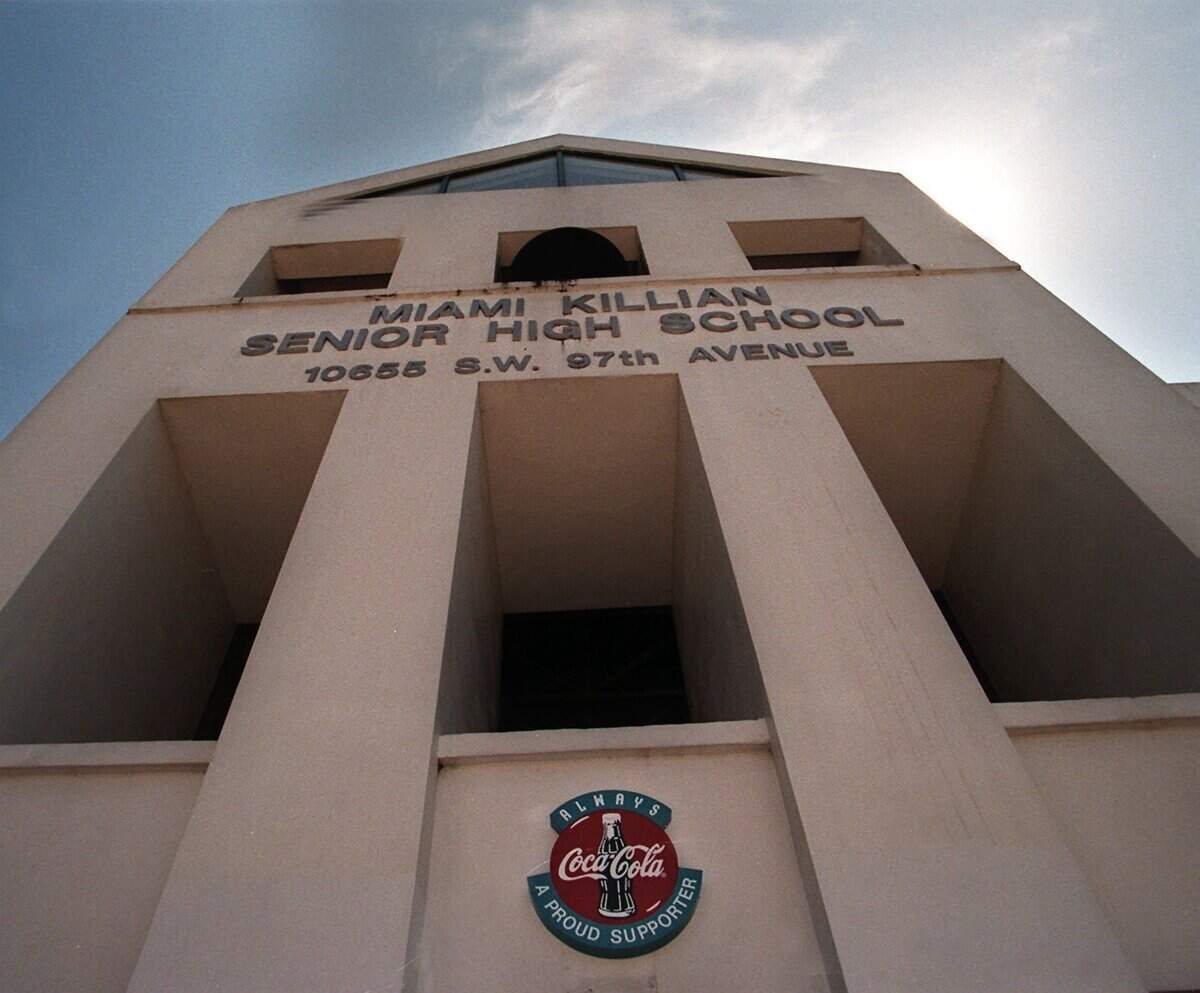 Miami Herald archive photo of Miami Killian High from March 26, 1998. Pedro Portal Miami Herald A tradition of sports
Students, parents and alumni packed both sets of stands at Sam Burley Park on a balmy August night for Killian’s “Week 0” preseason game against crosstown rival Miami Southridge.
Though it was technically a home game for Southridge, the park is also where Killian is playing its home games this season.
Southridge’s roster stretched twice as far as Killian’s on the sideline. It had more than 2,100 students in February – four times Killian’s enrollment at the time – and about twice as many football players that Friday. Southridge’s fan section was larger, mostly because more students showed up.
 Miami Killian Senior High’s defense lines up against Miami Southridge Senior High on Aug. 14. Austin Horn
Neither of those disparities mattered much. The Killian fans cheered every bit as loud, and the football team played Southridge – which features three highly-rated defensive line prospects – essentially even. If not for a broken play touchdown after a Killian player blocked a Southridge punt, the Cougars would have tied their rivals.
The crowds rose to their feet and roared at each pivotal moment. Students chattered and clustered in groups dancing to Miami rapper Saucy Santana’s social media hit “Quiet on the Creek.” On the field, both teams showed flashes of talent, made big plays and had a chance to win at the end.
It was a slice of the modern day high school Americana.
That’s what draws Randal Hill – a Killian 1987 graduate and former University of Miami and Miami Dolphins wide receiver – back to watch Killian games.
He sat in the stands watching and reminiscing with three former teammates. Wayne White, a running back from the class of ‘84, flew down from South Carolina and missed the first week of his hunting season to be there with his friends.
Hill said he thinks that “politics” was the main reason Killian’s enrollment was down, and sports plays a role. As politicians favor more pro-school choice policies, programs at elite private schools — many of which were attended by said politicians — often have more resources to attract top level talent. That wasn’t the case in Hill’s time,
“People that look at the heyday of the University of Miami — the majority of the players, I would say 90 to 95%, came from public schools,” Hill said.
The numbers bear it out: out of Florida’s top 50 senior football prospects, ranked by 247 Sports, this year, 26 attend traditional public schools; 23 attend private schools and one goes to a charter school. In 2007, 41 of the top 50 attended traditional schools; the other nine went to private schools.
 Mel Graham, Wayne White, Jerry Junious and Randal Hill watch a football game between their alma mater, Miami Killian Senior High and Miami Southridge Senior High Aug. 14. Austin Horn
The crowds aren’t quite what they were, either. Hill and White guessed their crowds were up to five times as large as the one at Sam Burley Park – 10,000 to 15,000 for a big game.
But the games still bring together old friends. One Southridge alum even came over to join Hill, White and their friends during the game.
They’re not sure what they would do if the school ever closed down.
“It would be a shame — a travesty. It’s a lot of memories there,” Jerry Junious, a former running back from the class of ‘87, said.
 Pictured at the 1997 state basketball championship semifinal, Killian’s Steve Blake brings the ball down court against OViedo’s Aaron Thomas. Blake went on to play in the NBA for more than a decade. JOE RIMKUS JR MHS Can school choice save Killian?
In a classroom at Killian lined with computers, a dozen students tweaked prototype flyers for various school sports events – a volleyball game, soccer tryouts, the next varsity football game – as part of teacher Michael Moreno’s Digital Business Foundations course.
The students prompted Google’s artificial intelligence-powered large language model, Gemini, to create the flyers for them.
Their work needed some tweaking. The AI mixed up the colors of an opposing team. But their flyers, and the magnet program as a whole, is still a work in progress. For the most part, the students seemed excited to learn from their teacher.
 Miami Killian Senior High School teacher Mr. Michael Moreno (not seen) assists students as they use Google’s AI tool Gemini to work on a design project during a Digital Business Foundations class in the school’s new sports marketing magnet program. Carl Juste cjuste@miamiherald
“I’m ready to learn about, like, money and all that – how the money works with sports. I know a lot of money comes out of sports,” ninth-grader Vian Gimenez, 14, said.
In Oberlander’s class, too — where students aren’t allowed to use AI — the work has already gotten her students thinking beyond the field of play.
Jamarquis Reid, a 10th-grade wide receiver with multiple Division 1 offers in hand, had just made a logo for a football card business. Alan, a 9th-grader interested in photography, made a logo for his own business in that field.
Like all other alumni interviewed for this story, one of the first things Oberlander mentioned about her love for Killian was athletics — football games in particular. In an era where kids are spending more time on their phones and less time socializing at big events, she’s excited for how her class will bring every student into that world.
“Even if they’re not athletes, they can still be a part of something that’s big like that — which is really cool,” Oberlander said.
That’s the core premise of the magnet program: leveraging Killian’s still-strong sports programs to build back its student body. If it works, Baker’s “death spiral” could turn into a positive feedback loop — new programming brings in more students, elevating the sports culture, which in turn could attract even more students.
“We have something that is different than what anybody else has,” Parra said. “But we also have that tradition, that history with sports, with athletics here at the school.”
In the early days, a lot of that work is essentially marketing.
 Miami Killian Senior High School Principal Jorge Parra walks the school’s hallways. Parra says he has dozens out tours lined-up for local middle schoolers to visit their new sports marketing magnet. Carl Juste cjuste@miamiherald
Parra said a big focus of theirs has been visiting middle schools and inviting them to their “Cougar for a day” events to get them interested in coming to Killian. By the end of the year, they’ll have brought in 31 middle schools and K-8 centers.
It is, ultimately, an exercise in fighting fire with fire. The bet is that if choice is what tanked Killian’s enrollment, then maybe choice will reverse the trend.
“When you’re offering so many choices, you spread the wealth… This is a perfect example. We see that our students are selecting other options. But, we want to make sure that SportsPLEX, is something that no one has, so that we can attract students back into Killian — not only from the private and charter schools, but also our own,” Pereira said.
Between thousands of alumni and the loyal fans in the stands at the football games, a lot of people are rooting for Killian to win that game.
This story was originally published August 29, 2026 at 4:30 AM.