
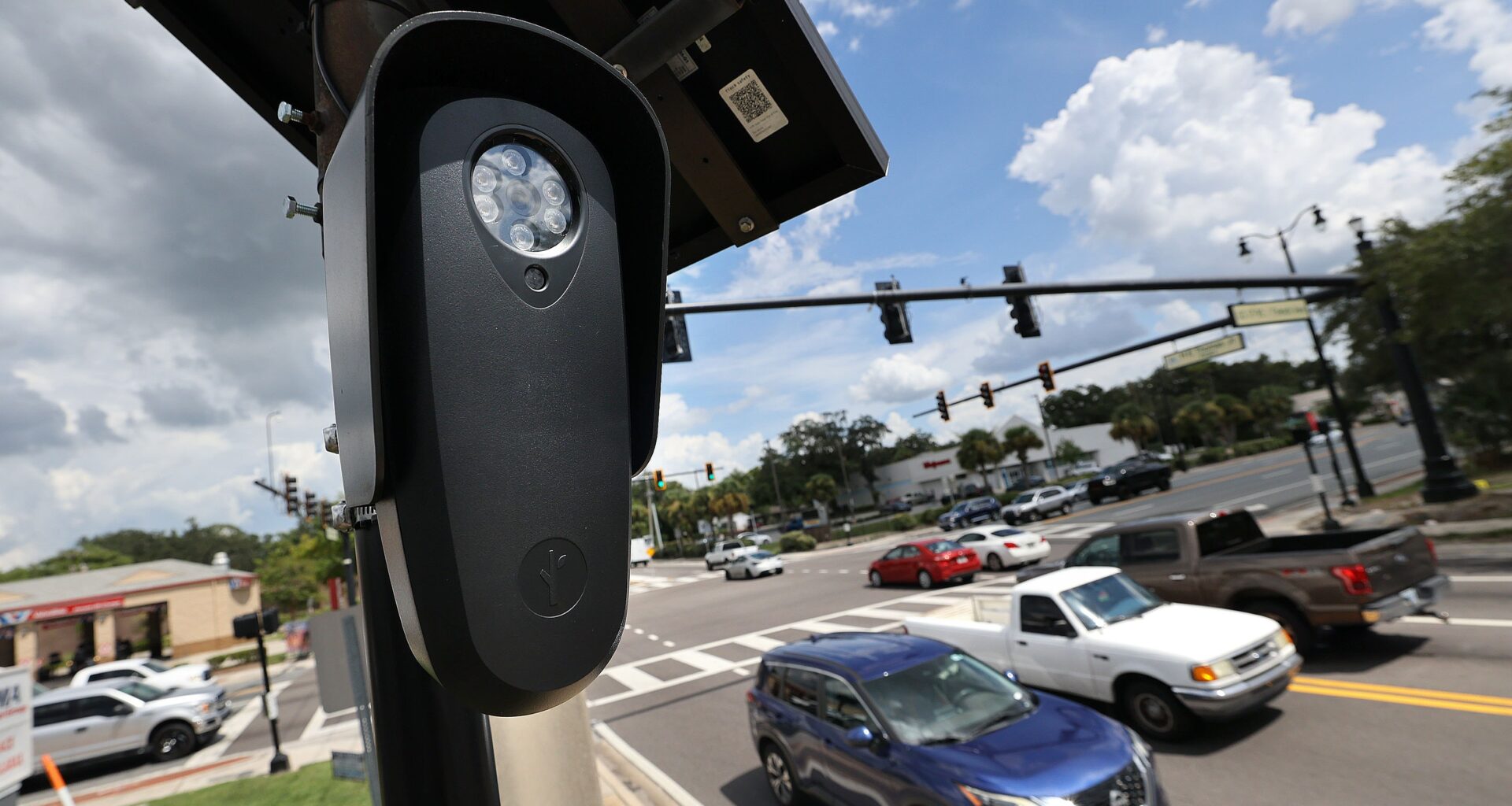
A growing revolt is mounting in Central Florida, and across the state, against cameras that photograph vehicle license plates, even as police say the technology has helped catch suspected murderers, find missing people and arrest the man later convicted of trying to assassinate President Donald Trump at a Palm Beach golf club.
Most commonly manufactured by a company called Flock Safety, the cameras are what everyone seems to be talking about, with many, even those who were once fans, increasingly fearful they are an invasion of privacy.
This month alone, Oviedo, which only last year agreed to a five-year contract with Flock to lease eight cameras, said it is considering ending its program after public outcry. More than a dozen people in Altamonte Springs urged their city to do the same. And a Lake County commissioner said he’ll push a countywide ban.
Gov. Ron DeSantis weighed in last week, too, calling for the Florida Legislature to consider a major overhaul of the devices’ uses, amid fears of “these handful of tech companies to know everything about you.”
His comments were in direct opposition to his administration’s past actions, which in the last year have funded nearly $6.5 million worth of the high-tech license-plate readers for state law enforcement agencies, including sheriff’s offices in Orange and Osceola counties. The money will go to at least 547 cameras that can be affixed to poles and vehicles or to trailers that can be parked on roads and capture who drives by.
Despite approving those grants as a member of the State Board of Immigration Enforcement, the governor said last week he’s worried.
“I think it’s out of control,” DeSantis said. “I’m all about having law enforcement have tools to be able to hold criminals accountable …but I don’t want to have this become a surveillance state.”
By the end of the week, he said state agencies would be removing their cameras from Florida roadways.
The growing furor has created unlikely alliances between conservatives and progressives. Like the Republican DeSantis, liberal Vermont Sen. Bernie Sanders posted on X Wednesday that “we cannot allow America to become a surveillance state where a handful of AI oligarchs profit by giving the government the power to track our every movement.”
The Democratic nominee for governor, David Jolly, told Florida Politics this week he supports a special session to discuss “dramatic reforms or elimination of Flock altogether.” While Byron Donalds, the Republican in the race, initially called for a full pause on their usage, he now says he wants to work with law enforcement to set parameters on their use.
A powerful crime-fighting tool
Flock cameras are installed on light poles and are powered by artificial intelligence. They photograph every vehicle that passes by, capturing the date, time and location, as well as information about the vehicle, such as the color, make and model, the license plate number and even bumper stickers, dents and other unique markings.
The images and data are stored in a searchable database, allowing law enforcement to pin down precise locations of people they’re tracking — though officials say they’re deleted after a certain period of time.
While Flock is the largest provider, other companies like Axon, Motorola, Neology, Leonardo and Genetec make similar products.
The app DeFlock is an open-source map that allows people to report automatic license plate readers they see on their daily commutes. There are more than 1,000 such cameras in Central Florida, spanning from Sanford to Kissimmee, in nearly every pocket of the region, according to the app.
Orange County Sheriff John Mina said the agency hasn’t used the sophisticated cameras for immigration enforcement, but he said the technology is among the agency’s most valuable crime-fighting tools.
Currently, the sheriff’s office has about 160 such cameras, costing the department about $158,000 annually. Thirty are made by Flock, he said.
“If somehow this were to go away, it’s a big win for the criminals,” he said. “It’d be a huge detriment to law enforcement if we lose it.”
In 2024, for example, Mina said his deputies were looking for a man they feared had hurt his girlfriend, based on blood found in his apartment.
The man’s pickup truck drove past a license plate reader in rural Georgia with a black trash bag in the bed. Nine minutes later, the truck crossed the Georgia-Alabama state line past another reader, which photographed the truck without the trash bag in the bed. Mina said deputies alerted Georgia authorities. They found the trash bag along the road — which hid a suitcase that contained the woman’s dismembered body.
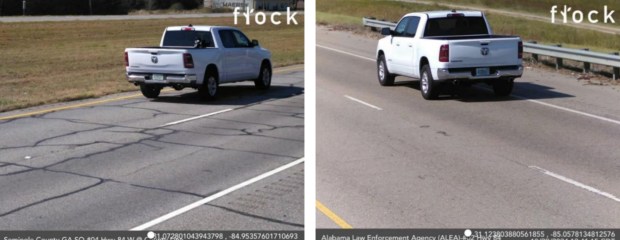 A pair of Flock camera photos of a man deputies believed was driving with the body of his deceased ex-girlfriend. The first photo, taken in rural Georgia, shows a trash bag in the truck bed, while the second photo, taken nine minutes later in Alabama, shows no bag. Investigators were able to find the human remains between the two cameras. (Orange County Sheriff’s Office)
“We’d probably still be looking for that… we would have had no clue where he was,” he said.
In Seminole County, the sheriff’s office has set up 105 Flock cameras, which a spokesman said have helped make 530 arrests and find 34 missing or endangered people.
Last year, Seminole sheriff’s office detectives investigating a murder in the Forest Lake area added a suspect’s vehicle to the camera database. The following day, the vehicle was captured by a camera in Altamonte Springs, and police in the city soon arrested two suspects.
Proponents also credit the cameras for helping to identify and capture Ryan Routh, who is serving a life prison sentence for the 2024 attempted assassination of Trump at his Florida golf course.
And the devices were also used to find 12-year-old Madeline Soto’s body, after her mother’s boyfriend raped and murdered her in 2024. Kissimmee Police Chief Charles Broadway said the cameras provided evidence that conflicted with Stephen Stearns’ alibi and helped secure a life sentence in the case.
A violation of privacy?
But earlier this month at a pair of city council meetings in Seminole, residents bashed the devices as overly intrusive and a threat to trust between the public and law enforcement.
“This information can be used to track profiles of people,” resident Ashtin Garner said at an Oviedo Council meeting. “What are your habits?”
A day later in Altamonte Springs, one man opposing the cameras declined to provide his address — standard practice among public commenters at government meetings — positing that the city’s police department could find it easily if it was wanted.
“I passed no fewer than a dozen Flock cameras on the way to this meeting, so you already know where I live,” he quipped.
Another speaker offered his license plate number in place of his address.
Altamonte Springs City Manager Frank Martz told speakers he and the police chief would review their concerns and bring back a report at a later meeting.
In Oviedo, council members seemed convinced their city police department is using Flock cameras correctly but shared residents’ fears of how the company may be wrongly sharing information.
“I think some of the concern is where the data is being stored and whether it’s secure,” said council member Keith Britton. “I guess we have to trust Flock or not trust Flock.”
Council member Alan Ott said he was trying to balance the benefits versus the harms, but he sounded more worried than supportive.
“The consequences of a plate being misread are high,” Ott said. “The consequences of a person in another jurisdiction abusing the system for their own personal reasons could be high. I don’t think you have to go much beyond that to say that this kind of system is a problem.”
Last April, a Florida woman wrongfully spent 13 days in jail on felony charges in connection to a fatal vehicle crash on Oct. 4 in Volusia County that she had nothing to do with because of the Florida Highway Patrol’s misuse of Flock cameras, according to a federal lawsuit she filed against the state agency.
Opponents of the devices contend that fewer than 1% of those surveilled are suspected of wrongdoing, and that while useful in some circumstances, they haven’t been shown to reduce crime.
And they point to the instances of misuse of the technology. For instance, a Kentucky officer was arrested this week after using the system to search his ex-girlfriend more than 2,000 times, and in Sarasota, an officer was arrested this month after searching his ex-girlfriend’s vehicle more than 300 times.
“When I see a police officer using this to track an ex-girlfriend, I’m like ‘what the hell is going on with this?’” DeSantis said last week. “I think people are right to be concerned.”
The Florida Fish and Wildlife Conservation Commission faced a furor this summer when it was revealed it had pulled driving records of outspoken environmentalists opposed to its black bear hunt. The environmentalists suspect the FWC pulled its records to obtain license plate numbers so it could then use Flock cameras to track their movements and see who was attending commission meetings.
In response to the backlash across the country, Flock officials have recently announced changes in how long it retains footage and new requirements that seek to limit who can search its files. CEO Garrett Langely also told CBS News the company supports state legislation to punish law enforcement officers who misue the technology.
But the anger remains.
In Lake, Commissioner Anthony Sabatini said he put an item on this week’s Board of County Commissioners meeting agenda to outright ban the cameras.
Earlier this month, Orange County Commissioner Nicole Wilson wrote a memo to her colleagues to discuss which entities are allowed to deploy them, who has access to data and whether that county’s policies adequately balance privacy and public safety.
Her memo states there are 327 such cameras across the county, with other agencies besides the sheriff’s office also using them. The sheriff’s office has conducted more than 425,000 searches using the system, the memo says. A discussion is expected later this year, a spokesperson said.
Mina said he hopes local and state leaders take a narrow approach to any reforms, implementing safeguards but allowing law enforcement to continue using the cameras. The safeguards could include audits and consequences for those who misuse them.
“I get the privacy concerns, I’m empathetic to that,” he said. “We’re more than willing to put the guardrails and safeguards in place to make sure it’s being used properly.”