
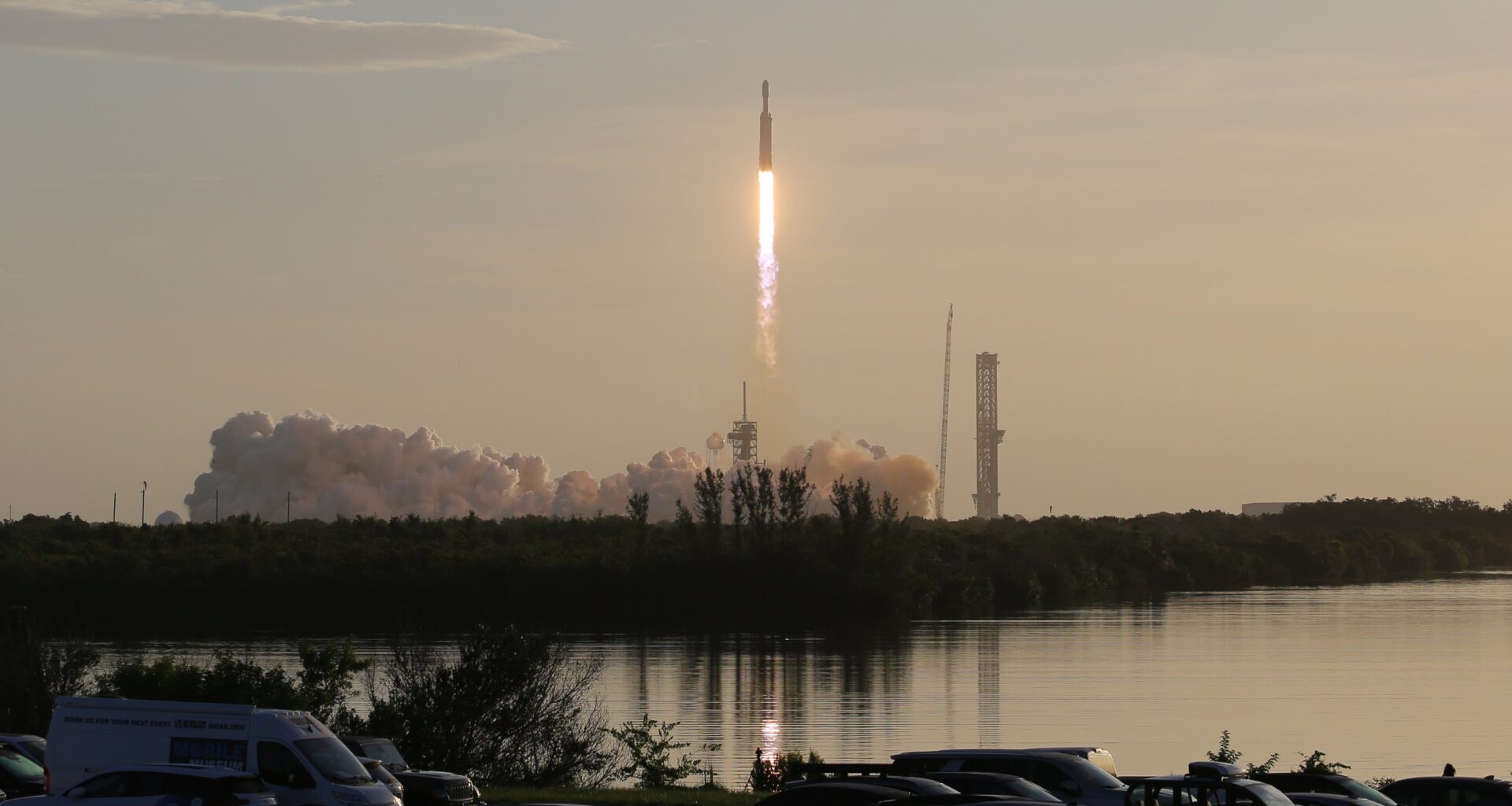
KENNEDY SPACE CENTER — NASA’s Nancy Grace Roman Space Telescope launched on a SpaceX Falcon Heavy rocket amid clear skies and a rising sun headed for a mission to unravel mysteries of the universe.
The powerhouse rocket lifted off from KSC’s Launch Pad 39-A at 7:26 a.m. with the $4.3 billion telescope that’s flying to a point 1 million miles from Earth. It’s on a mission to study the mysteries of dark energy while also in line to discover billions of galaxies and tens of thousands of planets.
The Roman Space Telescope is flying nine months ahead of schedule and within budget.
“This is a mission absolutely worth getting up for,” said NASA Administrator Jared Isaacman. “I am first. I’m beyond excited for the NASA Goddard Spaceflight team, the NASA JPL team, literally the thousands that have come together to deliver NASA’s great exploration asset right now, under budget and actually ahead of schedule. This is extremely exciting. I mean, this mission could change our fundamental understanding of the universe: dark matter, dark energy, maybe 100,000 more exoplanets. I mean, this is a really exciting time.”
It’s headed to a spot called Lagrange Point 2, putting the Earth between it and the sun. It’s where the James Webb and other space telescopes are parked, giving them a pristine view of the galaxy.
“It’s five years to be able to do everything that we want to do, but we are going to be looking, making the first direct measurements of exoplanets around distant stars,” said Nicky Fox, the associate administrator for NASA’s Science Mission Directorate during a prelaunch briefing Saturday. “We are going to be measuring dark energy and dark matter, and that’s like measuring the fabric of the universe and the energy that powers it.”
Compared to the Hubble Space Telescope, Roman will have a 100 times wider view, even though the lens is the same size, and it will gather data 1,000 times faster. It has a primary instrument that will take wide-view images of the universe.
“We’ve never been able to do that in the way that Roman is going to do it. We’ll look at swaths of the sky that we’ve never looked at before,” she said. “You think Hubble has done this incredible science. It’s looked everywhere. It’s looked at these amazing things. But there’s so much of the sky that we haven’t ever looked at, and that’s what Nancy Grace Roman is going to do for us.”
There is also a secondary coronagraph that will get chances to hone in on specific stars to try and find details about exoplanets that orbit them.
The mysteries of dark energy and dark matter are something astrophysicists have been wrestling with for nearly three decades. It’s hypothesized this is the main driver of how the universe is expanding. The Roman telescope will be able to use imagery of things like supernova and black holes to more definitely measure that expansion than has ever been possible before.
“We have a model of the universe, and with the data we’ve been taking with the other telescopes, it’s showing that the model isn’t quite correct,” Fox said. “When we launch this mission, we will have an actual model of the universe that, not just for a single moment, but something for years that we can study how it’s changing.”
Two of the Falcon Heavy’s boosters will make their way back to nearby Cape Canaveral Space Force Station for a landing, aiming for touchdowns at Landing Zones 2 and 40. This will be the first flight for one of the boosters while the other supported two previous Falcon Heavy launches.
Their return means Central Florida could be in store for one or more sonic booms.
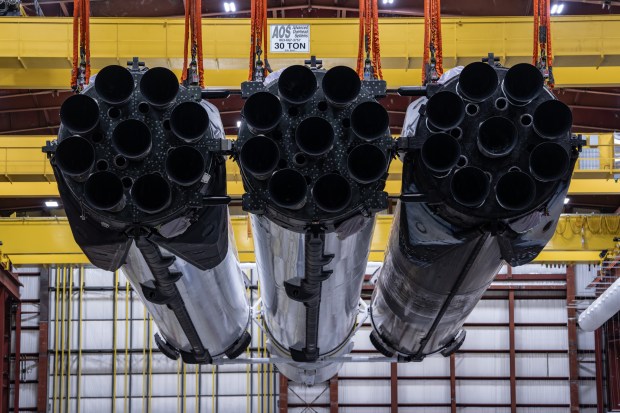 SpaceX’s Falcon Heavy is three Falcon 9 rockets connected that can produce 5.1 million pounds of thrust. (Courtesy/SpaceX)
This is only the 13th time Falcon Heavy has flown since its debut in 2018 when it launched Elon Musk’s Tesla roadster into deep space.
The rocket produces 5.1 million pounds of thrust at liftoff, which is only second to NASA’s Space Launch System among active rockets launching from the Space Coast.
Starship, though, when it arrives, will more that triple the power of Falcon Heavy.
But Falcon Heavy is still one of the spectacles that draw crowds for its launch.
This is only the second time it will launch this year after having not launched at all in 2025. Space Coast launches in general will be diminished until Starship gets up and running as SpaceX announced it would cease Falcon 9 missions for its Starlink satellite program from the Space Coast.
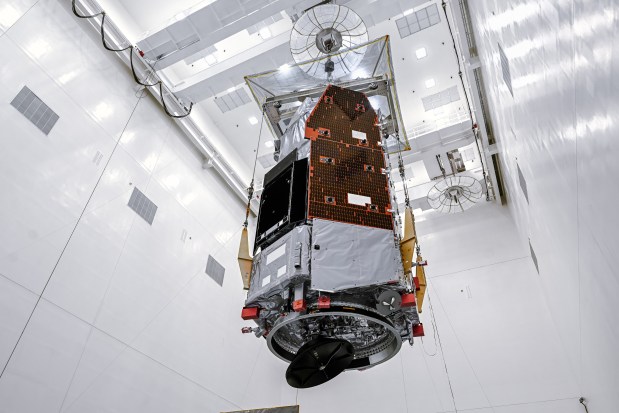 Technicians and engineers inside the Payload Hazardous Servicing Facility at NASA’s Kennedy Space Center in Florida use a crane to lift the agency’s Nancy Grace Roman Space Telescope to a vertical position on Thursday, June 25, 2026, as processing continues ahead of a launch on a SpaceX Falcon Heavy as early as August 30. (Sydney Rohde (Rocz)/NASA)
The space telescope arrived this summer from NASA’s Goddard Spaceflight Center in Greenbelt, Maryland.
“There’s going to be a lot of new observations trying to understand some of the big questions about what we call the ‘Black Universe,’ . . . to understand how the universe is evolving in an accelerated manner, is expanding and through something we call dark energy, and to hunt for new planets,” said Lucas Paganini, a program manager for the space telescope in NASA’s Astrophysics Division.
He said it will complement the likes of the Hubble Space Telescope, which launched in 1990, and James Webb Space Telescope, which launched in 2021, as it is armed with different instruments including a 300 megapixel camera and will cast a much wider net using infrared light when viewing the sky.
“Telescopes like Hubble and Webb, what we’ve done in the past is observe a specific object,” he said, but Roman’s approach will be “to observe huge portions of the sky … billions of galaxies, billions of stars, and discover thousands of new planets beyond the solar system.”
He paid homage to the telescope’s namesake, who was also given the moniker, “The Mother of Hubble.”
“She was a key person in our exploration of space. She understood that in order to better understand the universe, you have to go in space,” he said. “She made Hubble possible.”
He said the Roman telescope builds on Hubble and James Webb as well.
“We have learned a lot of lessons from from Hubble. We’re using a similar mirror, but lighter. We know what we need in order to understand wider portions of the skies by changing some aspects of the design, and of course, Webb is also an engineering marvel. It’s impressive what we can do with Webb, something we cannot do with Roman, right? That’s why they’re highly complementary. And eventually, what we learn from Roman is going to help us develop the next generation telescope, which is the Habitable Worlds Observatory.”
While the price tag is in the billions, it has come in under budget and ahead of schedule, with a launch about eight months earlier than originally planned. That hallmark has been one of the highlights NASA Administrator Jared Isaacman has been touting.
“Roman’s accelerated development is a true success story of what we can achieve when public investment, institutional expertise and private enterprise come together to take on the near impossible missions that change the world,” he said at a media event at NASA’s Goddard Space Flight Center in Greenbelt, Maryland, in April.
Fox said the project for a dark energy telescope has been in the works since it was recommended in the National Research Council’s 2010 decadal survey that ranks which astronomy and astrophysics projects should be pursued. The hardware came together at Goddard over the last six years.
“Since early in 2020 the Roman team has worked almost around the clock to develop and test the spacecraft and the hardware, completing the flagship mission in just six years, which is a true testament to the agency’s commitment to do science, cutting edge science even faster,” she said.

NASA’s Nancy Grace Roman Space Telescope is now fully assembled following the integration of its two major segments on Nov. 25, 2025 at the agency’s Goddard Space Flight Center in Greenbelt, Marylandd. The mission is slated to launch by May 2027, but the team is on track for launch as early as fall 2026. (Jolearra Tshiteya/NASA)

NASA’s Nancy Grace Roman Space Telescope stands fully assembled, following the integration of its two major segments, in the clean room at the agency’s Goddard Space Flight Center in Greenbelt, Maryland. (Jolearra Tshiteya/NASA)
Show Caption
1 of 2
NASA’s Nancy Grace Roman Space Telescope is now fully assembled following the integration of its two major segments on Nov. 25, 2025 at the agency’s Goddard Space Flight Center in Greenbelt, Marylandd. The mission is slated to launch by May 2027, but the team is on track for launch as early as fall 2026. (Jolearra Tshiteya/NASA)
She touted the speed of the telescope, but also the amount of data it will generate.
“The Nancy Grace Roman Space Telescope is a sheer powerhouse,” she said.
She noted Hubble gathered 172 terabytes of date over its first 30 years in service while Roman’s capacity will be do send 1.4 terabytes of data every day. Its primary lifespan is a five-year mission, although it has enough fuel to keep it up and running at least 10 years.
“That means it will potentially have about 2,500 terabytes over the course of its five year mission, and basically gathering like a hypothetical stack of science papers that would reach up to beyond the moon,” she said.
She noted that for now, the science community is aware of about 6,000 planets outside our solar system.
“Roman will discover tens of thousands of new planets outside our solar system. It will reveal billions of galaxies, thousands of supernova and tens of billions of stars,” she said. “That is an extremely exciting and literally all of the science that we can use to apply and build off our interconnected NASA science portfolio, Roman will help us address the question of how common solar systems like ours actually are, while also literally expanding the human mind to what the universe contains at an astounding rate.”
NASA’s Goddard Space Flight Center
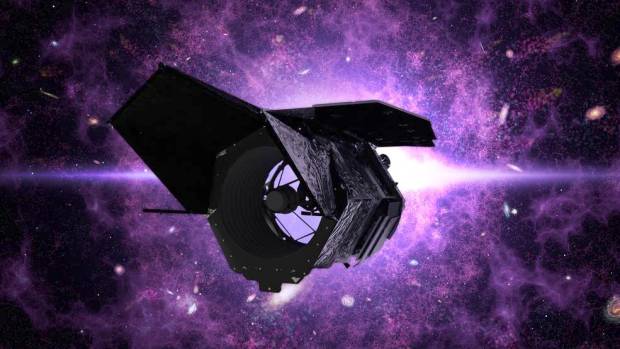
A high-resolution illustration of the Nancy Grace Roman Space Telescope against a starry background.
She also noted the space telescope, including the best coronagraph that has ever flown in space, and it’s a vanguard for a similar sensor being developed for a future telescope in NASA’s plans, the Habitable Worlds Observatory.
“It is so important to us that we get this coronagraph into space and get that first milestone towards the next mission,” she said
Julie McEnery, Roman telescope’s senior project scientist, is keen about Roman’s planet-finding capability, but is even more so about its tackling of the mysteries of dark energy.
“Current observations hint that our standard model of the universe is incorrect. Roman will be able to confirm these and set us on the path to understanding what’s right,” she said. “Our main survey will take more than a year. It’s huge. If we were to take the single image that is produced from our main survey and try and fully display it with a set of 4k TVs, you’d need more than half million 4k TVs.”
She said that survey will be used to study how the structures in the universe grew and evolved over time.
“These are the keys to unlocking the fundamental nature of dark matter, dark energy and the fabric of the universe itself,” she said.
The survey will also point it at our own galaxy periodically to monitor hundreds of millions of stars.
“We’re not going to just image millions of stars. We’re going to find a treasure trove of exoplanets, up to 40 times more than are known today. So think of this as the largest census we’ve ever done of planets in our galaxy,” she said.
She’s more excited about how pointing the telescope at 2 billion galaxies, means that there are literally 2,000 “one-in-a-million” mysteries out there Roman could uncover.
“We’re going to be surveying patches of the sky going back over and over and over again to find new things that go bump in the night,” she said. “I very much hope, and in fact, expect, that the most exciting science from Roman is going to be the things that we didn’t expect, that we couldn’t predict, but that will set the new deep questions for future missions to address.”