
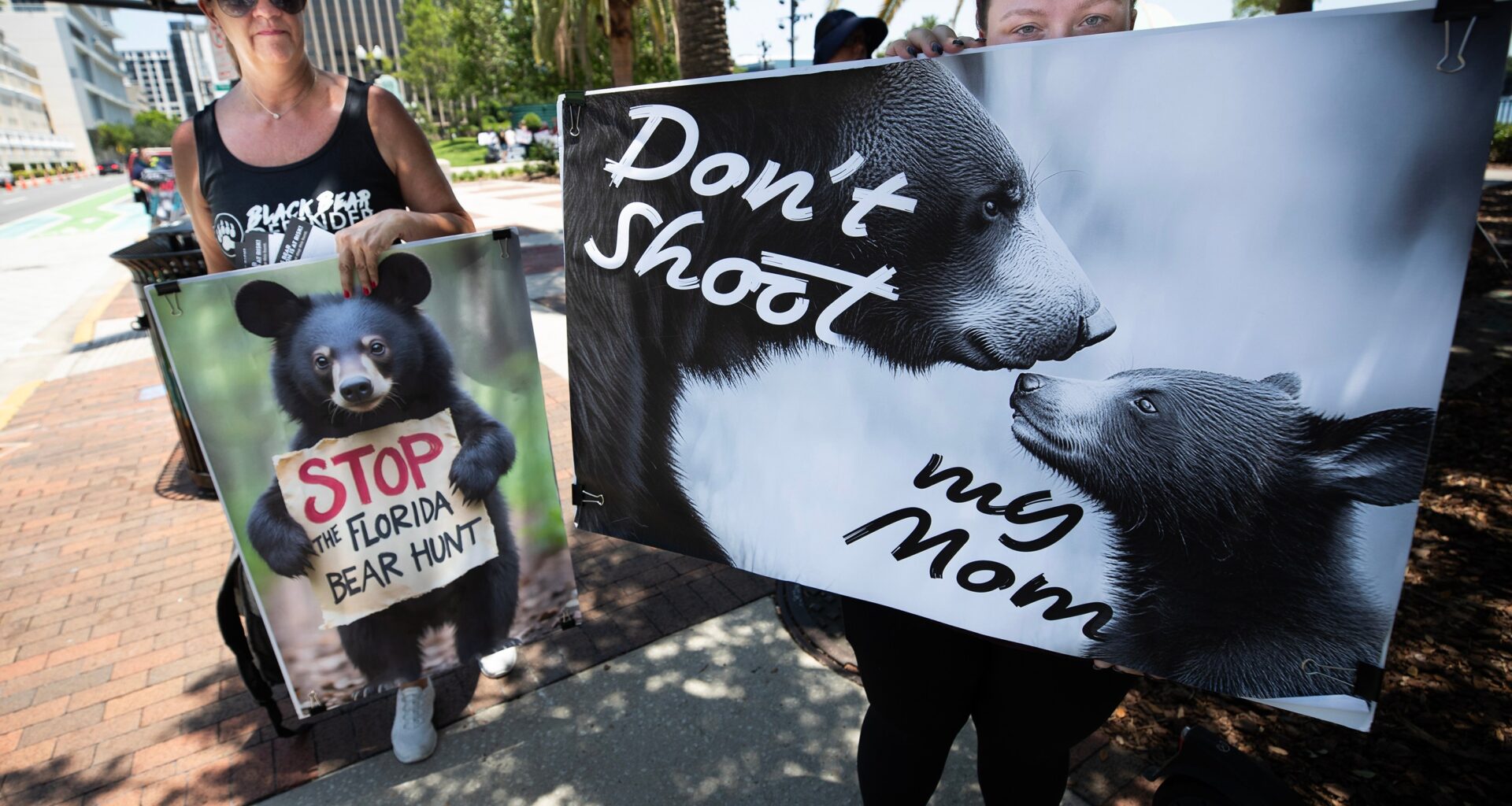
Florida is going on a bear hunt again this year.
The state Fish & Wildlife Conservation Commission recently announced there will be a new bear hunting season that begins Dec. 5 and ends Dec. 28, the second in as many years.
The agency will open the hunting permit portal Sept. 11 to those who want to apply for a permit to “harvest” or kill a bear during the upcoming season. The portal closes Sept. 21.
The decision was made without public hearings where conservationists and others opposed to bear hunting as well as hunters in favor of the planned bear season could share their views.
State wildlife commissioners, all appointed by Gov. Ron DeSantis, last year structured rules for future bear hunts — including setting kill quotas — so the state agency’s executive director, Roger Young, could act without listening to public opinion or requiring board input.
The debates last year were long and often rancorous. The FWC later approved Florida’s first bear hunt in a decade.
Hunters will have a chance to kill more bears this year than last, but the number of bears that can be taken are still limited by region. In a 13-county Central Florida area, home to about 1,400 bears — the state’s largest bear subpopulation, there will be 21 permits available.
And once again, non-hunters — spurred by the Sierra Club’s “Bag A Tag, Spare A Bear” campaign — are likely to flood FWC with applications in an effort to keep permits out of the hands of hunters aiming to kill the state’s largest land mammal, once listed as a threatened species.
The permits will again be awarded through a lottery.
Those whose names are drawn would have between Sept. 25 and Oct. 5 to pay for a non-transferable permit that costs $100 for Florida residents and $300 for non-residents. The state limits non-resident participation to 10 percent.
The agency received 163,459 permit applications last year from 14,996 individuals.
Florida set the kill quota at 172 bears in 2025, but hunters bagged just 52, as many who won a permit didn’t use it.
Just 52 bears killed in Florida hunt, state reports
This year, FWC is offering up to 215 permits, of which 193 will go to people who submit a $5 application to win a permit.
The other 22 permits will go to landowners of large private properties where bears roam. They can start hunting Oct. 1.
Individual applicants can submit an unlimited number of entries to the permit lottery, but they can win only one.
The Sierra Club emailed notices to members last week urging them to enter the permit lottery again.
“Our goal: buy up all the tags to keep them out of hunters’ hands,” the not-for-profit group said in its announcement.
FWC doesn’t want to hear from the public about their concerns about bear hunting, said Chuck O’Neal, founder of the nonprofit environmental group Speak Up Wekiva, which for more than a decade has challenged the science FWC has cited to reinstate bear hunts.
“All the decisions have been moved into the executive director’s office,” he said. “But the public is still overwhelmingly against this.”
Katrina Shadix, who leads the not-for-profit Bear Warriors United, said her group may again pay hunters who win a bear permit not to use it. “Monetarily incentivizing hunters to not kill bears worked very well last year,” she said. “I think we saved countless bears from the hunt…”
But Maria Davidson, Large Carnivore Program Manager for Safari Club International Foundation, a not-for-profit organization of hunters that defends hunting rights, reaffirmed support for the bear hunt this week, calling it “a science-backed tool for maintaining a sustainable population.”
“Even with a higher harvest quota this year, this remains a conservative estimate,” she said in an email. “The 2025 hunt drew fierce opposition, including legal battles and campaigns from anti-hunting groups, many of whom drew tags with no intent to participate in the hunt. As such activists gear up to do so again, they should consider that their actions will drive down the measure of hunter success, leading to an increase in tags year over year, and we are sure FWC can still put their financial contributions to good use to support other hunter-driven conservation efforts across the state.”
Hunter success is one factor in the state’s equation to set harvest quotas.
The state will allow hunting in four areas, with 31 permits available in a north zone, which runs along the Florida-Georgia state line; 78 in the east Panhandle region, which includes the Apalachicola Wildlife Management Area; and 63 in a south zone which includes parts of Collier, Hendry and Lee counties, an area where an elderly man and his dog were mauled to death by bear in May 2025.
The state will make 21 permits available for a central zone that encompasses the Ocala Wildlife Management Area and spans parts of Lake, Marion, Orange, Seminole, St. Johns and Volusia counties.
There were no legal bear hunts from 2015 to 2025.
Florida black bears have no true natural predators in the wild besides humans. The number of bears killed by motor vehicle strikes, euthanized as nuisances because of conflicts with humans or poached in the Central Florida region over the past decade total about 1,900.
FWC allowed just 18 bear hunt permits in Central Florida in 2025 and records show only five hunters were successful, four in Marion County and one in Volusia County .
The biggest bear killers by far in Central Florida are motor vehicles, blamed for killing 1,545 bears in the region in the past 10 years, including 219 in 2025, the most since 2021 when 242 bears died on the region’s roadways.
shudak@orlandosentinel.com