
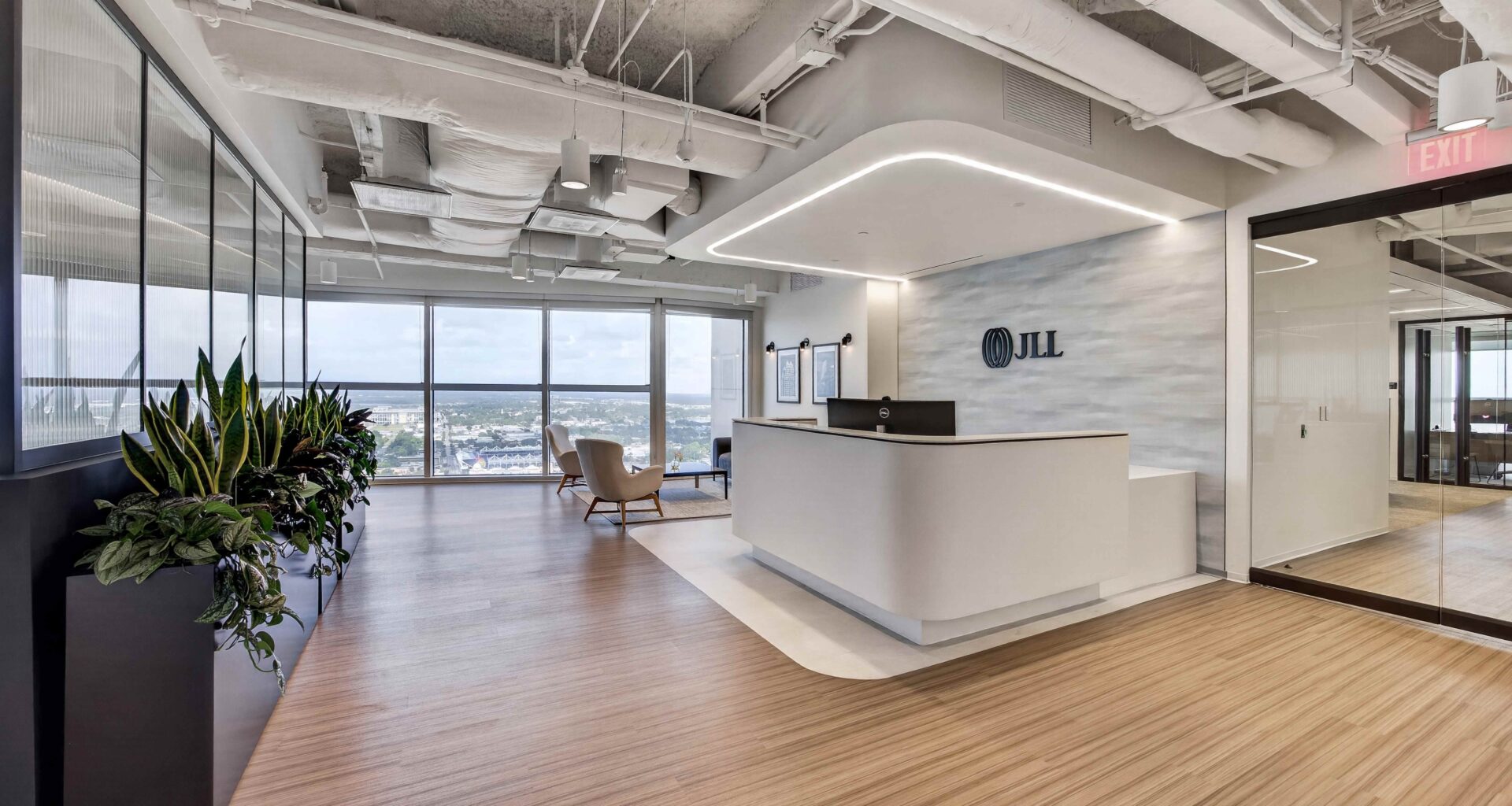
For the first time since COVID decimated Orlando’s economy in 2020, the city’s office market is beginning to stabilize and showing signs of modest growth.
JLL’s Q2 market report showed office vacancies are down nearly a full percentage point from this time last year, and the year-to-date absorption is a healthy 352,000 square feet—well ahead of the 17,000 square feet recorded for all of 2025.
Contrast that with 2021, which saw absorption drop to negative 900,218 square feet. The post-pandemic office climate was marked by high vacancies and sub-leasing amid the transition to a remote work environment.
JLL Managing Director Nick Poole told GrowthSpotter the market pendulum has started to “swing back the other way”, so most tenants want their employees back in the office full time.
“Certainly, there are companies still utilizing a flexible work schedule, but I would say for the most part, the companies that I’m speaking to and transactions that have been recently have a more normalized cadence of schedule in the office,” Poole said.
That has led to two notable trends in the office market: employers are downsizing their overall footprints while seeking highly amenitized, Class-A space that will draw employees back to the office. “We call it having a commute-worthy experience to come back to the office,” Poole said.
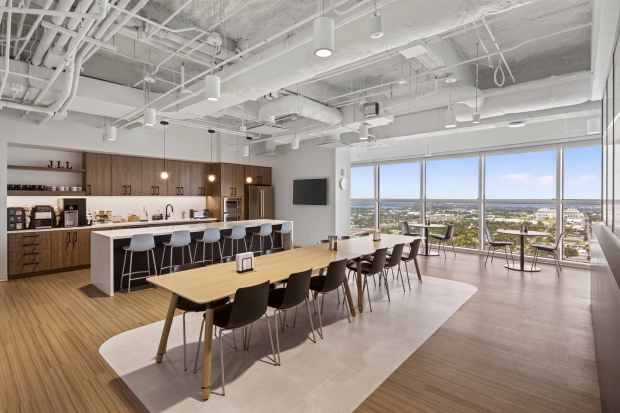 A café and kitchen area in JLL’s new Orlando office serves as a hub for employees and clients alike, offering space for informal meetings, events, and day-to-day connection. (Courtesy of JLL)
JLL’s recent move into the newly renovated 30th floor of The Exchange on Orange located at 200 S. Orange Ave. – the tallest tower within the three-building, Class A office complex in downtown Orlando — is such an example.
JLL was utilizing two floors in an adjacent building owned by the same landlord, Piedmont Realty Trust. The firm shed about 5,000 square feet from its previous bifurcated offices, but much of that was occupied by redundant reception areas, restrooms, break rooms and common areas.
Now the more streamlined space brings together JLL’s 70-plus workers across multiple divisions under one roof and onto a single floor. And it offers sweeping 360-degree views of the city, including iconic landmarks such as Lake Eola Park, the Kia Center, and Camping World Stadium.
“We are the beneficiary of a 30th-floor view, and many of the things inside of our office were meant for teamwork, collaboration, meeting spaces, conferencing rooms,” Poole said. “All of the technology has been updated, and it provides a nice experience for all of our people to come back to work.”
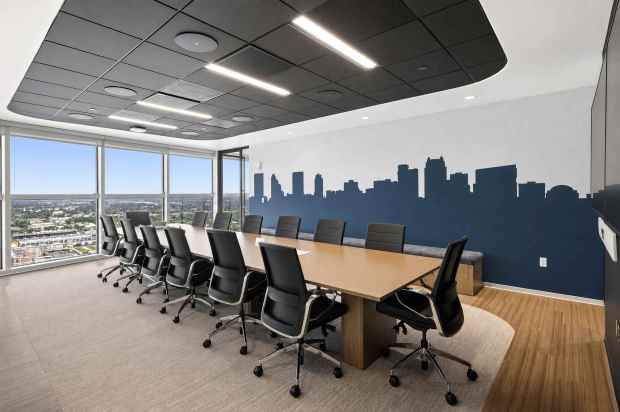 The office blends functionality with elevated design, featuring a mix of open workstations, private offices, and a variety of conference and huddle rooms to support different work styles. (Courtesy of JLL)
Piedmont paid $170.8 million in November 2015 for the 35-story office tower and a second building, as well as a seven-story parking garage. The tallest tower, The Exchange on Orange, recently underwent a $26 million renovation designed to create a hospitality-driven office environment offering best-in-class amenities, including an outdoor courtyard, a new 10,000-square-foot tenant lounge area with billiards, two Top Golf Swing Suites, a conferencing facility with capacity of up to 100 people, and a new eight-story atrium lobby experience.
“Through our exclusive tenant engagement program and strong amenity offerings, we have positioned the Exchange to redefine the future of the workplace,” said Ben Mullenix, VP, Piedmont Realty Trust. “We remain laser-focused on being a market leader in defining a hospitality-driven experience enhanced by productivity, collaboration, and connectivity.”
Shayna Hanson, senior VP of brokerage services for Lincoln Property Co., said these types of upgrades help create a sense of community within the building. “One thing we’re seeing across many of the buildings we represent is a real effort to make the office environment more tenant-friendly,” she said. “The ‘live, work, play’ concept is still very relevant. Tenants want their office building to be more than just a place to go sit at a desk.”
Like Piedmont, Lincoln is benefiting from these investments. “We have been very lucky to have signed a substantial amount deals this year – and the pipeline for 2027 is looking really positive,” she said. “There were some large renewals early in the year, and the 3rd quarter has been filled with a lot of expansions.”
While deal volume is down from 2025, leasing activity has increased for the first two quarters of the year, buoyed by notable transactions in the Lake Mary/Heathrow and University/Research Park submarkets.
“I would describe the Orlando office market in 2026 as being firmly in the recovery and stabilization phase,” Hanson said. “The improvement is becoming increasingly evident as leasing activity is strengthening every month. Space requirements are continuing to rise – where they were sitting pretty stagnant in 2025. We are also seeing a broader range of demand, including corporate relocations, business expansions, and the continued flight for quality.”
Poole noted that the overall office supply is changing, as many tenant users opt to purchase their own buildings. “So, inventory starts to be eaten up by those users in space,” he said. “And furthermore, in other situations, I can point to, like several out east by the UCF/Quadrangle market, there are other office buildings which are being demolished or redeveloped into kind of higher and better use opportunities on a go-forward basis.”
The growing demand, combined with reduced inventory, pushes the conversation toward new development. This is where Orlando lags behind markets in South Florida, which have robust development pipelines. Orlando hasn’t delivered a major Class-A office tower since 2023, in Lake Nona Town Center, and that building sat largely vacant for two years before luring Siemens Energy.
The only new construction since then has been the 4-story, 40,000-square-foot building being built by Dr. Phillips Charities in The Packing District. It will be delivered this quarter.
Poole said Orlando won’t see any speculative office space built in the near future, but some new construction will likely take place in 2027 and 2028. “Those types of conversations are starting to happen.”
One of the most anticipated projects in downtown Orlando is Westcourt, the $500 million sports and entertainment district across from the Kia Center. Turner Construction Company began site development this spring on the 900,000-square-foot district, which will include 310,000 square feet of Class-A office space anchored by the Orlando Magic. The developers, Machete Group and JMA Ventures, have not scheduled an official groundbreaking.
Pre-leasing will determine if other major office projects, like The Edge at Church Street Station or Building X at Creative Village, move forward. Hanson offered no update on The Edge, the 32-story mixed-use tower approved for 200,000 square feet of office space, along with apartments, retail and 10 stories of parking.
“You need to get over some of those pre-leasing hurdles to get any building out of the ground,” Poole said. “But any landlord is going to run a pro forma based on some type of pre-lease-up, and the financing has a lot to do with whether or not they can make those numbers work for their project.”
Have a tip about Central Florida development? Contact me at lkinsler@GrowthSpotter.com or (407) 420-6261. Follow GrowthSpotter on Facebook and LinkedIn.