
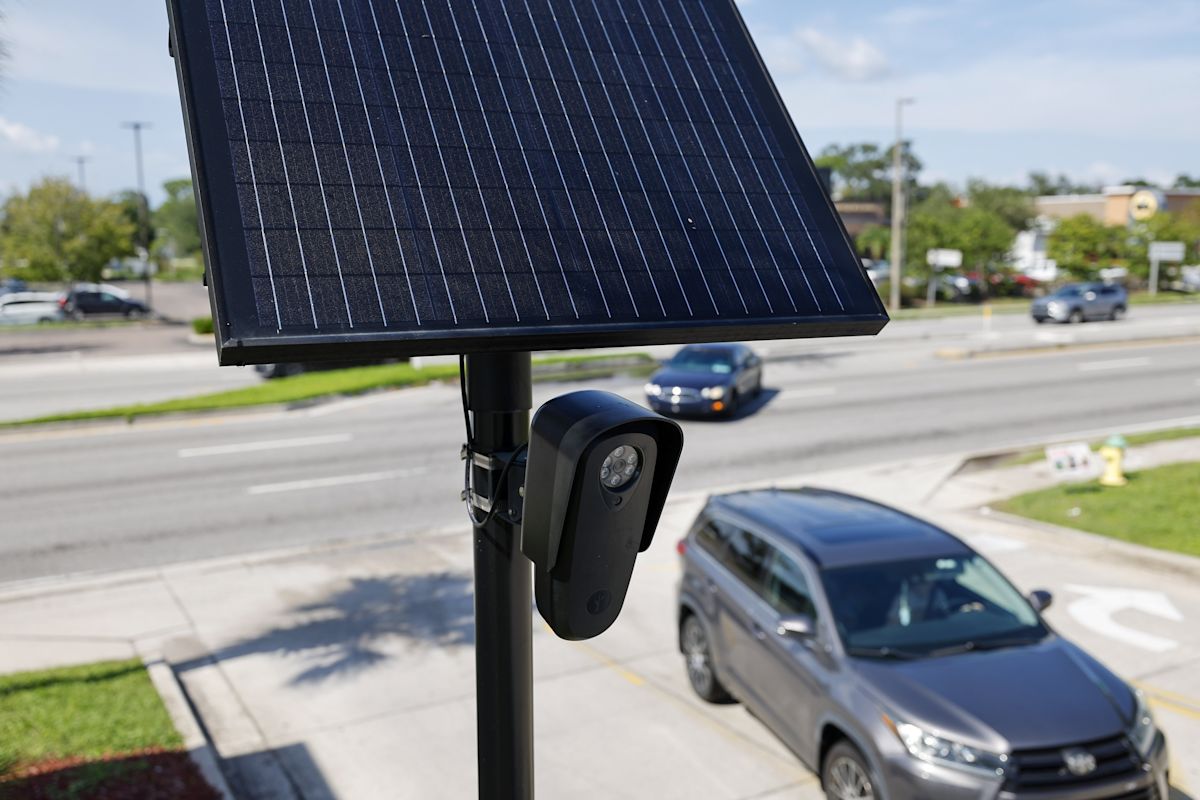
Florida’s Department of Transportation revoked approvals for cameras that read drivers’ license plates, directed local police departments to take them down and plans to remove any remaining devices after 30 days, according to a memo the agency sent out Monday.
The state’s move comes amid growing backlash to the use of Flock cameras, the primary brand of automated license plate readers. The new guidance applies to cameras on public roads that intersect with the state’s highway system.
“Recent exponential increase in deployments along our roadways, coupled with concerning reports of misuse, data privacy concerns, and surveillance schemes merit immediate action to preserve Floridians’ sovereignty and quality of life,” reads a copy of the memo obtained by the Times/Herald.
FDOT did not immediately respond to a request for comment.
Asked about Flock on Monday, Gov. Ron DeSantis told reporters in Jacksonville that he wanted more guardrails against their use, though the state has signed agreements with the company in the past.
“What we don’t want in the state of Florida is to have a digital AI surveillance state where everything we’re doing is being tracked at all times,” DeSantis said.
He pointed to news last week of a Brevard County deputy sheriff using his access to Flock camera systems to stalk an ex-girlfriend, and to concerns of Florida drivers’ data being sold to the highest bidder.
“If they can create a dossier on your movements, they would be able to make a fortune in selling that to companies for advertising and for product placement,” he said.
A Flock spokesperson defended the technology Monday, saying, “Flock’s technology is an important public safety tool for law enforcement agencies across Florida, helping officers solve serious crimes, find missing people, recover stolen vehicles, and support safer communities.”
At least 100 Florida agencies, mostly police and sheriff’s departments, have signed contracts with Flock in recent years, according to a database maintained by the Electronic Frontier Foundation, a digital privacy advocacy organization.
Those contracts include state agencies like Florida’s Department of Highway Safety and Motor Vehicles, which signed a “study agreement” with Flock in 2023, according to a copy obtained by the Times/Herald.
FDOT’s memo cites a Florida law that gives it authority to approve or deny cameras “within the right-of-way” of roads the department oversees. The new directive does not apply to Flock cameras on private property or other city roads.
Some agencies had already begun removing Flock cameras in recent weeks, however, and responded quickly in accordance with FDOT’s new guidance.
Jacksonville Sheriff T.K. Waters announced Monday he planned to go beyond the state’s directive and discontinue the use of license plate readers throughout Duval County in northeast Florida.
“Given the decision made at the state level and the concerns expressed by members of our community, I have determined that discontinuing the use of this technology is the appropriate course of action at this time,” he wrote.
The Miami-Dade Sheriff’s Office did not immediately respond to a request for comment.
Last week, Pasco County Sheriff Chris Nocco announced his agency would remove roughly 60 Flock cameras from public roadways, citing waning support from county commissioners. Another 110 cameras owned by homeowners associations, retail stores, gas stations and other private entities will remain in place.
On Monday, the Hernando County Sheriff’s Office said in a news release that it has already started removing Flock cameras from county rights of way. About 20 license plate readers will remain on commercial and private properties around the county, the agency said.
“While HCSO is adhering strictly to FDOT’s permitting guidelines, our agency remains steadfast in protecting our citizens, solving crimes, and supporting our deputies in the field,” the sheriff’s office said in a statement.
For DeSantis, next steps will largely come down to state legislation of the technology — a battle the state’s next governor will likely inherit.
“I know you can make some money selling cameras, but you really can make a lot of money if you can sell people’s data,” DeSantis said. “And that’s what the Legislature is going to need to address.”
Florida Democratic gubernatorial candidate David Jolly put the impetus back on DeSantis Monday evening.
“It’s now time for Gov. DeSantis to call a special session on (license plate recognition) and Flock cameras. Executive actions are important; getting this right and in law is most important,” he wrote.
Miami Herald reporter Shirsho Dasgupta and Tampa Bay Times staff writer Emily Wunderlich contributed to this report.