
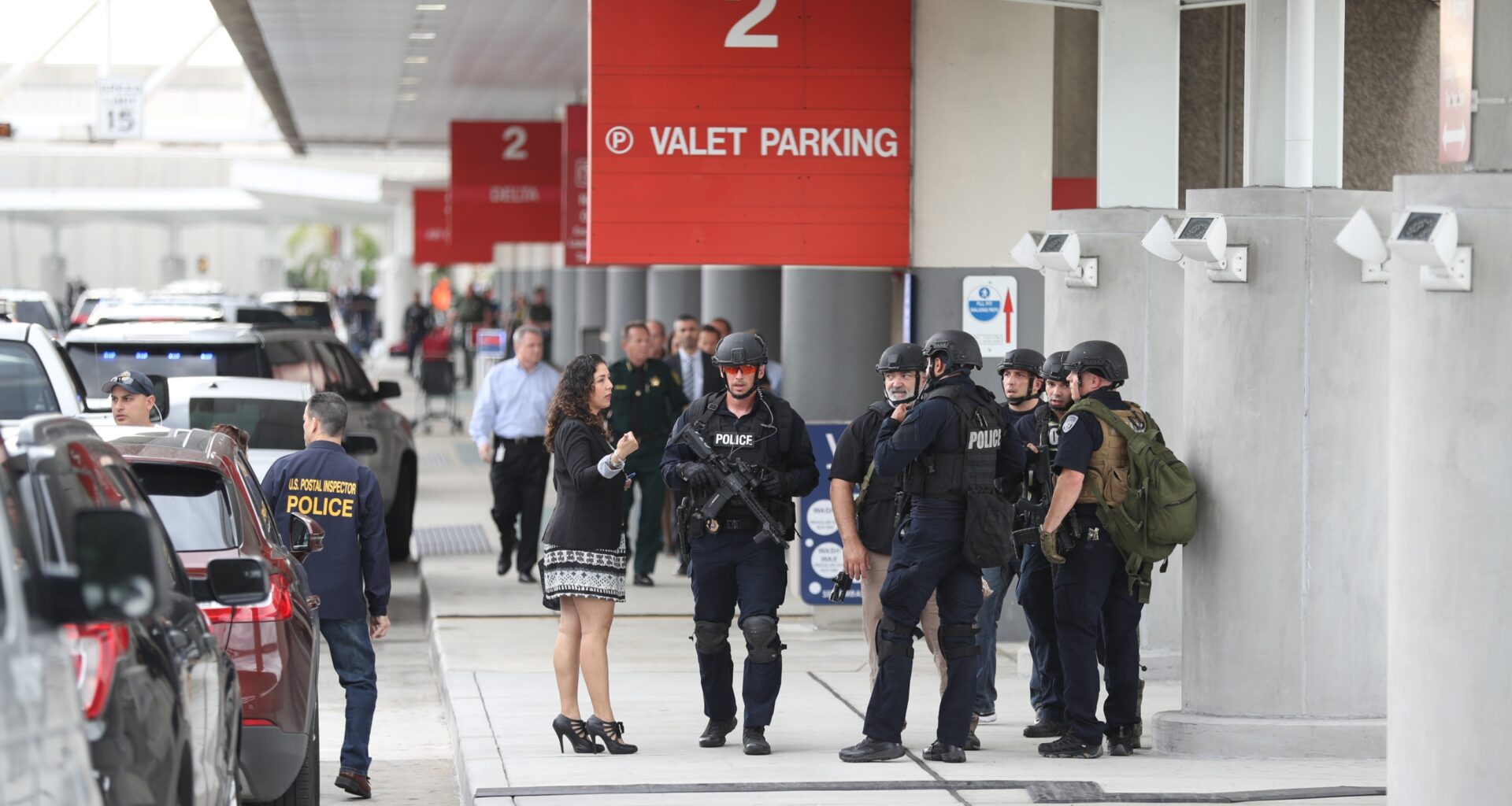
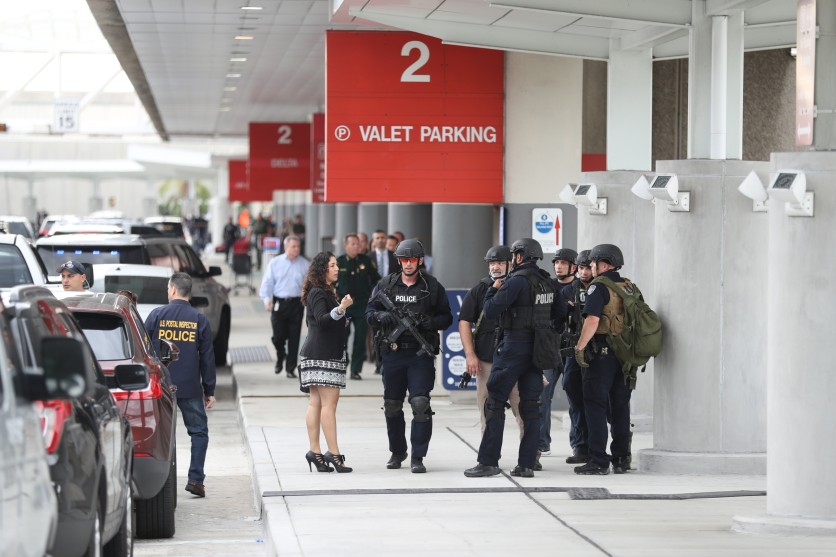
First responders secure the area outside the Fort Lauderdale-Hollywood International airport after a shooting took place near the baggage claim on January 6, 2017 in Fort Lauderdale, Florida.
Joe Raedle/Getty Images
A Miami man laughed after telling an American Airlines ticket agent he had a grenade in his luggage. He is now facing up to 15 years in prison and a permanent felony conviction that no judge in Florida is legally permitted to set aside.
Osniel Blanco-López, 52, a Cuban-born Miami resident, was at an American Airlines check-in counter at Miami International Airport in the early hours of Sunday, August 31, when an agent posed a standard security question: did he have any dangerous goods in his bags?
Blanco-López first said no, then added in Spanish, “Tengo una granada” — “I have a grenade” — and began laughing. A nearby ticket agent who overheard him told Blanco-López flatly that “that is not a joke,” according to the Miami-Dade Sheriff’s Office arrest report, and immediately contacted authorities.
A K-9 explosive-detection unit swept his luggage. No device was found. American Airlines resumed normal operations without interruption.
Blanco-López was escorted to the MDSO airport station, told deputies he was “just joking around,” and was arrested on a charge of making a false report about placing a bomb. A judge found probable cause and set his bond at $1,000. As of Tuesday morning, Blanco-López remained at the Turner Guilford Knight Correctional Center.
Why Conviction Cannot Be Undone: Florida’s Zero-Tolerance Provision
The charge Blanco-López faces is not reducible to a misdemeanor, and it is not the kind of felony a sympathetic judge can soften. Florida Statute § 790.163 creates an explicit structural trap that blocks nearly every conventional legal off-ramp.
Under § 790.163(1), any person who makes a false report — with intent to deceive, mislead, or otherwise misinform anyone — about the placement of a bomb, explosive, or destructive device commits a second-degree felony, punishable under Florida § 775.082 and § 775.083. That means up to 15 years in state prison, up to 15 years of probation, and fines of up to $10,000.
But § 790.163(2) is the provision that makes this charge different from most felonies. The subsection states that adjudication may not be withheld — meaning guilt cannot be suspended, deferred, or set aside under any circumstances. That language eliminates the most common outcomes in low-stakes felony cases — the deferred adjudication, the withheld judgment, the plea arrangement that keeps a first offense off a permanent record. None of those options are available. A conviction under § 790.163 is a permanent felony conviction, with the lifelong consequences for employment, housing, professional licensing, and civil rights that entails.
Florida law does not require that a defendant intended to cause actual harm or that anyone genuinely believed the threat was real. Courts look at whether a reasonable person could interpret the statement as a false report about an explosive and whether it prompted a security response. Laughing after the statement is not a statutory defense. Saying “just kidding” immediately afterward is not a statutory defense. Speaking in a language other than English is not a statutory defense.
Is This a Recurring Pattern at Miami Airport?
The Blanco-López arrest is not an isolated incident at Miami International.
In January 2026, Eulalio Felipe Orama, a 49-year-old Cuban national living in Houston, was arrested at MIA’s North Terminal, Concourse D, after telling an American Airlines gate agent he had a bomb in his bag — reportedly while expressing frustration about being asked to check his luggage due to limited overhead bin space. All passengers on his flight were deplaned and a K-9 unit swept the aircraft. No explosive was found. Orama faced the same second-degree felony charge.
The pattern goes back further. In 2014, Dr. Manuel Alvarado, a Venezuelan neurosurgeon, answered an Avianca ticket agent’s dangerous-goods question with the single word “C-4,” then explained it was a type of explosive and insisted he was joking. The joke shut down two Miami International concourses, delayed flights for thousands of passengers across five airlines, and resulted in Alvarado agreeing to pay $89,172.53 in restitution — roughly $84,000 to the affected airlines and the remainder to Miami-Dade Police — to avoid formal felony prosecution.
Broader Miami-Dade County has seen a documented wave of false bomb threats throughout 2026, with reports at malls, hospitals, and public facilities in addition to the airport — none of which involved actual explosive devices.
What Travelers Need to Know Before Their Next Flight
The question that triggers this law is not an idle courtesy. When a ticket agent or gate agent asks whether you have any dangerous goods, hazardous materials, or explosives in your luggage, that is a federally mandated security screening question under TSA regulations. Your verbal response becomes part of a documented security interaction. A false statement — regardless of tone, language, or accompanying laughter — is not treated as casual conversation. It is treated as a false report under Florida law and potentially as a federal violation under 18 U.S.C. § 844(e), which separately prohibits false explosive-related communications at airports and federal facilities.
The practical guidance is simple: do not say anything about explosives, grenades, bombs, dynamite, or any similar item at an airport check-in or security checkpoint, under any framing, in any language, whether or not you are laughing. The word “just kidding” belongs in private conversations. At an American Airlines counter at Miami International Airport, or at any Florida airport, it belongs in an arrest report.
If you witness someone making such a statement — even in what sounds like obvious jest — airport security personnel are trained to treat it as a credible report until proven otherwise. The response will be immediate, regardless of surrounding context.
Frequently Asked QuestionsWhat happens if you joke about having a bomb at a Florida airport?
Under Florida Statute § 790.163, making a false report about an explosive — including a statement made as a joke — is a second-degree felony, regardless of whether you intended to be taken seriously. The charge carries up to 15 years in prison, up to 15 years of probation, and fines up to $10,000. Florida law additionally prohibits judges from withholding adjudication, which means a conviction results in a permanent felony record with no legal mechanism to erase or defer it.
Can you use “I was just joking” as a defense for a bomb statement at an airport?
No, not under Florida law, and not effectively under federal law either. Florida § 790.163 requires only that the statement was false and made with intent to deceive, mislead, or misinform — courts apply this broadly, and the post-statement claim of joking does not eliminate criminal liability once charges are filed. The legal standard is whether a reasonable person could interpret the statement as a false explosive report, not whether the speaker meant it seriously. Defendants who immediately clarify they were joking have still been arrested, charged, and in some cases convicted.
Does this law apply to statements made in languages other than English?
Yes. The statute applies to any false report made to “any person” about the placement of an explosive. The Blanco-López arrest was triggered by a statement made in Spanish at an American Airlines counter. Language of delivery is not an element of the offense.
What are the real financial consequences beyond criminal penalties?
Beyond the criminal record, courts may order restitution to cover law enforcement response costs, emergency services, airport operational disruption, and airline delays. A prior Miami International Airport incident in 2014 resulted in a defendant agreeing to pay $89,172.53 — primarily reimbursing the five affected airlines for the disruption caused before formal charges were filed. In more serious cases, those amounts can be higher. A felony conviction also carries long-term consequences for employment eligibility, professional licenses, housing applications, and — for non-citizens — immigration status.