
Published September 1, 2026 01:20PM
Long dive fins clamp my feet, but instead of slicing through open water, they have vanished inside a shimmering turquoise tail that cinches my legs from waist to toe. I grab the fabric and pull, shimmying it higher over my hips, stuffing every last bit of skin inside like a pair of just-a-little-too-tight jeans.
“Perfect,” Mermaid Olivia, a wiry 25-year-old blond still dripping wet from her show and my guide for the day, says.
My knees no longer bend. My ankles have disappeared. My feet have become one long, rigid turned-out fin. Gravity and I suddenly negotiate new terms. I try to take a step. Nothing. Before I ever reach the spring, Olivia (first names only used for mermaids’ personal safety) continues the transformation. She paints my face with turquoise pigments, adding shimmering scales across my cheek and brushing metallic color over my eyelids to match my new tail.
I lower myself onto the weathered dock and scoot toward the water, pushing with my palms as the tail drags behind me in a glittering heap. It feels awkward. Undignified. Nothing like the graceful entrance I imagined when I signed up for mermaid camp at Weeki Wachee Springs State Park, hoping to learn from the legendary performers who have been gliding through the park’s natural spring for more than 75 years.
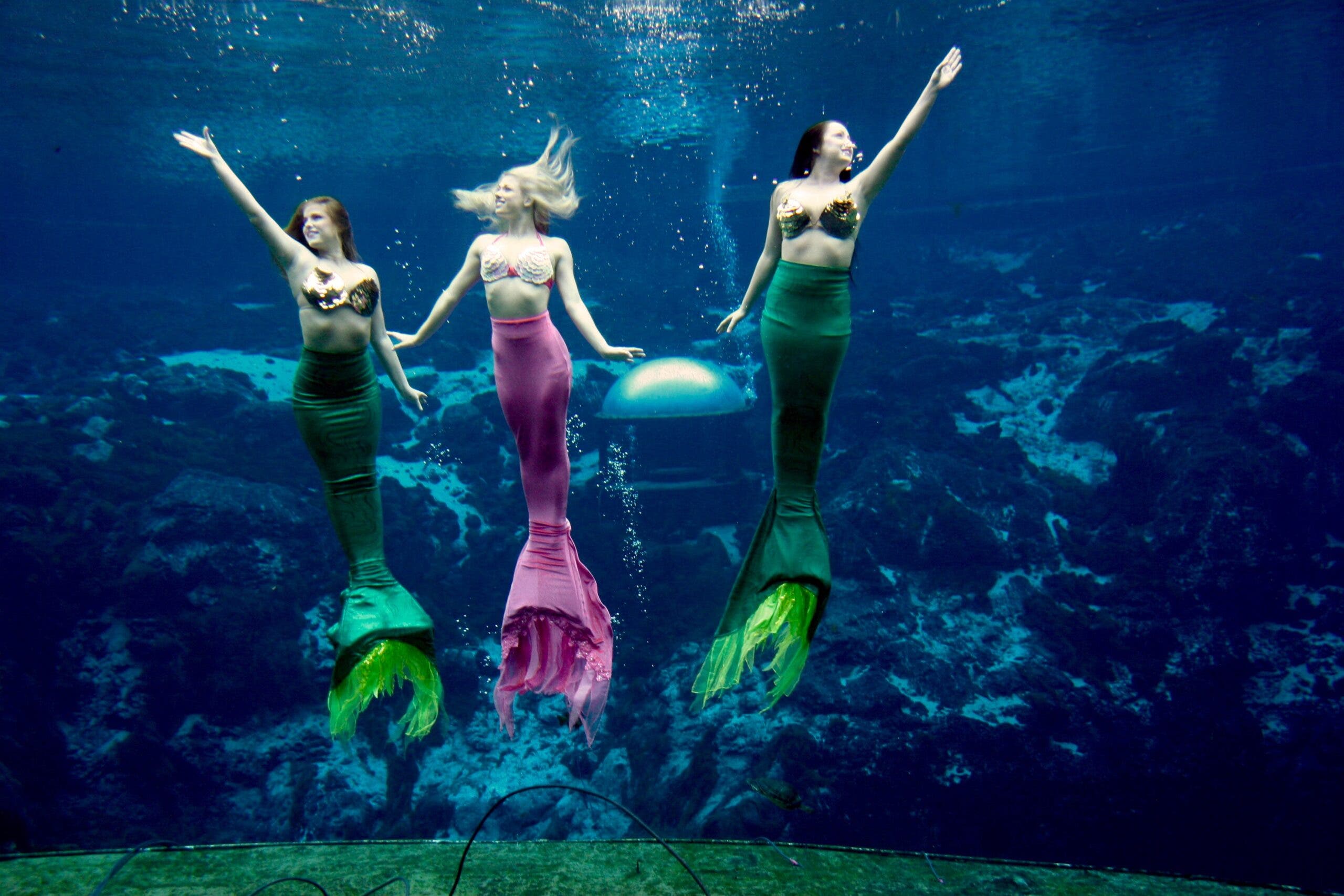 Weeki Wachee Springs State Park Mermaids (Photo: Weeki Wachee Springs State Park)
Then the dock vanishes. The spring catches me, 72 degrees, a cool, liquid shock that wraps around my body. The comforting silence underwater calms me. Sunlight fractures across pale limestone 60 feet below in the crystal-clear water, making the bottom appear close enough to touch. Bluegill hover in the current. Eelgrass ripples. Beyond the theater walls, hidden but sharing the same spring, kayakers drift downstream, and manatees wander through one of Florida’s most remarkable freshwater ecosystems.
“Slow bubbles,” Olivia says. I nod, fill my lungs, and freedive downward. The moment my face slips beneath the surface, instinct takes over. Water rushes into my nose. My throat tightens. My chest contracts. Every part of my body screams to get back to air. The calm descent I imagined disappears into a burst of bubbles. I rocket upward. When I break the surface, sputtering, Olivia hasn’t moved.
She hangs 20 feet down, suspended in the crystal water as if gravity forgot about her. Her hair floats around her face. One hand drifts through the current. She smiles. Chest-deep in the spring, trying to catch my breath, I realize I misunderstood what it means to become a Weeki Wachee mermaid. Forget the tail. This means learning an entirely different relationship with water.
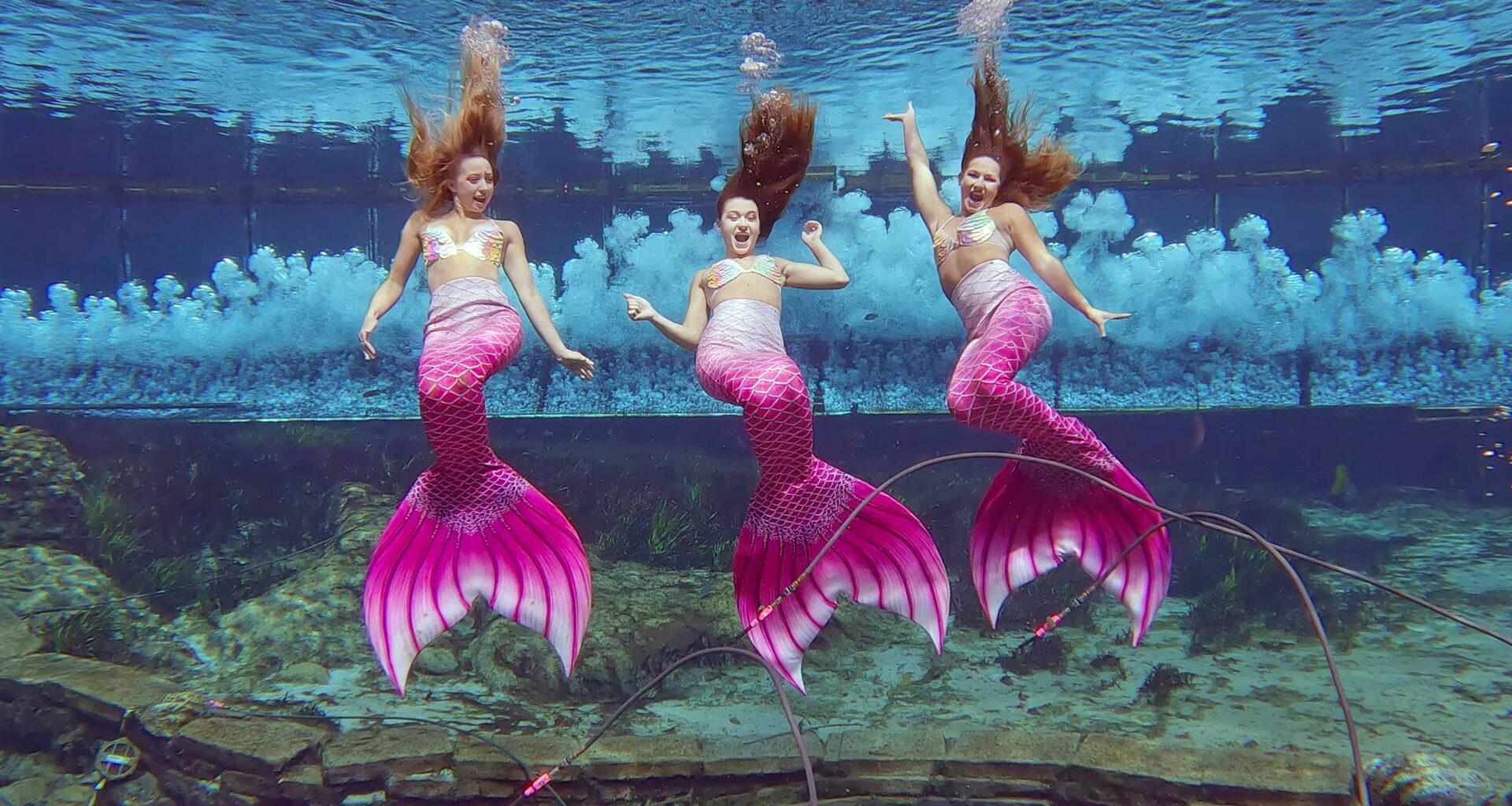
For nearly 80 years, performers at Weeki Wachee have transformed a first-magnitude spring, a designation for a body of water that discharges at minimum over 64 million gallons of water every day, into a stage, dancing beneath the surface while breathing through an unregulated airhose. They glide without weights, control their buoyancy with their lungs, and perform choreography in a current that pushes millions of gallons of water toward the Gulf every day. What looks like fantasy amounts to an underwater endurance sport where you freedive with your legs tucked into a tail that becomes your only propulsion.
Learning the Language of Water
Weeki Wachee mermaids do not simply slip into a costume. The fabric tail houses custom-fitted monofins, similar to scuba fins but locked together inside the tail. The swimmer’s legs become one powerful propeller.
Living in Florida for over 30 years, I have spent a great deal of time swimming in oceans and navigating the depths with a snorkel and on scuba. I know how to move through water. But the tail erases everything familiar. My kick changes. My balance shifts. My body wants to do what it has always done. Olivia teaches me the mermaid crawl, a strange combination of sweeping my arms through the water while my tail flicks behind me in almost a baby’s first crawl motion. Then comes the hardest lesson: staying down. The mermaids do not wear weights; and as every scuba diver and free diver knows, proper weight is the only way to ensure descent. The mermaids however, float, hover, and descend by controlling the air inside their lungs.
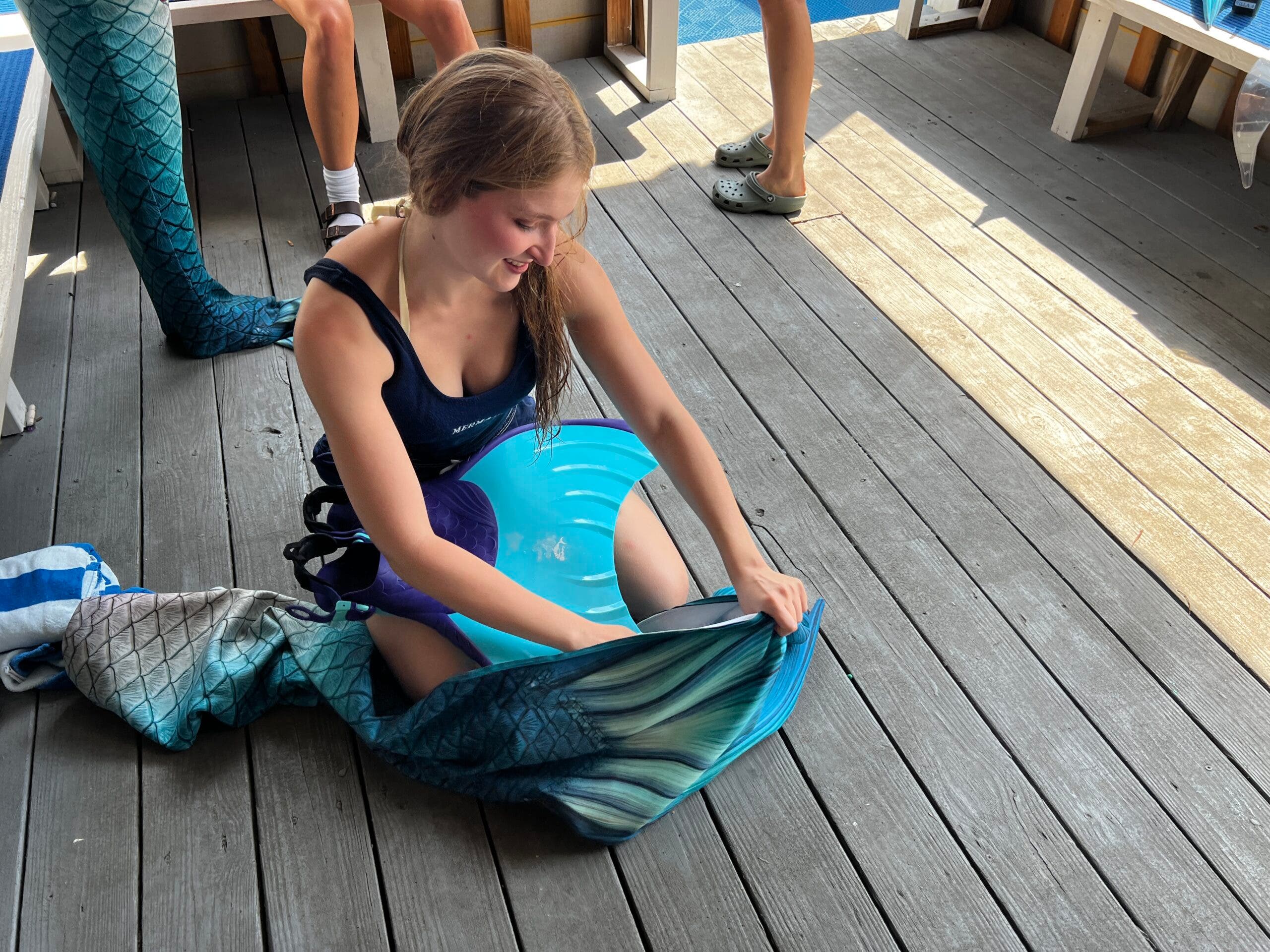 Mermaid Olivia slips into her tail. (Photo: Carrie Honaker)
“Half a breath,” Olivia tells me. Too much air and I rise. Too little and I sink. As a scuba diver, I’ve learned to manage buoyancy with a BCD and weights. The mermaids manage it with breath alone. Eventually, I manipulate a few turns, a few spins, a few seconds of feeling what it might be like to belong in this world. Then my body reminds me: I still breathe like a human. I break the surface again. Olivia laughs kindly. She knows. Every mermaid starts here.
After a successful audition for Weeki Wachee, Olivia moved to Florida from Wisconsin in 2025. She had studied theater and loved performing, but the water had always pulled at her. The chance to bring the two together felt impossible to ignore. Now, as she approaches the one-year anniversary of passing the battery of mermaid tests and earning her tail, she has settled into her role as Mermaid-in-training and is working towards learning all the shows to achieve full mermaid status.
Athletes Disguised as Myth
Olivia is part of a steady stream of newcomers drawn to a tradition that has found new life online. John Athanason, Weeki Wachee’s public relations director, says social media has introduced Weeki Wachee’s mermaids to younger audiences around the world, many of whom never grew up knowing the attraction’s history. Unlike earlier generations, today’s mermaids can carry that story beyond the spring, connecting with fans who might never have seen the underwater theater in person.
“There’s nothing quite like diving in the water here,” Olivia tells me. Becoming a Weeki Wachee mermaid takes years, but the desire to earn the tail hasn’t disappeared. Athanason says roughly 40 to 50 people have auditioned when positions have opened, a number that has remained fairly consistent throughout his 20 years working with the park. Auditions are held only when the park needs new performers, rather than on a set annual schedule. Men can also audition for the roles of Prince.
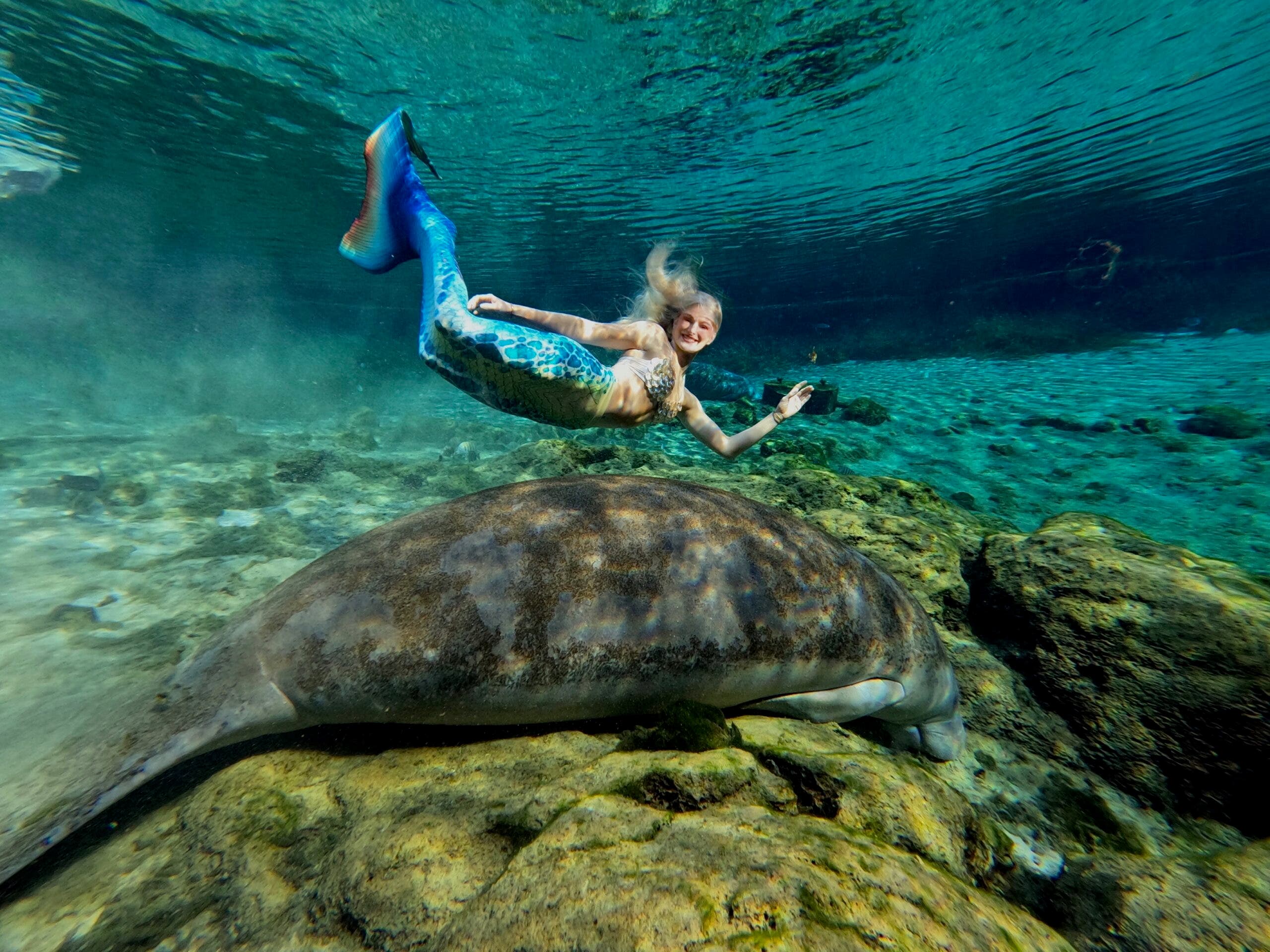 Mermaid Felicia swims with a manatee. (Photo: Weeki Wachee Springs State Park)
New performers begin as trainees, learning movements on land before entering the spring. They earn scuba certification, complete safety training, master the breathing apparatus, memorize choreography, and learn every role in every show. It can take six months to a year before a trainee performs her first show. Reaching full mermaid status takes considerably longer—typically two to four years. To achieve the title, performers must learn every role in every show and pass the “mermaid test,” which includes breathing underwater for 40 minutes or more without surfacing, memorizing all positions in 2 shows, all music ques, all ballet for every routine, show they can synchronize with other performers, stay evenly spaced at a stationary level, and all of that while looking graceful, a feat of memory and major physical strength.
Mastering the air hose challenges every performer the most—an invention that has kept Weeki Wachee’s underwater theater alive since 1947. Unlike scuba regulators, the system lets performers control their airflow, giving them the ability to maintain buoyancy without bulky equipment. Veteran mermaids make the skill look invisible. They hide the hose behind their movements, turning away from the audience to steal a breath, incorporating the equipment into the choreography instead of fighting against it.
Legendary Sirens Beckon New Generation of Mermaids
Now in her 80s, Rita King still carries herself like someone who knows her way around the water. Born and raised in Florida, she first arrived at Weeki Wachee in 1963, fresh out of high school, joining a generation of young women drawn to the little Florida spring and its underwater theater. She performed as a mermaid for five years before retiring in 1968, but the role never quite left her.
 Rita King Weeki Wachee Mermaid: Then and Now. (Photo: Courtesy of Rita King)
Weeki Wachee had already become a Florida curiosity by then. The park opened in 1947, when former U.S Navy serviceman Newton Perry saw possibility in the spring’s gin-clear water along U.S. Route 19 and opened what would become one of Florida’s most unusual spectacles. Perry had trained Navy frogmen in underwater combat swimming during World War II, and he adapted the breathing system he had developed for them into a device that allowed performers to stay submerged, breathe and move naturally beneath the surface. The technology made the illusion possible: mermaids could swim into view, seemingly holding their breath as they glided through the spring. Word spread quickly, drawing visitors eager to watch the mermaids glide through the clear, spring-fed water. Over the decades, generations of performers turned the spectacle into one of Florida’s most enduring roadside attractions.
In 2015, King returned to Weeki Wachee as part of its newly formed team of Legendary Sirens, a title bestowed on veteran mermaids who perform regularly at the theater and help teach the next generation at mermaid camps. The title reflects more than longevity: Legendary Sirens are keepers of the state park’s traditions, carrying forward the skills and discipline that have defined a Weeki Wachee mermaid for generations.
King remembers learning those lessons herself. “The first thing you’ll do is swim 400 yards without stopping,” she tells me of the tryout requirements. “Then you tread water, and then you do ballet and smile to see if you’re comfortable in the water.”
The training continued from there: first aid, rescue, scuba certification, written tests, choreography, and eventually the air hose. “It is the hardest thing to conquer,” Rita says. “You have to control your breathing, control the air hose, and make sure you’re not getting wrapped in it when you’re doing ballet.”
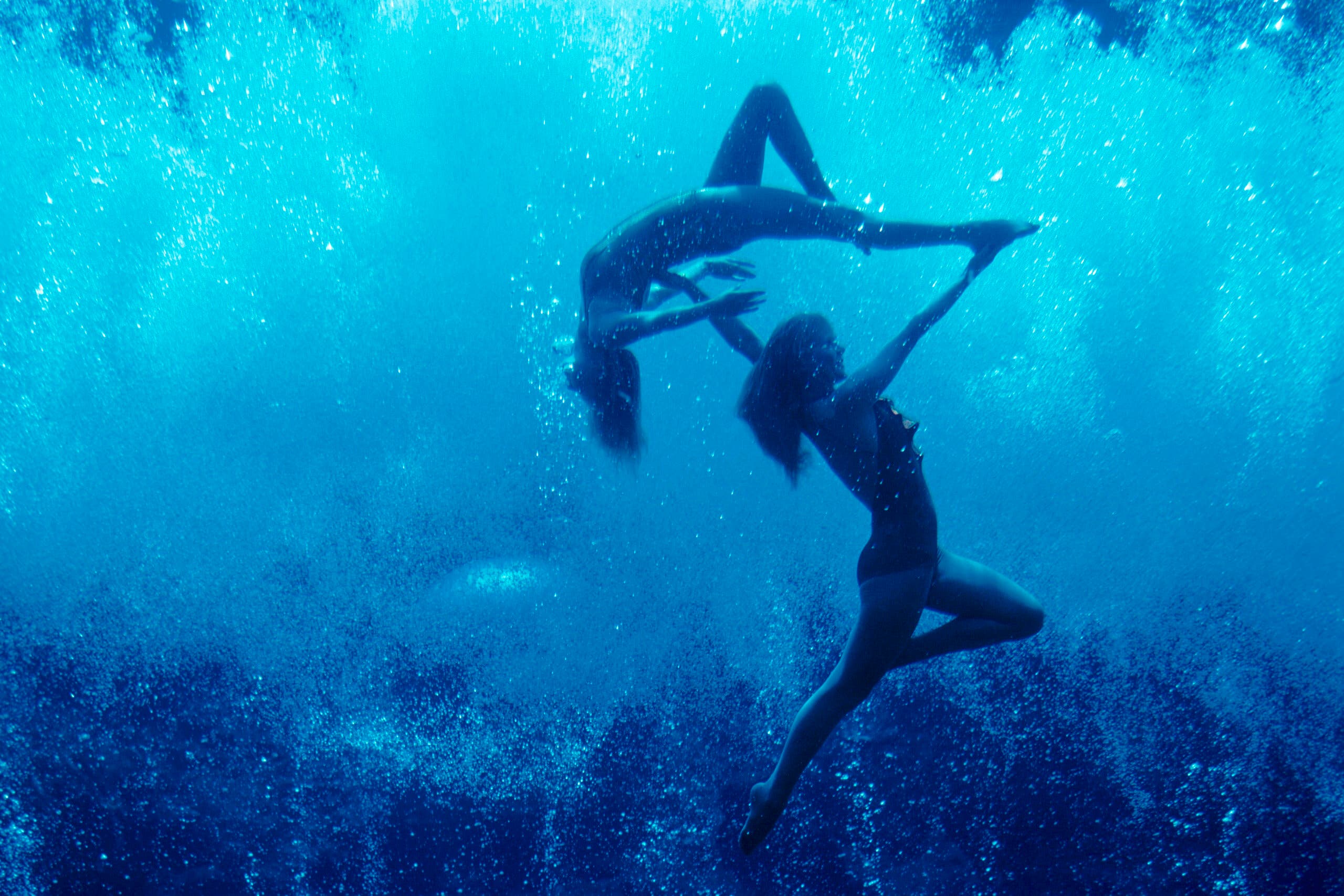 Since 1947, women have performed in Weeki Watchee’s underwater theater built into the springs. (Photo: Getty)
Then the current takes over. The Weeki Wachee Spring pumps far beyond the minimum to be classified as a first-magnitude spring, sending out 117 million gallons of fresh water every day, creating a steady force beneath the performers. “You’re compensating for that current all the time,” Rita says. These women don’t simply perform. They swim, hold their breath like athletes, and dance underwater. “We’re not the weekend warriors,” Rita says. “It’s a way of life.”
That kind of commitment is what makes the future of Weeki Wachee’s mermaids both reassuring and uncertain. The tradition still attracts hopefuls, but earning the title demands years of training, physical strength, and a willingness to make the spring part of your life. Olivia is nearly a year into that process. King has been carrying its memory for more than six decades. Between them lies the question that hangs over the spring: Can a tradition this demanding keep finding women willing to inherit it?
A Theater Built by a Spring
Weeki Watchee’s original performers didn’t play mermaids at all. The Aquabells, a group of female synchronized swimmers from St. Petersburg, created underwater ballet routines instead, including the iconic Adagio pose now immortalized with a 25-foot fountain that greets visitors at the entrance of the state park.
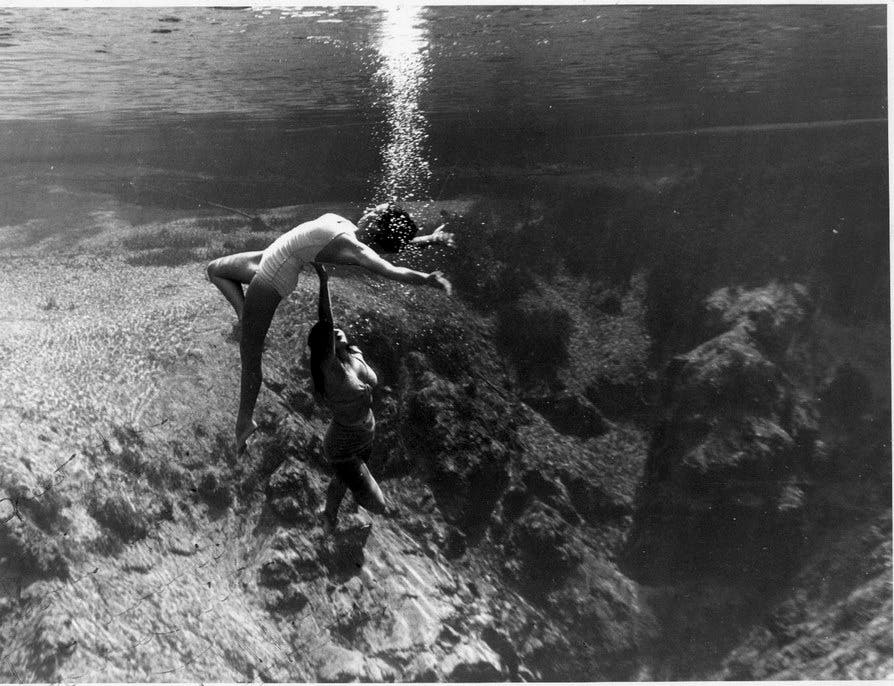 In 1947, a synchronized swim team known as the Aquabelles became the very first “mermaids” to perform at the grand opening of Weeki Wachee Springs State Park. (Photo: Bob Reed)
In the beginning, no tails existed. Performers staged underwater scenes: picnics, football games, even Thanksgiving dinners with a turkey anchored to the table. The fantasy evolved after ABC Paramount purchased the attraction and transformed it into a full-scale production. The theater expanded from a 22-seat venue into the 400-seat submerged theater that still exists today. Tails arrived in the 1960s as the shows grew more theatrical. Soon Weeki Wachee had become one of Florida’s biggest roadside attractions. Elvis Presley took a break from filming nearby to visit the mermaids. Television crews arrived. Celebrities like Don Knotts, Esther Williams, Bob Hope and Arthur Godfrey came to see the impossible spectacle happening beneath the surface.
In the 1970s, Florida changed. Interstates replaced two-lane road trips. Disney World reshaped tourism. Many roadside attractions disappeared. Lifelong Floridian from nearby Ocala and longtime Weeki Wachee mermaid fan, Athanason arrived in 2001, when Weeki Wachee needed aid. “I wanted to help save it,” he says. He then spent two decades protecting the park’s history and guiding it through its transition into a Florida state park in 2008. The audience has remained remarkably steady, too. Athanason says Weeki Wachee has welcomed roughly 300,000 to 400,000 visitors a year over the past five years, proof that the mermaids still have an audience well beyond the nostalgia of those who remember them from childhood.
As they rolled out the state park designation in 2008, state park officials didn’t know what to do with the mermaids. “They’re not part of the identity of a typical state park,” Athanason says. But he argued that they represented something bigger. “They serve a cultural significance to what Florida tourism has been.” And park officials agreed.
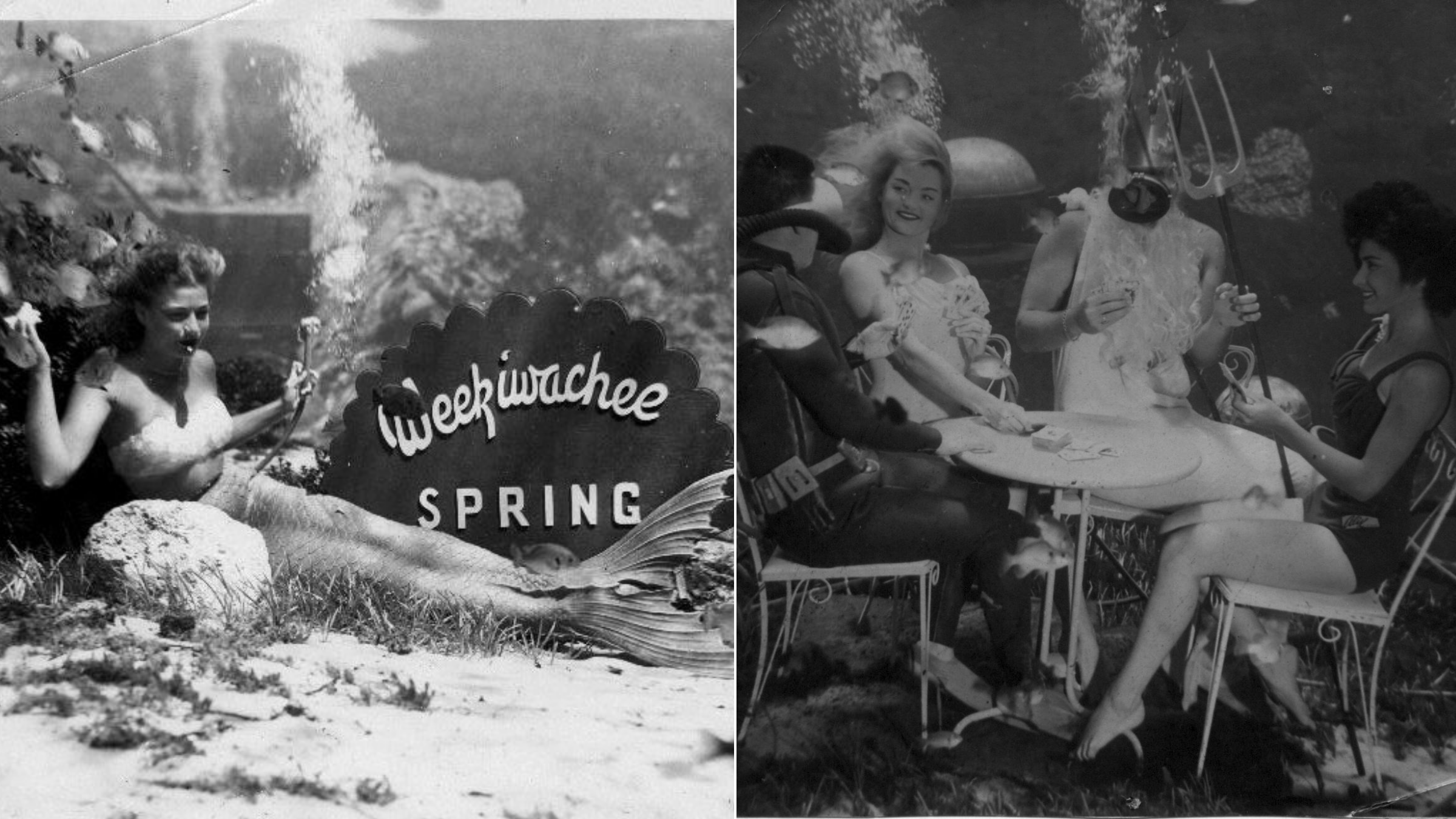 Vintage photos from Florida’s iconic roadside attraction at Weeki Wachee Springs State Park.
For Athanason, the magic comes from the combination. “It’s the spring,” he says. “That theater is the only one of its kind in the world.” When the curtain rises, and visitors look through the four-inch glass into the spring, they don’t just watch a performance. They look into a place no one can recreate. “Forget the mermaids even exist,” John says. “[The spring] itself is magical. But when you throw in the history and the iconic mermaids, that’s where the magic happens.”
King retired from performing in 1968, but she never really left the spring. She returned as a Legendary Siren, teaching new generations of swimmers through mermaid camps and special performances. Once retired, she didn’t miss applause or the flash of the shows; she missed the water. “I always looked forward to swimming underwater,” she says. “It wasn’t as much about performing as it was being in the spring.”
The former mermaid describes looking upward through the surface and seeing clouds, trees, and sunlight shimmering above her. “It’s peaceful and serene,” King says. The veteran mermaid still feeds the fish when she enters the spring. She still feels the pull. And somewhere between King, who first put on a tail in 1963, and Olivia, who crossed the country to earn hers more than six decades later, the tradition keeps finding its next generation. Netflix’s 2023 MerPeople, the latest documentary about professional mermaiding, shows the current state of this half-billion-dollar industry. And while this is a growing global subculture, Weeki Wachee Springs remains like nowhere else: a place where mythology and ecology share the same stage.
The River That Carries the Story
After my mermaid lesson, I trade the tail for a kayak. The Weeki Wachee River, which flows out of the spring, carries me downstream beneath a canopy of cypress and Spanish moss. The water looks shallow enough to walk through, until suddenly the bottom disappears into deep blue caverns. Green herons flit through the trees. Blue herons glide across the water. Ibis stalk the banks. The sky shifts from gray to bright Florida blue. Then rain falls through the sunshine, creating a rainbow above the river.
Weeki Wachee means “winding river” in Seminole, and the name fits. The water bends through forest and history, carrying pieces of every generation that has touched it. Families paddle downstream. Fish swim around their boats. A manatee mother and calf glide silently beneath my kayak.
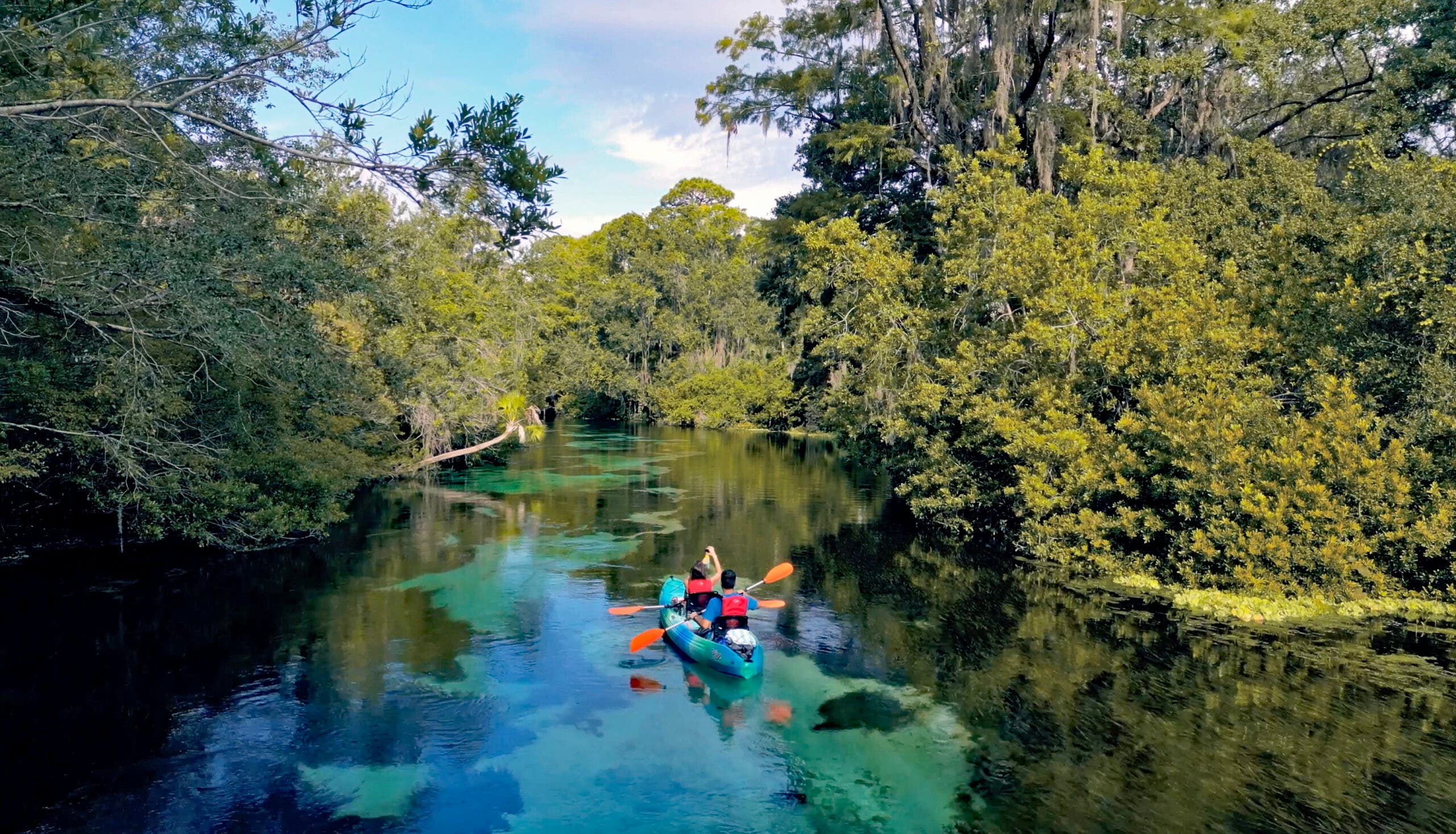 Kayaking on Weeki Wachee River. (Photo: Weeki Wachee Springs State Park)
But inside that spring, another generation of mermaids keeps learning how to breathe under the water. I never mastered the graceful underwater smile. My turns wobbled. My breath stayed tentative. My instincts still betrayed me on every descent. But somewhere between my first panicked ascent and my last awkward dolphin kick, I stopped thinking about becoming a mermaid. I started thinking about the spring and King returning decades later because the water still called her back like a magnet. About Olivia, who moved four states away to chase an underwater dream. About Athanason, who fought to preserve a place where grandparents and grandchildren can share the same strange, sparkling piece of Florida—and where a new generation can discover those mermaids from halfway around the world on a phone screen, then decide they want to become one.
As I paddled downstream beneath the trees, the theater disappeared from view. Behind me, the mermaids returned to the spring, and the applause faded. Ahead, the river carried me toward the Gulf, moving through the landscape that has made Weeki Wachee possible for nearly 80 years.
Mermaid Country: How to Dive In
Become a mermaid.
At Weeki Wachee Springs State Park, the Friends of Weeki Wachee offer several ways to get beneath the surface. The Mermaid Experience affords participants one hour to swim in the spring wearing a professionally fitted mermaid tail for $175. For adults 18 and older, Sirens of the Deep goes deeper: the two-day camp includes underwater ballet training, behind-the-scenes lessons in mermaid performance, and instruction from former Weeki Wachee mermaids. Participants receive an honorary mermaid certificate; this $575 camp requires swimming in about 15 feet of water and does not include the air-hose breathing used by professional performers. Junior Mermaid Camp, for ages 7 to 14, combines swimming sessions with mermaid crafts, makeovers, photos, and spring education in a two-day experience for $475.
Follow the trail.
Continue the mermaid mythology on the Mermaid Tale Trail, a free public-art scavenger hunt winding through Hernando County. Each of the life-size fiberglass mermaids begins with the same original sculptural form, modeled after the face of Kristy, a former Weeki Wachee mermaid who allowed a sculptor to cast her face. Local artists then transformed the figures into wildly different characters inspired by Florida’s landscapes, wildlife, history, and folklore. Download the digital passport and check in as you find them to earn prizes.
Make it a weekend.
Less than ten miles from the state park entrance, stay at Hernando Beach Motel (rooms from $139 per night), a mermaid-themed property that’s home to one of the trail’s statues. For a hearty breakfast before camp, head to Silver Dolphin Restaurant in Hernando Beach, where two mermaids from the Mermaid Tale Trail keep watch. Then get on the water with Get Up And Go Kayaking– Weeki Wachee for a guided clear-kayak ecotour through the Weeki Wachee River and estuary, where you’ll have chances to spot manatees, dolphins, turtles, rays, and other wildlife.
Swim in Buccaneer Bay.
While visitors can paddle the river, swimming in the spring itself is limited to Buccaneer Bay, the park’s water-play area, where two slides—the Cannonball and Pirate’s Revenge—drop riders into the natural spring water. It’s an easy way to trade the kayak for a swim and spend a little more time in the water that makes Weeki Wachee so singular.
Carrie Honaker is a Florida-based travel and food writer whose work has been honored with a Gold Award from the Solas Awards for Best Travel Writing. A lifelong water lover, her adventures have taken her diving wrecks off her home coast in Panama City Beach, working oyster farms across Florida—hauling and flipping cages in a wetsuit—and paddling the state’s gin-clear springs.