
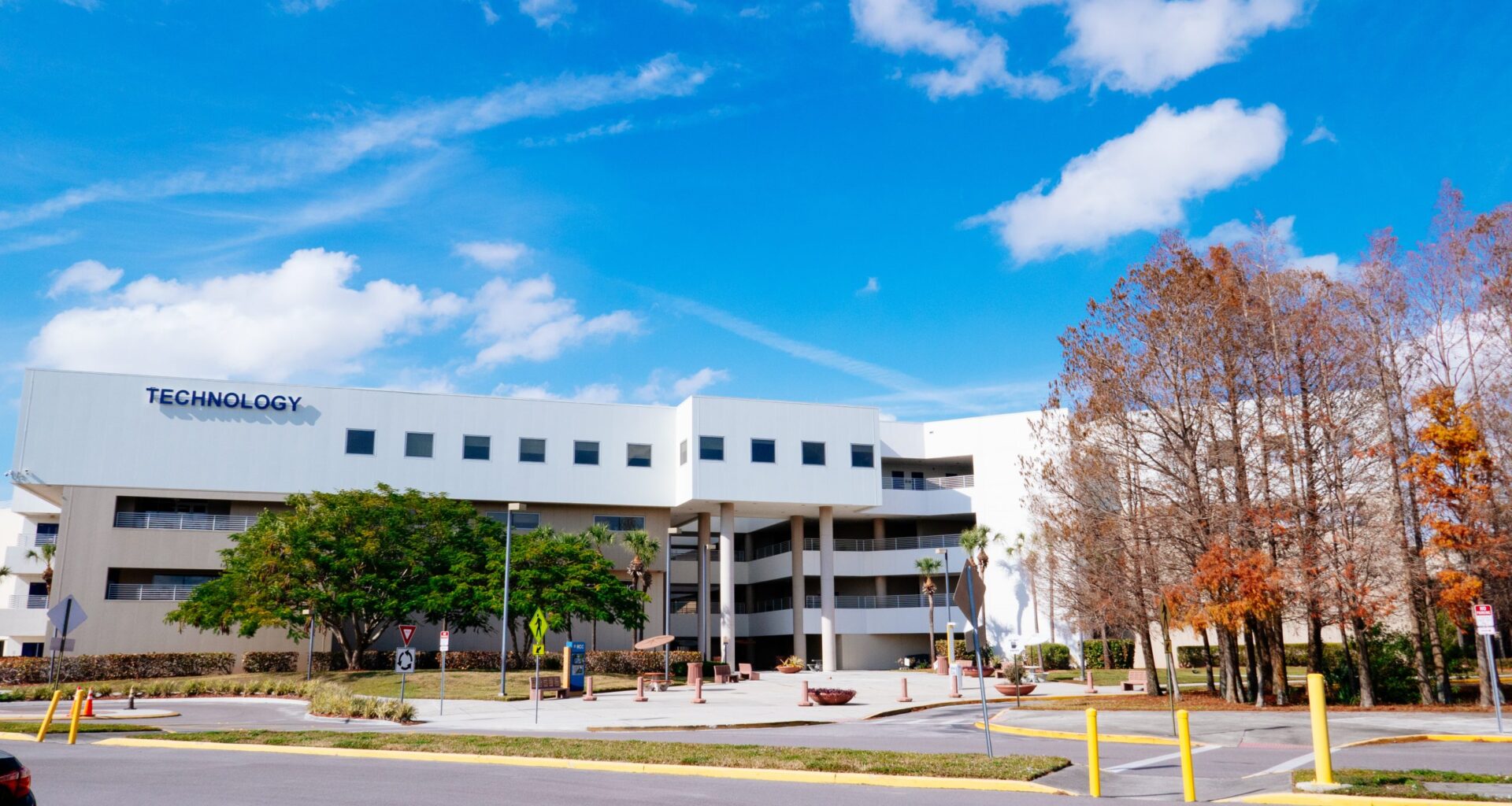
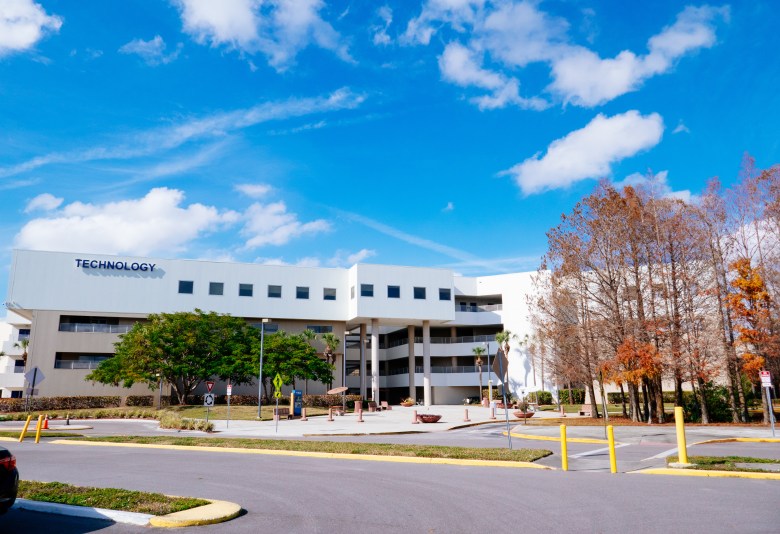
 Hillsborough Community College’s Dale Mabry campus on Jan. 25, 2021. Credit: Feng Cheng / Shutterstock
It’s 6:30 in the morning and inside my headphones is the calming sound of ocean waves. Outside, the sun is rising behind the apartment complex across the street. Swooping into view is an osprey, who lands atop an orange construction cone and stares intently into the pond below. It’s nest on the next telephone pole. In a few hours, I’ll drive to work and begin another lesson with my students at Hillsborough College’s Dale Mabry campus.
As each school year has come and gone, the home of the Hawks feels less like the nest I once knew. Over the last five years, I’ve noticed my student’s reading comprehension start lower and lower; I’ve witnessed my colleagues grow more bitter and disheartened; I’ve begrudgingly sat through (countless) committee meetings on how to “integrate AI into my classroom.”
This year, while sitting through another faculty in-service watching the AI-generated videos of what “could be” our new (much much smaller) campus, I can’t help but feel like the conductor on the Titanic, hopelessly trying to convince my students that the music matters as the ship begins to slip into the icy unknown.
For the first time since becoming a teacher, I found myself dreading the start of the Fall semester. Aside from the uncertainty of our campus’ future, my apprehension was in part due to the fact that a week before the semester started, I was informed my Intro to Creative Writing course would be cancelled due to low enrollment—a class I’ve been fighting tooth and nail to resurrect after being buried in the college’s course catalog.
Now, you might think “low enrollment” means “low interest.” But the answer isn’t that simple. In fact, considering I ran the same course with 19 students last spring the reason for “low enrollment” becomes much more complicated. With each passing semester student’s time is further monopolized by general education courses, “first-year experience” requirements, not to mention Florida’s housing crisis, a stagnant job market, and exponential increases in living expenses that make “electives” seem “unnecessary.” Unfortunately, the problem of low enrollment has affected dozens of courses across the Humanities, which leaves eager faculty and students wilting on the vine.
When I was a student in community college, my humanities courses were some of my favorite. Learning about art, culture, and language in new ways with new people was exciting. What I remember most about those days now, though, is that the classrooms were always full. I was just one of 25 students excited to share their work, discuss that week’s reading, and (at our best) debate the merits of the Oxford comma.
The short-term (and perhaps most obvious) answer to the low enrollment question is that Hillsborough College’s Dale Mabry campus is set to be turned into a professional sports stadium, coffee shops, and high-rise apartments. To say HC’s redevelopment is an afterthought in those plans is easily proven by our forthcoming moniker: Innovation Edge Featuring Hillsborough College.
As higher education becomes increasingly transactional, I see students who are apathetic; they want to “get-in-and-get-out” as quickly as possible. In a world that wants to leave them behind, why wouldn’t they microwave their education with ChatGPT and Gemini? I see professors burnt out from teaching six, seven, and eight courses a semester. For context, at most four-year public universities, you’re considered to be “paying your dues” if you teach four classes a semester. The students and faculty of Hillsborough College deserve their time back. We deserve the space (literally and metaphorically) to explore art, culture, and language that deepen the educational experience and enrich our community, not commodify it.
I don’t blame my students for their apathy. I don’t blame my colleagues for their disillusionment. What scares me is that I’m starting to feel those things, too.
It’s now 9 a.m. and the alarm on my phone cuts through the soft sound of waves washing ashore—it’s time to get ready for work. I close my laptop and glance back out my window. The orange traffic cone is silhouetted against the sky. I take off my headphones and listen for the high-pitched chirp of an osprey, scanning the auburn colored roof of the apartments across the street. There’s rain clouds off in the distance. I wonder if the hawk has found better shelter, if it’s ready to weather the storm.
Joshua Corson is an English instructor at the newly-rebranded Hillsborough College, formerly known as Hillsborough Community College.
Creative Loafing Tampa Bay accepts letters to the editors and op-ed pitches. We will not run your letter without permission. Email your submissions to [email protected] for consideration.
Pitch in to help make the Tampa Bay Journalism Project a success.
Subscribe to Creative Loafing newsletters.
Follow us: Google News | NewsBreak | Reddit | Instagram | Facebook | BlueSky
This article appears in August 27 – September 02, 2026.
Related