
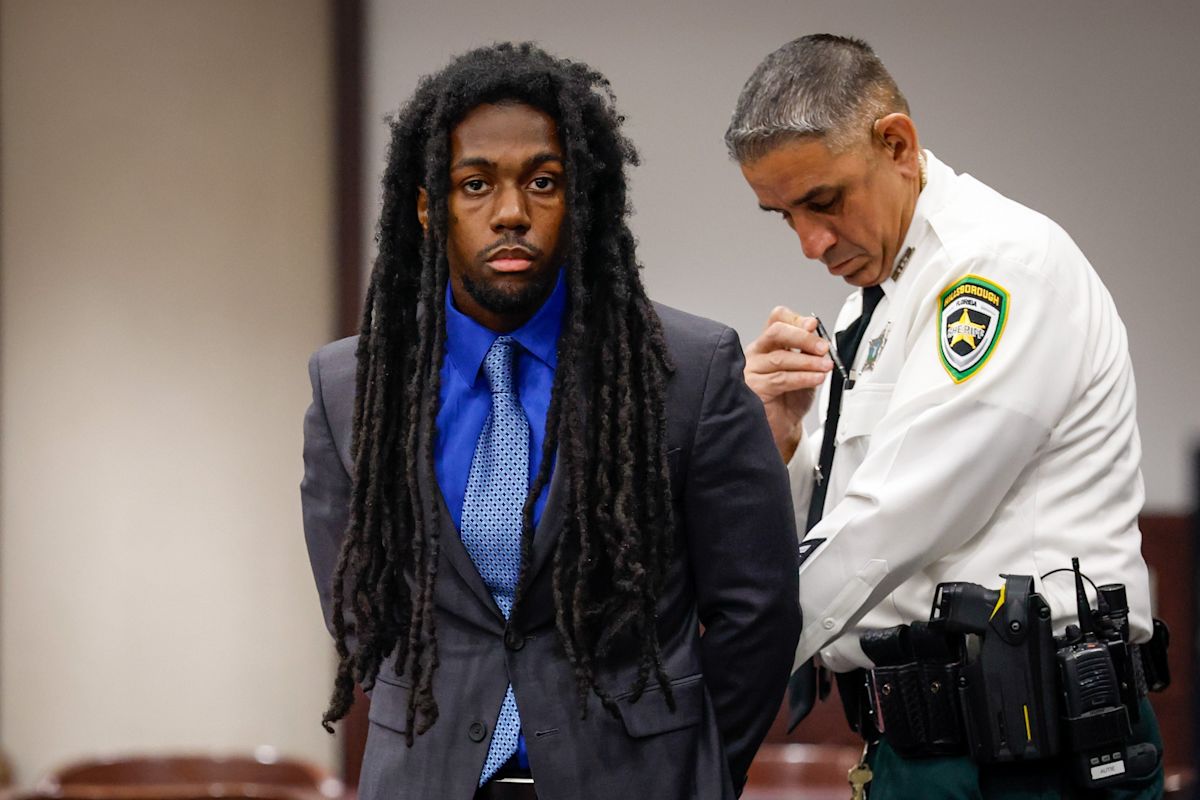
Billy Adams III murdered Alana Sims in cold blood and caused the death of her unborn child, a jury decided Tuesday.
The panel of five women and seven men deliberated for five hours before finding the Tampa rapper guilty of first-degree murder in Sims’ death. The jury also convicted him of killing her baby.
Adams, 28, sat with a hand over his mouth as the verdict was read aloud in court, but showed no reaction.
In the courtroom gallery, a woman wept.
The decision pushed the case into a second phase, wherein prosecutors will ask the same jury to recommend the death penalty. The trial continues Wednesday.
The guilty verdict came three years after Adams was found not guilty in a double murder case. In that trial, he’d argued he shot two men in self-defense.
He tried to do the same when police questioned him about the killing of Sims.
Because he was found not guilty in the earlier case, the jury in his trial for Sims’ killing never heard about it.

The 22-year-old was found dead late the night of Jan. 30, 2023, on pavement along an unfinished road in the Easton Park subdivision in New Tampa. She’d been shot once behind her right ear. She was about five months pregnant.
Her Ford EcoSport was parked beside her. Her 18-month-old child sat inside in a car seat, unharmed.
State prosecutors argued that Adams killed Sims because he believed, mistakenly, that he was the father of her unborn child, and he didn’t want to have to care for her and the baby. He plied her with lies, prosecutors said, assurances that he wanted to make a life and a home with her.
“The defendant considered Miss Sims and her child dispensable,” Assistant State Attorney Lindsey Hodges said in closing arguments. “He didn’t want a relationship with her, but he led her to believe he did.”
Adams’ defense denied that he believed he was the father of Sims’ child. They acknowledged that he lied to police about his involvement with her but asserted her pregnancy was not a motive for him to kill her.
“Just because he lied doesn’t make him a murderer,” Assistant Public Defender Jennifer Spradley told the jury.
An acquittal, then a new crime
On Jan. 27, 2023, Adams was found not guilty in the shootings of Trevon Albury and Daniel Thompson. The two men were shot to death in a Lutz recording studio one night in December 2020.
A hip-hop artist who performed as Ace NH, Adamssaid at trial in that case that he shot the men because he overheard them talking about robbing the studio’s owner.
Absolved of murder charges that could have landed him a life sentence, Adams left court that day a free man. Three days later, Sims was killed.

Defendant Billy Adams III relaxes before the start of jury selection in his trial in Tampa.
Questioned a day after she died, Adams first told Tampa police he hadn’t spoken to Sims since before the previous Thanksgiving. He said he’d been at home the night she was killed.
Detectives pulled videos that showed a car belonging to Adams was in the Easton Park neighborhood that night. Thereafter, Adams said he was with friends that night and showed police a video to prove it. But the detectives later determined a time stamp on the video was altered, and it was actually recorded after the crime.
Detectives examined Adams’ cellphone. They found text messages between him and a woman named Lakenya Brantley. They’d referred to each other as husband and wife.
In text messages a day before the crime, the pair appeared to lament the impact another woman’s pregnancy would have on their relationship. Adams seemed intent on taking care of it.
“Tomorrow dis s— done,” he wrote.
Prosecutors highlighted several Google searches he made around the time of the crime. They included:
“Probable cause for arrest in Florida.”
“Will gloves keep gunpowder off your hands?”
“Can you wash gunpowder residue off?”
A day before the shooting, messages showed Adams apparently telling his friends to give him an alibi.
He told one man that police may be calling him.
“Tell them I pulled up on you,” he wrote.
Changing stories
A video from a Tampa police interview room memorialized much of what Adams told detectives the third time they spoke with him.
In the courtroom, Adams put a hand over his mouth and nose, watching as the jury viewedit.
The recording, taken from a ceiling camera, showed Adams clad in shorts, a gray T-shirt, sandals and handcuffs.
Tampa police Detectives Aaron Campbell and Nicholas Magill sat near him. On a table beside them sat a fake gun, painted bright blue, a training weapon.
Campbell asked Adams why his car was in the Easton Park subdivision when Sims was killed.
“I’d prefer to have a lawyer for that,” Adams replied.
The detective asked if Adams wanted a lawyer for anything else. After that, he started talking.
He first said he’d gone to Easton Park to meet an old girlfriend. He said he didn’t see Sims that night.
The detective pressed him.
“For a fact, you went there that night,” the detective said. “For a fact, you shot her in the head.”
Campbell suggested that Sims may have done something that forced Adams to shoot her. Eventually, Adams said she’d pulled a gun on him.
At one point, Campbell picked up the fake gun and walked Adams through a reenactment.

A video shown last week in court shows Billy Adams III, center, reenacting a struggle over a gun with Tampa police Detective Aaron Campbell as Detective Nicholas Magill, right, looks on.
“So, if I was Alana and I’ve got this gun, how are my arms?” the detective asked. “Are they here?” he asked, thrusting the gun away from his body. “Are they here?” he said, holding the weapon farther away.
With the gun in the detective’s right hand, Adams reached out and placed both his hands on it, turning it to the right.
“We’re just struggling,” Adams said. “And she just won’t let it go.”
He twisted the gun toward the detective’s left side to demonstrate where it was when the fatal gunshot was fired.
Sims was shot on the right side of her head.
When Campbell suggested the shooting didn’t happen the way Adams described, his story changed again. He said he’d wrestled the weapon away from Sims, side-stepped, then shot her.
He said he’d stashed the gun in a patch of woods off Morris Bridge Road. Police conducted an extensive search of that area but never found a gun.
Adams’ defense pointed to that and other gaps in the evidence. They noted that no one saw Adams in the neighborhood the night Sims was killed. No physical evidence tied him to the murder scene.
But more evidence against Adams came by way of a man who’d bunked with him in jail.

Billy Adams III sits in court before the start of jury selection in his trial in Tampa.
A jailhouse informant
Bryan Boggs appeared before the jury in jailhouse orange and shackles. Tattoos marked his face. One, above his right eyebrow, read “loyalty.” Soft-spoken and polite, he punctuated his responses to the attorneys with”ma’am.”
Boggs bunked beside Adams for a week in early March 2023 in the Falkenburg Road Jail. He detailed an elaborate scheme he concocted to elicit incriminating information from Adams.
He’d heard about Adams’ case on TV, he said. Not long after they moved into the same jail pod, Adams introduced himself and asked for his help and shared details about his case.
Adams told him he’d been accused of murdering a woman he’d been having sex with, Boggs said. He told him he hoped to get his statements to them thrown out of court because he’d asked them for a lawyer. If that didn’t work, Boggs said, Adams planned to claim self-defense by saying Sims confronted him with a gun and that he took it from her.
He told Boggs his car was seen in the neighborhood where the crime occurred, that detectives asked him what he’d done with the gun and that he put them on “a wild goose chase” down Morris Bridge Road.
Boggs said Adams asked him to smuggle some letters out of jail for him. He wanted Boggs to deliver them to some of his friends and acquaintances. The letters, prosecutors said, were an effort to craft an alibi for the night of the murder.
Boggs took the letters to police.
On the witness stand, Boggs acknowledged he is serving a five-year prison sentence for theft-related crimes. A 28-time convicted felon, whose record includes seven crimes involving dishonesty, he admitted he’d shared the information with detectives in the hope that it would yield a benefit for himself. But, he said, he hadn’t been promised anything.
During closing arguments, Adams’ defense attacked Boggs’ credibility.They accused him of manipulating Adams, of getting him to write down details of the crime to try to get help for his own legal situation.
“You know he is not believable,” Spradley told the jury.
The prosecutor argued that Boggs provided information about the crime that only Adams could have known.
Besidesthat, she said,there was ample evidence of his motive and his guilt.
“The defendant murdered Alana Sims and Baby Girl Sims because he no longer had a use for them,” Hodges said. “They stood between him and the life he wanted.”