
In January 2026, 17-year-old Christian Wallace landed his first job at the Winn-Dixie on Northwest 11th Avenue and 54th Street in Liberty City. Resident Tromain Parker would frequent that same location, shopping for groceries or using its banking services to buy and send money orders.
North Allapattah resident Kenemo Williams says he used to visit that Winn-Dixie store nearly every day. And for Daniella Pierre, it’s where she knew to head to if she ever ran out of Crystal Hot Sauce, her favorite.
Now, the store’s doors are shuttered, its large parking lot mostly empty.


The Winn-Dixie at 1150 NW 54th St. is closed down as of August 2026.
(Samantha Morell for The Miami Times)
The longtime Liberty City grocer officially closed down last month. Its fate? To be converted into an ALDI, the supermarket chain that bought out Winn-Dixie’s parent company, Southeastern Grocers, in March 2024.
Two other Winn-Dixie locations – one at 11030 NW 7th Ave. in Pinewood and another at 1155 NW 11th St. in Overtown – have also shut down and are now awaiting conversions. All three are expected to open in early 2027, according to Chris Hewitt, regional vice president at ALDI.

The Winn-Dixie at 1155 NW 11th St. in Overtown is closed down and boarded up.
(Samantha Morell for The Miami Times)
Other locations in Opa-locka, Miami Gardens and Doral will remain under the Winn-Dixie brand.
The loss at 1150 NW 54th St. is leaving a gap in the community, residents say, with many labeling Liberty City a food desert. Members of the predominantly Black and low-income neighborhood say they’ve been forced to choose between limited alternatives for groceries, often traveling outside of their area for quality food options and all the while wondering whether the new ALDI will provide meaningful relief when built.
More than a grocer
For many, Winn-Dixie was a one-stop shop for groceries, pharmacy pick-ups and banking services. It was also a place of gathering and a cultural institution.

Daniella Pierre stands in front of the home she grew up in, wearing her pink Winn-Dixie uniform.
(Courtesy of Daniella Pierre)
“Winn-Dixie was more than the grocery store,” said Pierre, a Liberty City resident and president of the Miami-Dade NAACP. “You were able to connect there, to catch up on the latest gossip. You could find something out at Winn-Dixie. Seafood boils? That started at Winn-Dixie.”
The Winn-Dixie Deli also offered hot meals, ready to be eaten.
“People who are unfortunately unhoused, that was how they would eat a balanced meal, ‘cause there was hot kitchen food right there,” Pierre added.

Christian Wallace, 17, began his first job at Winn-Dixie in January 2026.
(Courtesy of Satin Fye)
Satin Fye, Wallace’s mother, noted how the grocer was also a steady employer of young men in the neighborhood.
“It was like [the store manager] was almost getting a lot of the young people off of the street and giving them something productive to do,” Fye said. “So the social part of it for our community is such a great loss.”

Daniella Pierre stands in front of the shuttered Winn-Dixie store in Liberty City.
(Samantha Morell for The Miami Times)
Pierre can speak firsthand to Winn-Dixie’s value as a launching point for a successful career, having – like Wallace – landed her first job there, at the former location on East 10th Avenue and 12th Street, now a Fresco y Más.
“Look at me. I started as a cashier, and I’m working on my doctorate,” Pierre said.
Where’s left to go?

Satin Fye and her son Christian Wallace.
(Courtesy of Satin Fye)
For customers, figuring out where to shop has “been a cluster,” as Fye describes it. Her house is just a three-minute drive from the Liberty City Winn-Dixie location. Now, that convenience is gone.
She said she’s been shopping at the Publix on Biscayne Boulevard and Northeast 48th Terrace as an alternative, if not skipping the commute altogether and resorting to using Instacart, which upcharges for food and has service and delivery fees. Other residents reported going to the Walmart on Northwest 32nd Avenue and 79th Street, about a 20-minute drive with traffic.
Fye said she’s heard from neighbors who now have to take two buses just to get to the grocery store.
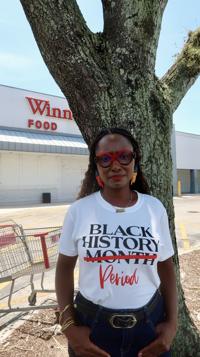
Satin Fye, a union leader and Liberty City resident.
(Samantha Morell for The Miami Times)
City of Miami Commissioner Christine King, who represents District 5, told The Miami Times that she’s already spoken with the Resilience and Public Works Department to help transport seniors and other residents to their desired grocery store within five miles of city limits. That includes the ALDI at 1290 NE 108th St. and the Walmart, King said.
Within Liberty City, there’s a Presidente Marketplace on Northwest Sixth Avenue and 62nd Street. Just last month, however, that location was reported as having numerous health code violations, including old food, according to the Miami Herald.
The old versus the new
Even with ALDI slated to take over the closed Winn-Dixie locations, residents are wary that the switch won’t act as a one-to-one replacement.
ALDI does not offer the same resources that Winn-Dixie did, including a pharmacy, banking services or ready-made food. It also doesn’t accept WIC, a federal assistance program that provides healthy foods to pregnant, postpartum or breastfeeding women, infants, and children up to age five.
“[Winn-Dixie] was a place where they still accepted checks for seniors who still used checks,” Pierre said. “It was a place for everyone, whether you had cash, checks, coins, even WIC – they still would take you. And we don’t know to this date whether ALDI will be able to sustain those services.”
Asked about the discrepancies between the two grocers, Hewitt said ALDI has a “different operating model, focused on providing fresh groceries, everyday essentials and consistently low prices that help customers stretch their budgets further.” According to its website, ALDI accepts “cash, most debit cards, Visa, MasterCard, Discover, American Express, Electronic Benefits Transfer (EBT), SNAP, Link cards and contactless pay.”
ALDI is also known for charging for grocery bags and requiring its guests to deposit 25 cents to access a grocery cart – obstacles that residents believe will prove to be burdensome for the community.

The closed Winn-Dixie store in Overtown displays a sign advertising the ALDI to come.
(Samantha Morell for The Miami Times)
Hewitt notes that the 25 cents are returned at the end of the visit, and that “anyone who doesn’t have one can ask an ALDI employee to borrow a quarter.”
“Shoppers are welcome to bring bags they already have from home or purchase bags at checkout,” he added. “These practices help us reduce operating costs and waste so we can keep grocery prices low.”
But beyond the differences, customers appreciated Winn-Dixie simply because it’s what they were used to.
“Winn-Dixie has been around for hundreds of years, you know? We all know the beef people. We grew up with that,” Williams said.
Ronald Frazier, a trailblazing architect, urban planner and founding member of the Miami-Dade Chamber of Commerce, recalls the effort to bring Winn-Dixie back into the community after it was vandalized during the 1980 Arthur McDuffie riots.

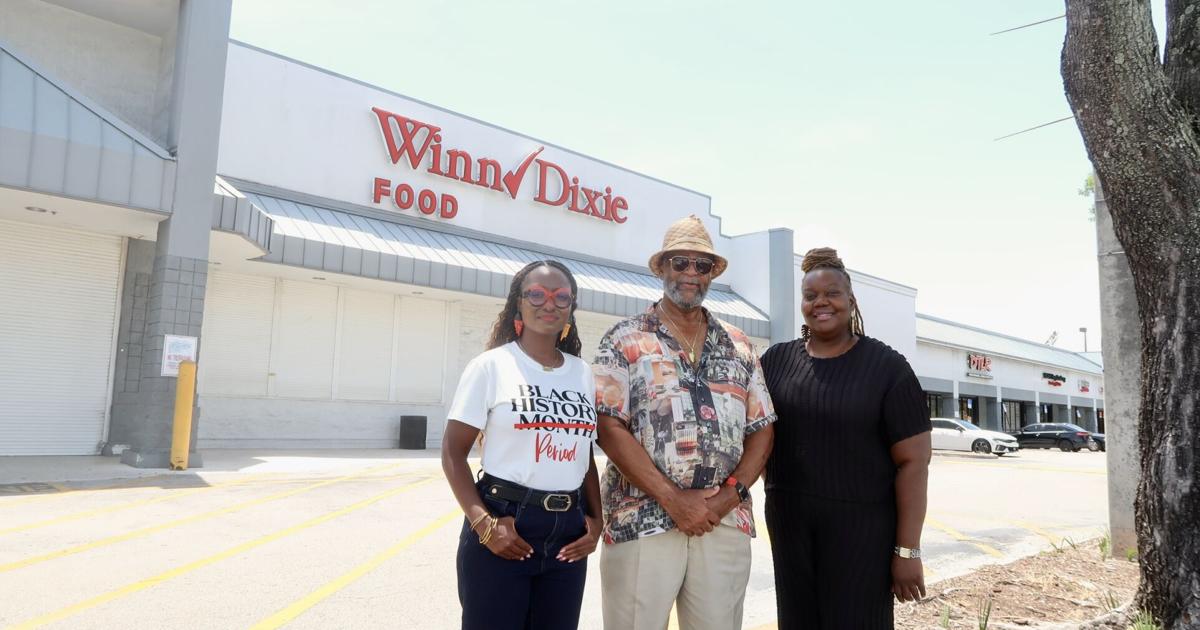
(L-R) Satin Fye, Ronald Frazier and Daniella Pierre.
(Samantha Morell for The Miami Times)
He described how the late Otis Pitts Jr., founder of the Tacolcy Economic Development Corporation, developed Edison Plaza on Northwest 62nd Street and Seventh Avenue, the only shopping center in Liberty City, which included Winn-Dixie. Frazier, chairman and CEO of the BAC Funding Corporation, helped fund the redevelopment after the riot.
A few years later, the grocer moved to its location on 54th Street.
“Winn-Dixie was a mainstay grocery store in this particular area,” Frazier said. “This was Winn-Dixie’s territory, so they had to know the market because they had been here for so long.”

Ronald Frazier stands in front of the shuttered Winn-Dixie store in Liberty City.
(Samantha Morell for The Miami Times)
A call to ALDI
Several residents worry ALDI won’t provide products that are culturally sensitive to the community, especially for seniors, Williams said, whom he describes as “creatures of habit.”
“I’m not saying we can’t evolve,” said Pierre. “I’m just saying we’re used to different types of products. We got a certain type of flavor that we want in our community, and that’s important to us. That’s very important.”
With concerns circling, residents are calling on ALDI to survey the community it plans to one day call home.
“We need to make sure that the residents, the people, have a say in the products that are there,” Pierre said. “If that means ALDI needs to partner with our small, local Black-owned businesses to make certain that the products are there, let’s do that. And I think we can do that … Let’s be intentional with what’s going to be on those shelves.”
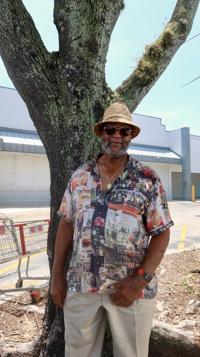
Ronald Frazier, an architect, urban planner, founding member of the Miami-Dade Chamber of Commerce and chairman and CEO of the BAC Funding Corporation.
(Samantha Morell for The Miami Times)
Fye is calling for a town hall with the new grocer. Otherwise, she predicts “a silent boycott, if not an out-loud one.”
“Because we didn’t ask for this, and no one came and spoke to us,” she said.
Though not agreeing to a town hall, Hewitt said customer feedback is welcome.
“We continually evaluate our assortment based on customer demand and feedback and welcome input from Miami shoppers about the products and grocery staples that are important to them,” he said.
King later committed to trying to facilitate a conversation to see “what kind of community partner [ALDI is] going to be.”
The deeper problem

Daniella Pierre, president of the Miami-Dade NAACP.
(Samantha Morell for The Miami Times)
The closure of Winn-Dixie has raised a deeper concern in Liberty City, an area long deemed a food desert.
Residents left comments under a Miami-Dade NAACP Facebook post regarding the Winn-Dixie closure, noting the lack of grocers located directly within their community.
“You go in South Miami, Coral Gables, or any predominantly Hispanic neighborhoods and every two miles there is a Whole Foods, Publix, Milams, etc. But they take the one credible store that we have in our communities,” wrote Crystal Nicole.
“Someone needs to contact Publix and they need to open grocery stores. Why are there no stores in the black neighborhoods?” wrote Lanette R. Jones, sharing a map of four Publix locations near Liberty City’s borders but none within.
Pierre said the community is faced with only two options: eat potentially old or unsafe food, or travel longer distances outside of the neighborhood for healthier alternatives.
“Especially in Liberty City, it’s only certain grocery stores that were able to provide those fresh, quality products for us, because we are a community that is saturated with corner stores,” she said. “And those corner stores, they serve a purpose for some, but they don’t have the fresh, quality foods that bring wellness to all.”
Pierre hopes any conversations that result from the Winn-Dixie closure also address the wider issue of food access in Liberty City.
“We can not continue to have our community suffer and go without grocers that put products that are healthy and high-quality for all people,” she said.