
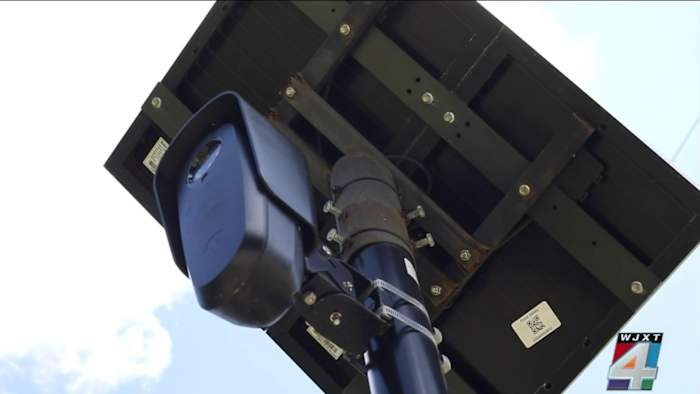
JACKSONVILLE, Fla. – Sheriffs across Florida are pulling automated license plate readers off state roads after the Florida Department of Transportation revoked the permits that allowed the cameras to operate on state property. The move follows pushback from Gov. Ron DeSantis, who questioned where the data collected by the cameras was going.
The decision affects hundreds of cameras across Northeast Florida, including 141 fixed cameras and nine mobile readers operated by the Jacksonville Sheriff’s Office, 157 cameras in Clay County, 180 in St. Johns County, and 34 in Nassau County. Sheriffs in Jacksonville, Bradford, Clay, and Nassau counties have all said they will remove the cameras within a 30-day window.
A tool credited with catching an accused killer
Nassau County Sheriff Bill Leeper, who has been in law enforcement for nearly 50 years, calls the technology a game changer.
“Technology is always changing and this is, really right now, a game changer for law enforcement to benefit our community and keeping our community safe,” Leeper said.
Leeper says the cameras proved their value in a recent high-profile case. After accused killer Christian Barrios allegedly shot and killed Melissa Wood and Jason Chatham in St. Johns County in March, he stole a car and fled to Nassau County. Cameras in a crime scene tracking room picked up a hit on the car’s plate, leading deputies directly to Barrios, who had ditched the vehicle and run into the woods.
“That’s a case where we would not have caught him that quickly had it not been for these cameras,” Leeper said. “The benefits are just tremendous.”
DeSantis raises data privacy questions
DeSantis has not disputed the cameras’ effectiveness, but raised concerns about data collection.
“There’s probably times when it’s been useful, but where is this data going?” DeSantis said.
The company behind the cameras
Flock Safety CEO Garrett Langley, a Georgia Tech graduate, started the company after crime in his Atlanta neighborhood left residents frustrated.
“In my neighborhood in Atlanta, we were frustrated. Crime was happening and we felt police couldn’t do anything,” Langley said.
Flock Safety cameras are now in more than 120,000 locations across 49 states, making them the most widely used license plate reader in the country. Langley pushed back on common misconceptions about the technology in a recent interview with News4Jax sister station WDIV in Detroit.
“When did you guys do facial recognition? Ma’am, we don’t do facial recognition. But do you sell the data? We don’t sell the data. We don’t own the data. Our customers do,” Langley said. “I’ve found that once people choose to see the truth, they feel that this is a very good tradeoff — because at the end of the day, we have to find a society where safety and privacy can co-exist.”
Residents push back
Not everyone is convinced. St. Johns County resident Debra Campbell celebrated the news that sheriffs were pulling the cameras.
When asked whether people who have nothing to hide should have concerns, Campbell was direct.
“I don’t have to be doing anything wrong to want my own privacy, to want my children’s privacy,” Campbell said. “I’m a law-abiding citizen, but I also have constitutional rights along with the rest of us Americans, and those are being forfeited under the guise of safety.”
What taxpayers are paying
News4JAX reached out to all four counties to find out how much the cameras cost taxpayers. Here is what we know so far:
Nassau County: $98,000 per year for 34 cameras
Clay County: Nearly $609,000 budgeted for cameras and maintenance in the 2025-26 fiscal year for 157 cameras
Jacksonville Sheriff’s Office: Cost not yet available (150 total cameras)
St. Johns County: Cost not yet available (180 cameras)
News4JAX is still waiting to hear back from Jacksonville and St. Johns County officials on their costs.
It remains unclear exactly how long the full removal process will take across all four counties.
Copyright 2026 by WJXT News4JAX – All rights reserved.