
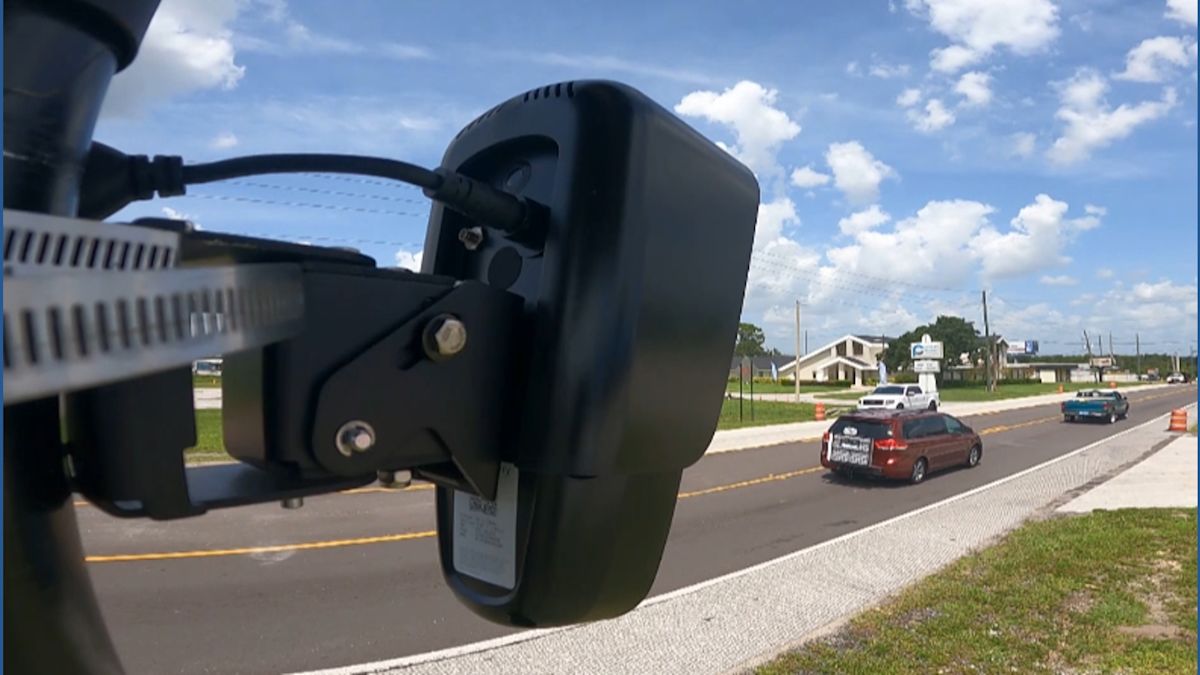
Tampa police announced Tuesday that they will remove 17 automated license plate readers from state roads within the city, becoming the latest local agency to respond to Florida’s new order requiring the cameras to come down from state highway rights of way.
In a statement, Acting Tampa Police Chief Brett Owen said the department will “continue to evaluate new technologies with our ongoing focus on community trust, strict oversight, and transparency.”
The department said measures are in place to prevent the current technology from being misused by members of the agency.
The move comes as law enforcement agencies across the Tampa Bay area work to comply with the state’s decision to pull automated license plate readers, including Flock cameras, from state roads within 30 days.
The key distinction is where the cameras are located. The state order applies to cameras in state highway rights of way, but agencies can continue using them on local roads and private property.
In Pasco County, officials are removing roughly 60 cameras from public roads while about 110 cameras on private property will remain. Hernando County is also removing cameras from public rights of way while keeping about 20 cameras on commercial and private property.
Pinellas County, Hillsborough County and St. Petersburg are reviewing the locations of cameras in their Flock programs.
Florida Attorney General James Uthmeier said the state is now considering additional legislation aimed at preventing potential abuses while preserving what he described as legitimate uses for the technology.
“I think that there were a lot of abuses,” Uthmeier said. “We’ve all heard the stories where some officers were spying on ex-girlfriends or tracking people.”
Uthmeier said he believes the technology has sometimes been used too broadly.
“I do think that these things were overly, broadly used all over the country, in many communities, and I think that goes too far,” he said.
He said he expects to work with Gov. Ron DeSantis and the Legislature on new protections, including restrictions involving how companies handle the data collected by the cameras.
“We should not have private companies out there that are monetizing, selling or widely disseminating data outside of its purpose,” Uthmeier said. “Data should not be stored for long periods of time.”
Still, Uthmeier said he does not want to eliminate the technology entirely.
“There are legitimate uses,” he said. “It does save lives and put bad guys away. But we need to make sure that it’s limited to those uses.”
Some local agencies are also confronting the financial consequences of the state’s order. Agencies with multiyear contracts with Flock may move cameras to locations that are not state-owned rather than abandon the equipment.
Law enforcement officials also point to recent cases in which the cameras provided critical investigative leads.
Last month, Treasure Island police said Flock cameras helped identify a suspect vehicle in a multimillion-dollar scam. Investigators initially had little more than a description of a white pickup truck.
Treasure Island Police Chief John Barkley said the technology helped officers narrow their search.
“If not for the Flock cameras, all we had was a white pickup truck,” Barkley said. “Well, how many white pickup trucks do you think there are in Florida?”
Barkley called the cameras “a game changer,” but emphasized that they are an investigative tool rather than a replacement for police work.
“We can’t make an arrest with a Flock camera,” he said. “But if not for Flock, it would be a lot of investigative leads that we wouldn’t have. We would have a dead end.”
Polk County Sheriff Grady Judd also defended license plate readers, saying they help deputies find wanted suspects and missing people.
“I think there’s a lot of misunderstanding about license plate readers,” Judd said. “They do not violate anyone’s privacy. They are not in the private space. And all we do is look for bad guys and look for Alzheimer’s patients that are missing and try to keep you safe.”
The debate over potential misuse has intensified after at least two recent cases in the Tampa Bay region involving police officers accused of improperly accessing the Flock camera system.
One officer in Haines City and another in Sarasota were fired and arrested after authorities alleged they used the technology to track romantic interests.
DeSantis has cited concerns about widespread surveillance and questions about how private companies handle the data.
“What we don’t want in the state of Florida is to have a digital AI surveillance state where everything we’re doing is being tracked at all times,” DeSantis said.
The governor acknowledged that license plate readers can be useful but questioned where the data goes and whether anyone is adequately monitoring companies that collect it.
The policy shift also follows significant state investment in the technology.
Over the past year, the DeSantis administration approved about $2.5 million in state immigration grants to help six local agencies purchase and integrate Flock equipment.
Now, cameras covered by the state’s new restrictions and located along state roadways must be removed, while agencies and state lawmakers continue to debate where the line should be drawn between public safety and surveillance.
Uthmeier said any future legislation will require that balance.
“We need to put bad guys away,” he said. “But we also need to make sure that these things are not all over communities. That is wrong.”