
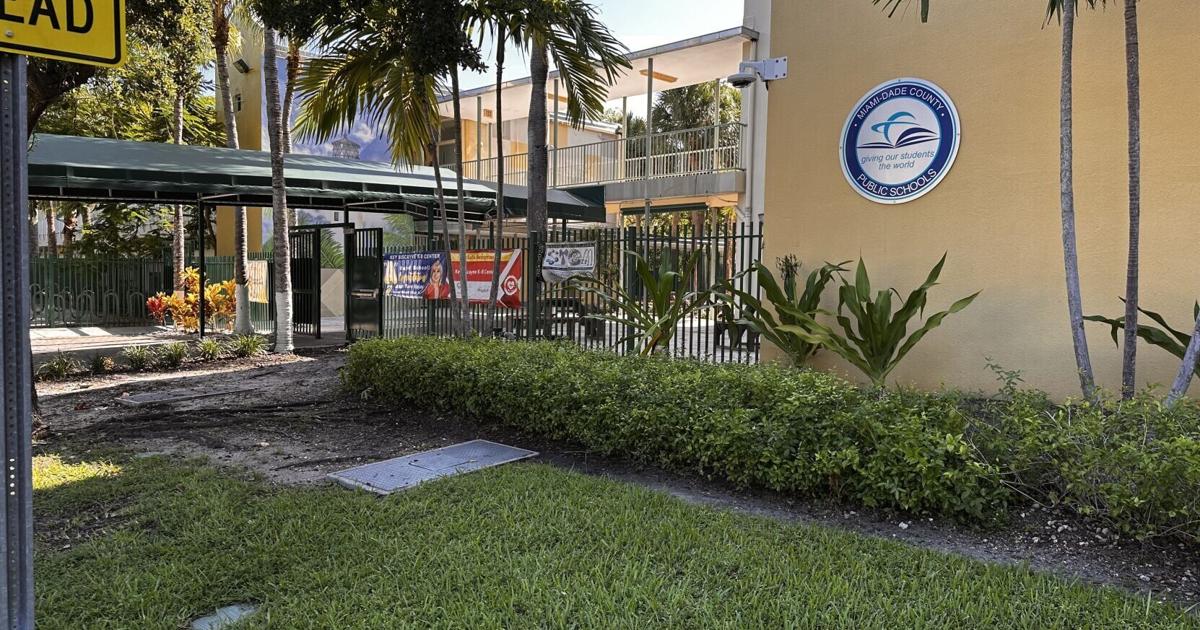
Consistent student population decline in grades 6-8 at the Key Biscayne K-8 Community Center has sounded alarms in recent years, especially these days when just 12 students are enrolled in sixth grade there and 52 make up the entire middle school group.
Now, Village Education Advisory Board (EAB) Chair Robert Duzoglou has some suggestions, starting with asking the Council’s support to pull back on part of its inter-local agreement with MAST Academy that would optimize, or even prevent middle school students from transferring there until ninth grade, but still be guaranteed one of the 1,100 seats the Village gets.
Based on data from the K-8 Center. and a chart shown to Council members last week, the drop-off in enrollment correlates with classroom proficiency as well.
“It’s like a tale of two schools,” Duzoglou said. “Elementary, PK through 5 is strong and growing, but the grades for the middle school, 6-8, are terrible. Why is this sudden drop happening?”
According to state assessment proficiency scores in a chart, he showed:
• Math: 90% are above par in PK-5, while 70% are below in grades 6-8
• Reading: 78% are above par in PK-5, while 58% are below in grades 6-8
• Science: 61% are above par in PK-5, while 34% are below in grades 6-8
Duzoglou said students are still learning year-round.
“Parents are not choosing to leave public education, just leaving this particular school,” he said, “It’s an exodus to MAST, in particular.”
The 52 students in grades 6-8 make up just 10% of the total K-8 school population.
So, what happens when there is a shortage of students?
“Funding in this state follows population enrollment; if the funding disappears, programming falls apart,” Duzoglou said. “We have to look at the pipeline.
“We have a decision to make. If we don’t take action, it’s going to die,” he said, emphatically.
There are no similar signs of enrollment decline in grades 1-5:
• Grade 1: 107 students
• Grade 2: 87 students
• Grade 3: 111 students
• Grade 4: 144 students
• Grade 5: 136 students
Duzoglou said the EAB has done a “tremendous amount” of communication with the community. There have been parents’ surveys and teacher surveys, a very engaged parent-teacher support group, and together collaborated on a couple of ideas.
There already have been some positives in the wake of the declining enrollment.
For example, there’s a new computer lab that has been updated; a resident donated $12,000 toward new computers; the playing field has a new scoreboard; and there’s been a great deal of work done with the surveys with a deep analysis of a proposed project list.
Equally important is the fund-raising capabilities. Duzoglou called the new principal, Evie Mayor, “just incredible,” and at a recent fair, $11,000 was raised “because people wanted to dunk her (in the water tank).”
Duzoglou showed Council members a long “want” list that would cost an estimated $635,000 to fulfill all of the needs. The good news is that the PTSA has agreed to nearly triple their fund-raising efforts and are committed to raising $324,000 this year.
“Listen, if you want a high-quality school, you can’t just go with county (about 46% of ad valorem taxes go to public schools) and state funding, you gotta do more,” he said. “I know a couple of schools in our district are raising $1 million a year, apart from the taxes.”
In looking at the lower state assessment proficiency scores for grades 6-8, Councilman Ed London said he didn’t see those numbers going up anytime soon.
“Are you trying to keep the school open for people who can’t get into MAST?” London asked.
Duzoglou said “no,” later adding that, “By the time you get done with middle school, you already have several credits in high school. We don’t have that availability (right now). If we create that. … If the program is good enough, they’ll stay.”
The idea of transferring to MAST comes with proximity; getting that false sense of getting in early to make sure the student will be enrolled there for the high school grades; or just wanting to share classes with their friends and not feel left out.
But, some parents, Duzoglou said, don’t want their junior high kid mixing with high school-level thinking yet, and “we are much better with special needs or special education (at the K-8). None of that service exists in MAST.”
Duzoglou’s bottom line to Council?
Support the K-8 and look at the inter-local agreement really hard for the first time in 12 years and support a discussion with MAST Academy, and he’s asking Council to repeat the $50,000 budget item as this past year (the First Budget Hearing is Sept. 8) “in hopes of going to $140,000” to help boost the school curriculum.
“The goal is to not let (the middle school) die,” Duzoglou said.