
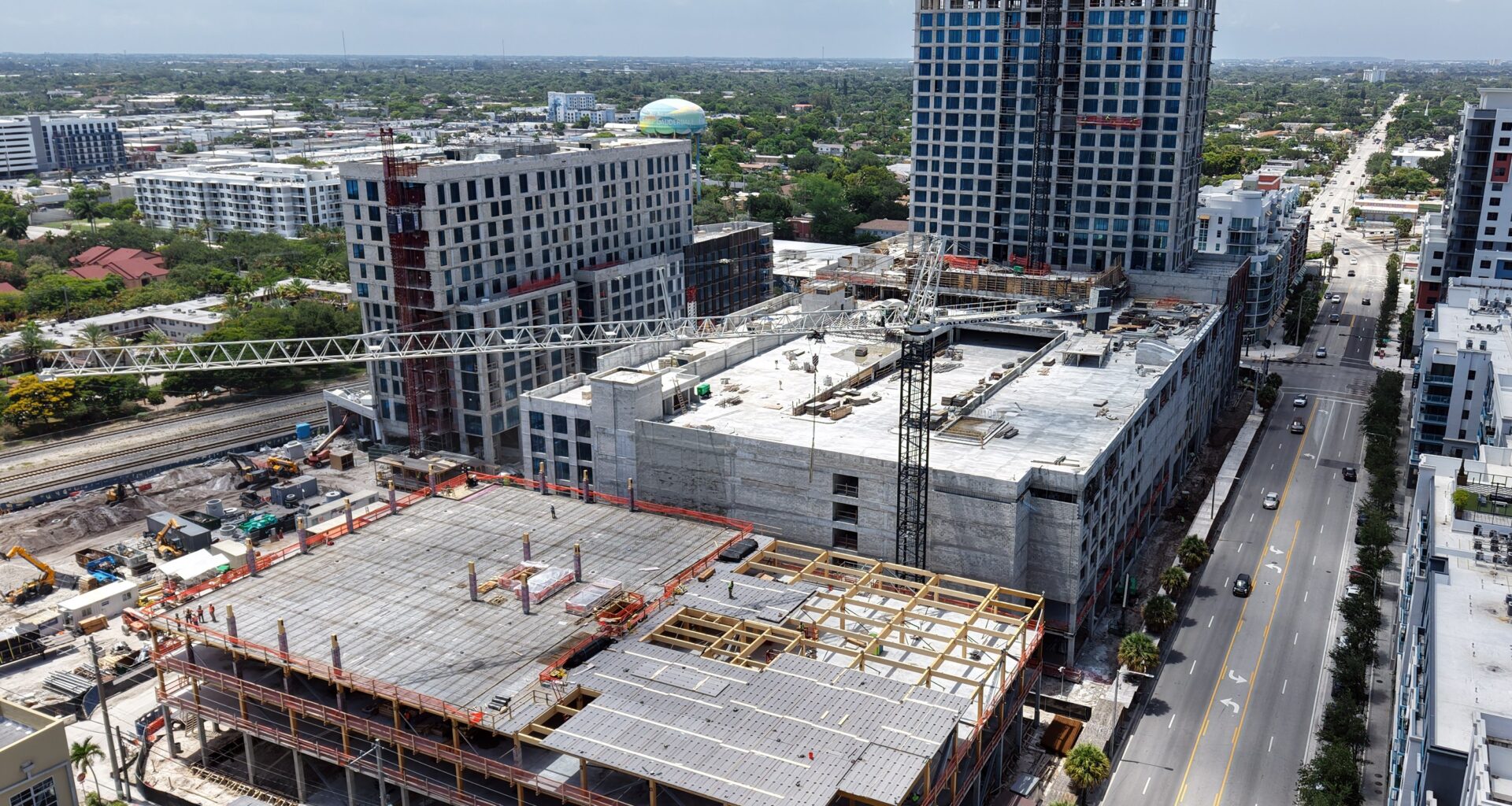
In milestone firsts for Fort Lauderdale’s T3 FAT Village project, the Fortune 500 firm GXO Logistics and the CB Workplace Solutions design firm have become the initial tenants to sign up for office space at the innovative mixed use enclave along Andrews Avenue and south of Sistrunk Boulevard.
Based in Greenwich, Connecticut, GXO Logistics is a publicly traded company with a listing on the New York Stock Exchange. It intends to use 35,000 square feet of space to support its Americas-Asia Pacific region.
GXO Logistics bills itself as “the world’s largest pure-play contract logistics provider and is positioned to capitalize on the rapid growth of e-commerce, automation and outsourcing.” GXO says it employs more than 150,000 people at more than 1,000 facilities in 27 countries. A reported 150 people will occupy its space in FAT Village.
CBI, a national firm founded in North Carolina in 1993, is moving its Fort Lauderdale operation from a Las Olas Boulevard location.
Both moves will occur next year.
The impending arrival of GXO in the city’s Flagler Village section north of the Las Olas Boulevard business district is a byproduct of a yearlong recruiting initiative by Broward County and its economic development arm, the Greater Fort Lauderdale Alliance.
“Broward County is home to a multi-billion global logistics industry where GXO will benefit from our established infrastructure, exceptional talent pool, pro-business climate, and geographic proximity to international markets and Latin America,” added Bob Swindell, president and CEO of the alliance, which helped GXO map its expansion in Fort Lauderdale.
“GXO’s new regional headquarters at T3 Fat Village is a testament to the location’s incredible appeal and further distinguishes Fort Lauderdale as a premier destination for high-value targeted industries and the high-value jobs they create,” Broward County Mayor Mark Bogen said.
“T3 Fat Village is a transformational mixed-use and class AA office space location — the first of its kind in Florida — that is positioned to draw top companies and talented professionals from across industries, fueling continued economic growth and job creation in Broward County,” he added. “Results like these come from sustained recruiting and follow-through by Broward County partners and leaders who keep driving meaningful investments in our region.”
In the same statement, Fort Lauderdale Mayor Dean Trantalis said GXO’s decision to locate in the city shows “great confidence in our city as a leading corporate location across a diverse set of industries and will surely kick off a cascade of new arrivals.”
From top-off to tenants
The T3 FAT Village project celebrated its topping off in October 2025. In a statement at the time, co-developers Hines of Atlanta and Urban Street Development of Fort Lauderdale said the event marked “a significant milestone in Fort Lauderdale’s dynamic arts and innovation district.”
The development contains the region’s “first mass timber office building” with an objective of redefining “sustainable office design while honoring the artistic roots of the area.”
“The six-story, 180,000-square-foot T3 FAT Village is designed to cater to the evolving needs of forward-thinking companies, integrating cutting-edge technology with environmentally conscious design,” the developer said. “It aims to foster an environment of wellness, collaboration, and creativity among tenants. This innovative building is the cornerstone of a larger redevelopment plan that includes residential, retail, and cultural spaces, designed to create a vibrant and walkable neighborhood.”
Tucked between Andrews Avenue and the Florida East Coast Railway tracks below Sistrunk Boulevard, the $500 million “FAT Village (Food, Art and Technology) rose in the form of a timber-supported office building and other structures designed to house residences, retail and places for artists to do their work. The entire project encompasses a 5.6-acre, 835,000-square-foot, office, retail and residential mixed-use urban destination
More than 600 apartments are allocated between two towers, one with 24 floors standing 270 feet high and the other with 13 floors standing 161 feet high.
A third 83-foot tower will have office space for young professionals among six floors. A fourth tower with 257 apartments and 25 floors would be the tallest high-rise at 305 feet.
As part of a second phase, the last tower could become a hotel or a second office tower, depending on market needs.
Construction was scheduled for completion this year “with the full master plan expected by 2027.”