
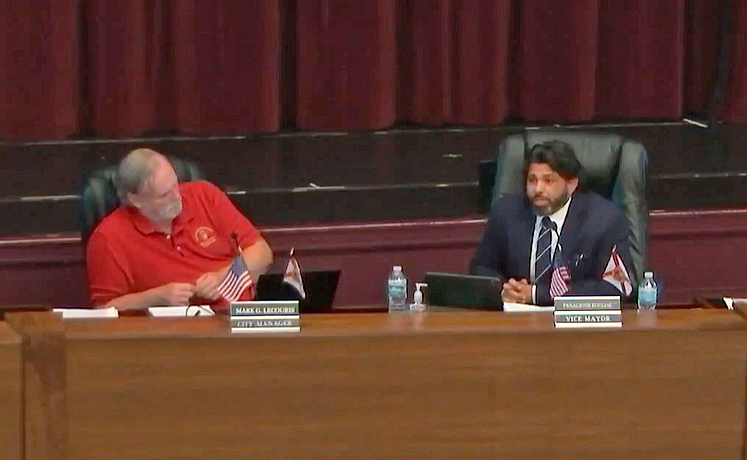
A Tarpon Springs commission meeting Aug. 25 erupted into personal insults, accusations of political maneuvering and an unsuccessful attempt to strip the city’s vice mayor of his leadership post, laying bare the hostility among members of the five-member board.
The confrontation did not grow out of an ordinance, development proposal or other item commissioners were scheduled to decide. It broke loose during commissioner comments, a portion of the meeting that allows board members to raise matters not otherwise on the agenda.
Vice Mayor Panagiotis Koulias used his comments to answer criticism from Commissioner Michael Eisner over his recent absences from city meetings. His response quickly widened into grievances over spending, previous commission decisions and the conduct of fellow commissioners, with members interrupting one another and Mayor John Koulianos repeatedly trying to restore order.
Commissioner David Banther summed up the scene from the dais after the eventual vote.
“I was used as a lynchpin in this Jerry Springer show,” Banther said. “I’m done with this. I’m absolutely done with how this board operates.”
He also called the proceedings a “three-ring circus.”
Koulias directed much of his criticism at Eisner. During his commissioner comments, he attacked Eisner’s positions on city spending and other decisions before calling him the “putz of putzes,” a “lame duck” and a “selfish narcissist.”
“So, you can come at me anytime you want,” Koulias said. “But I’m going to stand firm. I’m going to represent the citizens of Tarpon Springs.”
The confrontation shifted toward Commissioner Lori Weaver after Koulias suggested she and Eisner had acted together and raised the possibility that their conduct implicated Florida’s Sunshine Law. Weaver called a point of order and accused Koulias of breaking the commission’s rules.
“I’ve just listened to a tirade that was … it’s embarrassing,” Weaver said during the meeting. “There’s rules of procedure. You signed them. Do they not mean anything to you? We all signed them.”
When Weaver said she did not believe Koulias was fit to serve as vice mayor, the exchange became even more personal. Koulias called her a “space cadet,” prompting Koulianos to repeatedly tell him to stop the personal attacks.
Weaver then moved to remove Koulias as vice mayor, citing “his behavior tonight and previous behavior and an unexcused absence.” Eisner seconded the motion.
“We all signed rules of procedure,” Weaver said while explaining her motion. “The vice mayor has obviously broken them. There has to be a consequence. We do not allow this behavior from staff. We cannot allow it here on the dais.”
The commission adopted its current Rules of Procedure in June 2025. The document assigns the mayor responsibility for maintaining order and decorum and includes provisions aimed at preventing attacks on personalities and the impugning of motives. Koulias was among the commissioners who voted to adopt the rules.
Koulias rejected the argument that his criticism justified removing him from the leadership position. During debate over Weaver’s motion, he accused her and Eisner of acting together against him and argued that elected officials must be able to criticize one another.
“If we as board members can’t criticize our fellow commissioners, well then we’re running a dictator,” Koulias said.
Banther found himself caught between objections to Koulias’ conduct and reservations about removing him. During the meeting, he offered to vote against the motion if Koulias apologized to Weaver for calling her a space cadet.
Koulias responded, “I’ll apologize, but her actions need to speak towards being nice towards people. So, I do apologize for that.”
Banther rejected the qualification, saying an apology was lost “as soon as you say but.”
The dispute over Koulias’ attendance also became part of the debate. Eisner criticized him for missing meetings and argued that he had failed to fulfill the responsibilities he believed came with serving as vice mayor. But Eisner also acknowledged during the meeting that the rest of the board had approved Koulias’ absence for two meetings, while Eisner had opposed it. Eisner said Koulias then extended his time away and missed an additional budget meeting.
In a follow-up email to the Catalyst Tuesday, Koulias said he traveled to Greece to accompany his mother back to the country for the first time in 40 years and that his absences had been approved.
“I had excused absences they agreed to,” Koulias wrote. He accused Weaver and Eisner of criticizing him while he was gone “knowing I would respond.”
After lengthy debate over the motion and procedure, commissioners voted. Weaver and Eisner supported removing Koulias as vice mayor. Banther, Koulias and Koulianos opposed it, defeating the motion 3-2.
The vote would not have removed Koulias from his elected commission seat. Commissioners select a vice mayor annually to preside over meetings when the mayor is absent.
The fight over the position unfolded against another political question hanging over the board: whether Koulias will leave his commission seat to run for mayor. During debate over his removal, Koulias acknowledged the possibility.
“There are rumors of me possibly resigning and running for mayor,” Koulias said during the meeting. “I may just stick here.”
Banther also raised the prospect during the live debate, saying he assumed Koulias would resign in October to run for mayor. Banther said he would rather become vice mayor “organically” in that circumstance than receive the position through Koulias’ removal.
In his Tuesday email to the Catalyst, Koulias said he has not decided whether to run and said he has until Oct. 2 to make that decision. He also alleged that the attempted removal was connected to the possibility of a mayoral campaign.
“This whole demotion was about tarnishing my name if I resigned in the near future,” Koulias wrote.
The failed vote did not leave a clean divide between commissioners who supported Koulias and those who opposed him. Banther voted against removing him despite condemning his remarks toward Weaver. Koulianos also voted against removal before using his own commissioner comments to confront Koulias over what the mayor described as a broader pattern of conflict.
“We’ve had more than our share of drama,” Koulianos said during the meeting. “This stuff has got to stop.”
The hostility did not end when the meeting did.
In a separate written response to the Catalyst, Koulias accused Weaver and Eisner of mounting a “pre planned, coordinated, and coerced attack” against him and said their actions gave the appearance of a Sunshine Law violation. Koulias said he does not intend to seek an investigation.
Weaver declined to expand on the confrontation in a follow-up email to the Catalyst, instead pointing to what occurred publicly during the meeting.
“If you watched the meeting you will have seen the disparaging remarks which led me to fall upon the rules of Procedure which governs our body,” Weaver wrote. “The meeting speaks for itself.”
Eisner, in a separate interview with the Catalyst, rejected Koulias’ allegation that the effort was coordinated and described the confrontation as part of a longer-running series of disputes involving Koulias and other members of the commission.
Banther offered a more measured assessment in his own follow-up email. Despite describing the proceedings as a “Jerry Springer show” during the meeting and objecting to Koulias’ treatment of Weaver, he ultimately voted against removing him.
“Matters like this do not always have a clear line that can be drawn,” Banther wrote. “While the rules may appear black and white, their application can often involve shades of gray in such matters.”
Koulianos declined an opportunity to comment further to the Catalyst. But after voting against Koulias’ removal Aug. 25, the mayor made clear from the dais that his vote should not be mistaken for approval of Koulias’ conduct.
Koulianos said the board had experienced “more than our share of drama” during meetings, outside them and elsewhere at City Hall, and warned that he had reached “zero tolerance” for personal insults and attacks on commissioners’ motives.
“This stuff has got to stop,” Koulianos said. “You have to admit that, when you have any reflection, that your behavior has not always been appropriate.”
Then, with the vote over and Koulias still vice mayor, Koulianos acknowledged his own uncertainty about the decision he had just made.
“I’m still torn right now whether I should have or not voted for that.”