
Tampa City Council members grappled on Thursday with a $100.4 million decision that has long divided a flood-prone corner of South Tampa.
The council’s hourslong discussion of the South Howard Flood Relief Project previewed what could likely be a tight vote Sept. 17, when the group will make a final decision on a total cost for the project.
An affirmative vote would propel the initiative into the construction phase. Denial would kill it.
“I strongly want to get to yes on this,” said chairperson Alan Clendenin, likely to be the council’s swing vote. “I’ve always said that I felt like the engineering was good, but I’ve had problems getting to that cost-benefit ratio.”
City engineers argue that adding underground structures along stretches of South Howard Avenue and West Swann Avenuewould suck water away from Parkland Estates, Palma Ceia Pines and surrounding neighborhoods that flood even inshort bursts of rain. Shaped like a giant bowl, the neighborhoods collect water that can’t escape through small, aging pipes.
Flood-fatigued residents have begged for a fix for years and say they support the proposed plan. They crowded the council’s chambers Thursday morning — some, for the second or third time this year — wearing T-shirts that read, “Stop flooding in Parkland Estates and Palma Ceia Pines.”
On the opposing side, agroup of business owners on South Howard Avenue worry street closures could disrupt their shops, offices and restaurants. They are suing the city over public records tied to the project and have proposed alternative routes that would skirt the busy street. Both sides have accused the other of spreading misinformation.

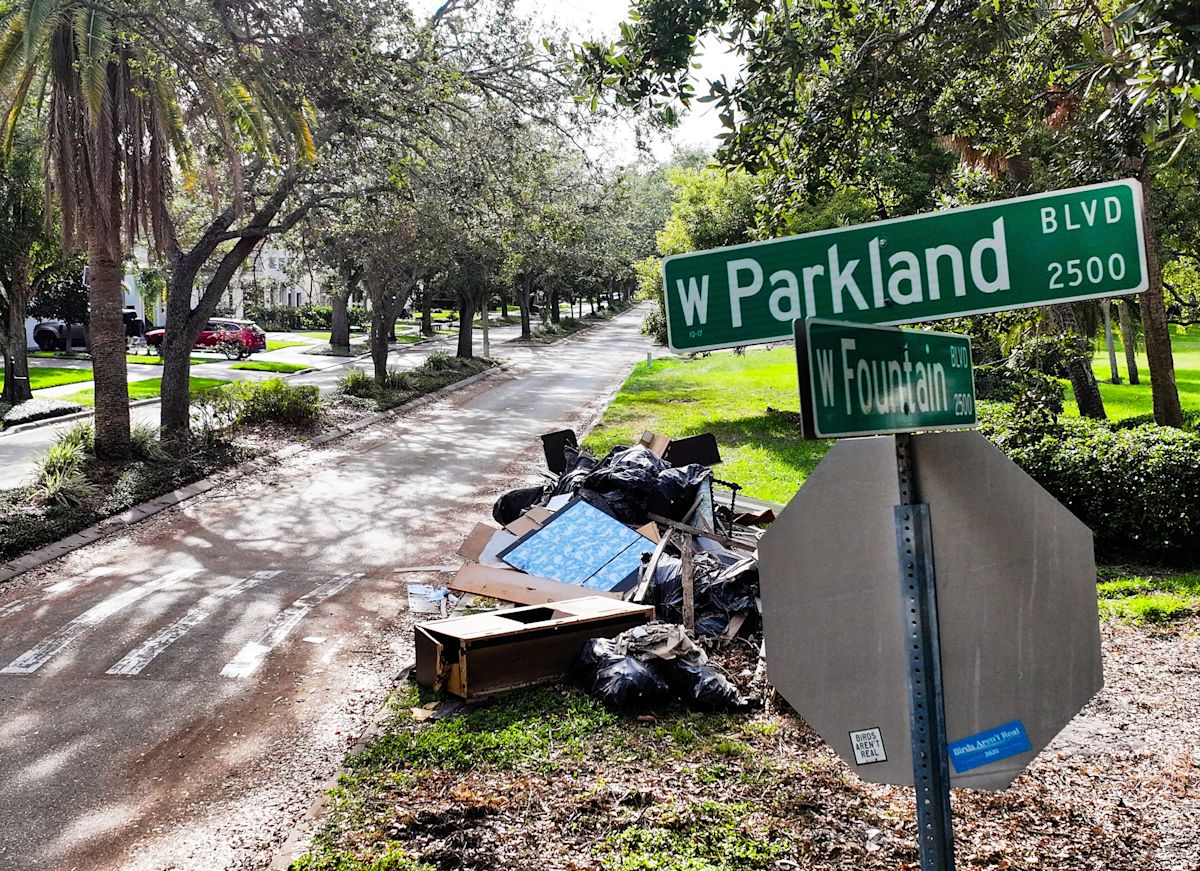
Streets in Parkland Estates flooded during two summer storms last month.
City staff on Thursday presented their final pitch to council members, including a business support plan and a “myth” versus “fact” segment.
Council member Bill Carlson, who has long opposed the effort, questioned why the city would embrace a project that could face lawsuits. The SoHo Business Alliance — the group already engaged in a public records lawsuit against the city — has threatened further legal action to delay the project if it passes, he said.
“If the engineering is perfect and the budget is approved, it appears that litigation will hold this up for years,” Carlson said. “Why wouldn’t the city try to avoid litigation and find some solution because the ultimate thing, as my colleagues have said, is that the neighborhoods deserve to be protected as soon as possible?”
“People threaten to sue us on just about everything,” responded Brandon Campbell, the city’s mobility director.
At a news conference this week, representatives for the business group presented more than a dozen reasons why the city should abandon the project in its current form.
Engineer David DeLoach, hired by the business alliance, pitched an alternative route on behalf of the business group that he said would be faster, cheaper and avoid South Howard altogether. His plan would involve underground storage vaults in the affected neighborhoods and upgrades to an existing drainage system.

At a news conference on Tuesday, lawyer Ed de la Parte presented more than a dozen reasons why officials should not approve the project. He serves as general counsel for the SoHo Business Alliance.
But Brad Baird, Tampa’s infrastructure and mobility administrator, told council members, “Many red flags jump off the page on this alternative.” The plan would not meet the city’s flood relief goals, he said, and would require more construction.
While Carlson was resolute, Clendenin teetered.
He wants to support the project, he said, but has questions that need answering before Sept. 17. Among them is the engineers’ plan to build below railroad tracks that slice across South Tampa. He has also questioned the cost, which ballooned from $64 million in 2022 to more than $100 million this year.
Council members in two weeks will vote on a $92.7 million guaranteed maximum construction price. That number does not include $7.7 million already approved for design.
“I really want to provide flood relief to these neighborhoods,” Clendenin said. “Before we vote on a contract of $100 million, we need to make sure that we know what we’re voting on.”