
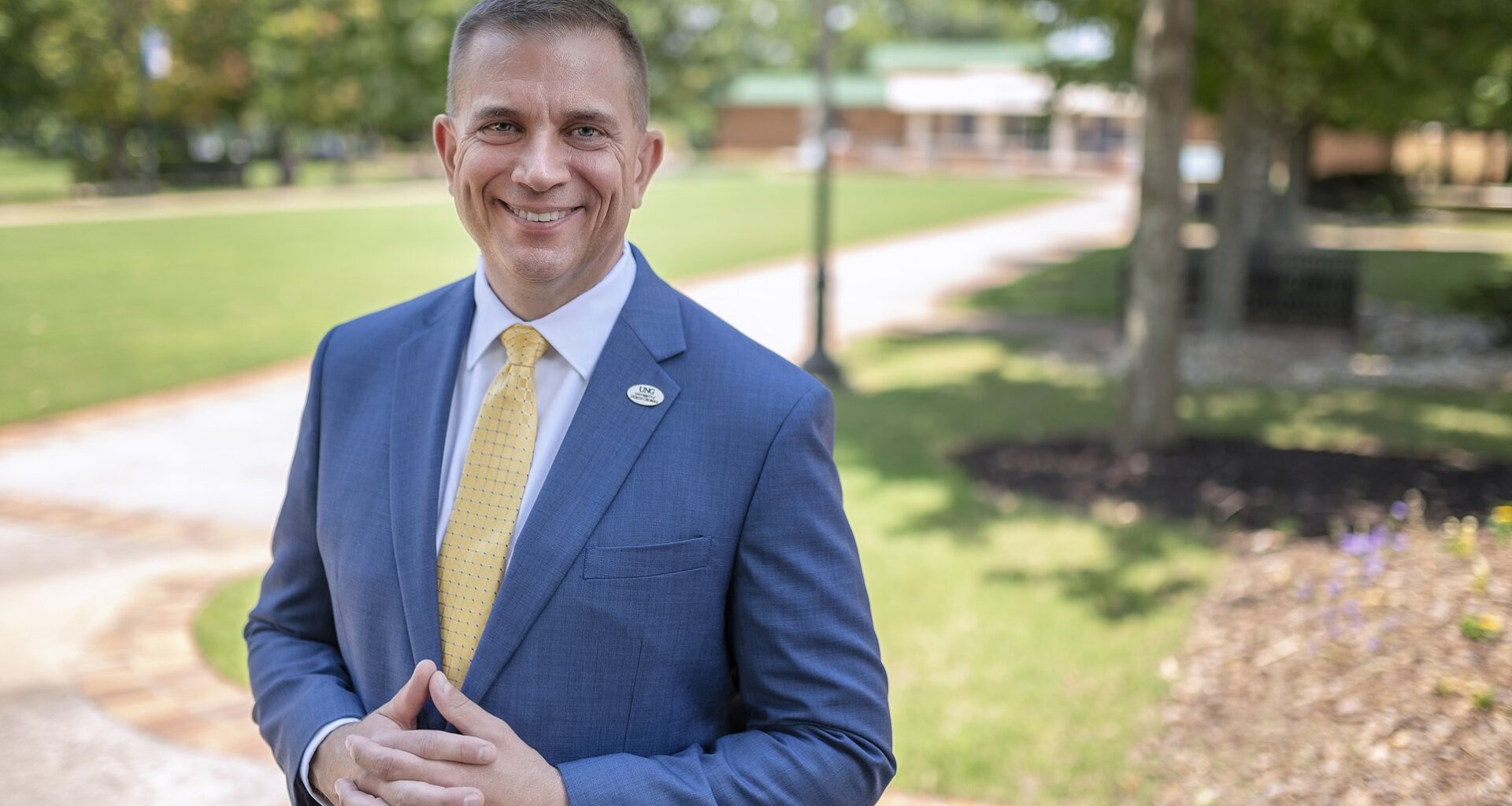
The University of North Florida Presidential Search Committee has named University of North Georgia President Michael P. Shannon as the sole finalist for UNF’s eighth president position. The decision has drawn both pushback from UNF faculty and mixed insight from Shannon’s current institution.
The selection of a sole finalist from an initial pool of 152 candidates has intensified concerns among UNF faculty, who are questioning the search process’s transparency and Shannon’s academic credentials and administrative background, according to anonymous questions gathered by the UNF Faculty Association.
“Faculty fear retribution for speaking out,” said Michelle DeDeo, a UNF professor of mathematics.
The selection timeline, outlined in a campus-wide email from presidential search committee chair Jack Boyle, began with eight semifinalists. While seven advanced to in-person interviews in late July, the process narrowed when three of the four chosen finalists withdrew. After a failed attempt to recruit additional candidates, Shannon emerged as the sole individual willing to proceed.
UNF has scheduled hybrid campus forums for faculty to meet with Shannon on Sept. 9-10. The university’s Board of Trustees will interview him and deliberate during a public meeting on Sept. 16, with final confirmation required by the Florida Board of Governors.
Mixed reactions to Shannon’s leadership
Shannon, a U.S. Army veteran who assumed leadership of UNG in 2023, announced his candidacy for UNF to his current campus community in an email. In the message, he described the opportunity as the next step in a journey “riddled with experiences, opportunities, decisions, successes, failures and challenges.”
“This afternoon, the University of North Florida will announce that I have been advanced as a finalist for consideration to serve as its eighth president,” Shannon wrote, adding that the choice to pursue the role was the most difficult decision of his professional life.
At UNG, faculty members described Shannon as a “mentor for leadership” who “understands how to deal with all stakeholders”.
Supporters highlight stability and vision
Jamie Mitchem, a scribe on the UNG Faculty Senate, stated that Shannon always treated colleagues with respect and led with “a steady vision and an infectious amount of energy.” Mitchem stated that UNF “will be lucky to have him.”
“I appreciated his willingness to have conversations about creating shared governance guidelines on a complex 5-campus university,” Mitchem stated. “I have personally thought of Dr. Shannon as a mentor for leadership and character development.”
Matthew Boedy, a faculty member at the Georgia institution, stated that Shannon’s military history and past experience at the Georgia Institute of Technology made him a strong fit for his current role.
“I learned quickly that his skills at vision and goal setting showed he was not long for this place,” Boedy stated. “He came in with ambitious ideas and a wide scope of engagement with stakeholders; I think he understands how to deal with all stakeholders, including local politicians.”
Boedy also stated that Shannon’s “skills at vision and goal setting” are signs of a rising star, adding that his military background would likely serve him well in a city like Jacksonville. However, Boedy questioned whether Shannon would remain at the Florida school for more than a “few years”.
“It seems strange to see him apply for a new job when he’s only been here a short time, but I think the combination of his own desired career path and the retirement of the [Georgia] system’s chancellor in April created a moment in time to move,” Boedy stated. “I doubt if he gets the job at UNF he will stay more than a few years if he has the same level of success he had at UNG.”
While at UNG, Shannon “strengthened student retention” and surpassed 20,000 students for the first time in the university’s history, according to a campus-wide email to UNF.
Current faculty question leadership
Shannon’s leadership style has also drawn scrutiny from his current campus, according to one UNG professor who requested anonymity for fear of retaliation.
The professor stated that while Shannon “mitigated some of the worst attacks on academic freedom” by the state government, his approach aligns with a “neoliberal vision of higher education” that emphasizes privatization and external fundraising.
“The UNF community could do worse than President Shannon, who seems to be a man of honor, no doubt inspired by his military history,” the professor stated. “That said, his leadership style clearly appeals to the state legislatures and Boards of Regents/Governors of Georgia and Florida, both publicly pushing to curtail academic freedom and shared governance, and who seek to enact the most neoliberal vision of higher education possible with an emphasis on privatization and external fundraising.”
“The unfortunate reality of higher education administration is that those running universities are political appointees, put in place to take the most extractivist approach to governance possible,” the professor stated. “They prioritize the profit of external entities and investors, and will stay only until they clear their own retention bonuses or the political winds change.”
The professor also alleged that communication with Shannon often occurred off the record, suggesting that public records were largely ignored to satisfy state lawmakers’ objectives.
“While again there is much to commend, including his availability to students, faculty, and staff, one might expect that communication to occur off the record and what little is put on the record to largely be ignored for the sake of state lawmakers’ marching orders,” the professor stated.
While supporters point to Shannon’s military background as an asset for stability, those same qualities and his administrative trajectory are the primary source of concern for many faculty at UNF.
Transparency and the search process
UNF faculty members are also questioning the mechanics of the selection process itself, according to a compiled list of anonymous faculty questions from the UNF FA.
“Another ‘sole’ candidate for the top job at UNF? Why did UNF’s Board of Trustees spend tens of thousands of dollars for a search firm if this is the best they can do?” an anonymous faculty member asked.
UNF used Funk Associates to recruit and vet candidates for this presidential search, but the BOT still makes the final selection and advances finalists like Shannon.
An anonymous faculty member also asked whether the committee was pressured to advance a single candidate to satisfy the political preferences of the Florida BOG.
“How did the committee come to just one candidate for the role of the next UNF president? Such a lack of choice suggests either that UNF couldn’t attract a broad and diverse set of finalists or worse, that the committee has been pressured to push forward one person who might appeal to a far-right BOG. What reason did the three candidates who withdrew from the process give for exiting the application process? What insights did the search committee gain from these withdrawals? And how are those insights being utilized to prepare for the next search,” an anonymous faculty member stated.
Shannon’s emergence as the sole remaining candidate points to an increasingly controversial pattern across public universities in the state.
Under Florida Statute 1004.098, enacted in 2022, the identities of university presidential applicants remain strictly confidential and shielded from public records requests. The law mandates that names are only unsealed once an official list of finalists is released, at least 21 days before final interviews.
Because three of the four selected finalists withdrew before that 21-day public window opened, their identities and specific reasons for exiting remain legally protected behind a wall of corporate and state confidentiality.
Debating credentials and institutional fit
Beyond the process, staff also voiced concerns regarding how Shannon’s professional experience aligns with UNF’s long-term institutional goals, according to the anonymous questions.
A central point of contention among the faculty is the contrast between UNF’s academic ambitions and Shannon’s current institutional metrics.
Under the Carnegie Classification of Institutions of Higher Education, universities are categorized by their research output, with R1 denoting “very high research activity” and R2 representing “high research activity.”
While UNF currently holds R2 status and has active strategic plans to elevate its national research profile, Shannon’s current institution, UNG, is classified as a regional Master’s Colleges & Universities institution and does not hold an R1 or R2 research designation.
Furthermore, data from the U.S. Department of Education indicates that UNG’s graduation rate as a four-year university is 39 percent, while the midpoint for four-year colleges is 59 percent.
This gap prompted criticism from UNF faculty members who worry the selection could jeopardize the university’s upward trajectory, especially following recent national recognition.
“Time Magazine just placed UNF 58th among public colleges in the United States. Why would the BOT forward a candidate for our president who doesn’t even lead an R2 university, let alone an R1. Why would the BOT forward a candidate for our president whose six-year graduation rate is 37.3%? How would we expect to improve our R2 status or graduation rate with these types of numbers? This is going backwards, not forwards. This candidate seems like the worst possible candidate to move UNF forward in these two important areas,” an anonymous faculty member stated.
These faculty concerns extend to Shannon’s personal academic credentials. UNF faculty members raised objections to his lack of traditional academic tenure, according to the anonymous questions.
“It would appear from his CV that Dr. Shannon has held various assistant, visiting, or adjunct professor positions on occasion, but has yet to be subjected to the tenure or post-tenure process, as his CV lists his highest academic rank as “Assistant Professor.” How did the search committee rationalize moving him forward knowing that he will be participating in the tenure and tenure review process with so little experience in this process himself?” an anonymous faculty member stated.
Shannon’s cover letter and letter of intent, submitted to the UNF BOT, are publicly available for viewing.
For UNF faculty, this alleged gap in academic leadership experience, coupled with the financial contrast of his potential $1 million to $1.4 million salary, nearly double the starting salary of his predecessor, Moez Limayem, has fueled a narrative that Shannon may not fully represent the university’s academic mission, according to anonymous faculty questions.
“Given that Dr. Shannon’s current salary is $360,200 and Dr. Limayem’s starting salary was $525,000, how does the BOT justify a starting salary range being offered between $975,000 to $1.3 million?” an anonymous faculty member stated.
On Wednesday, Sept. 16, the UNF BOT will interview Shannon and deliberate during a public meeting in the Talon Room on the fourth floor of Osprey Commons, Building 16. The Florida BOG must confirm a presidential selection.
Updates about the search process and more information about Shannon are posted on the Presidential Search page on UNF Central.
For more information or news tips, or if you see an error in this story or have any compliments or concerns, contact [email protected].