
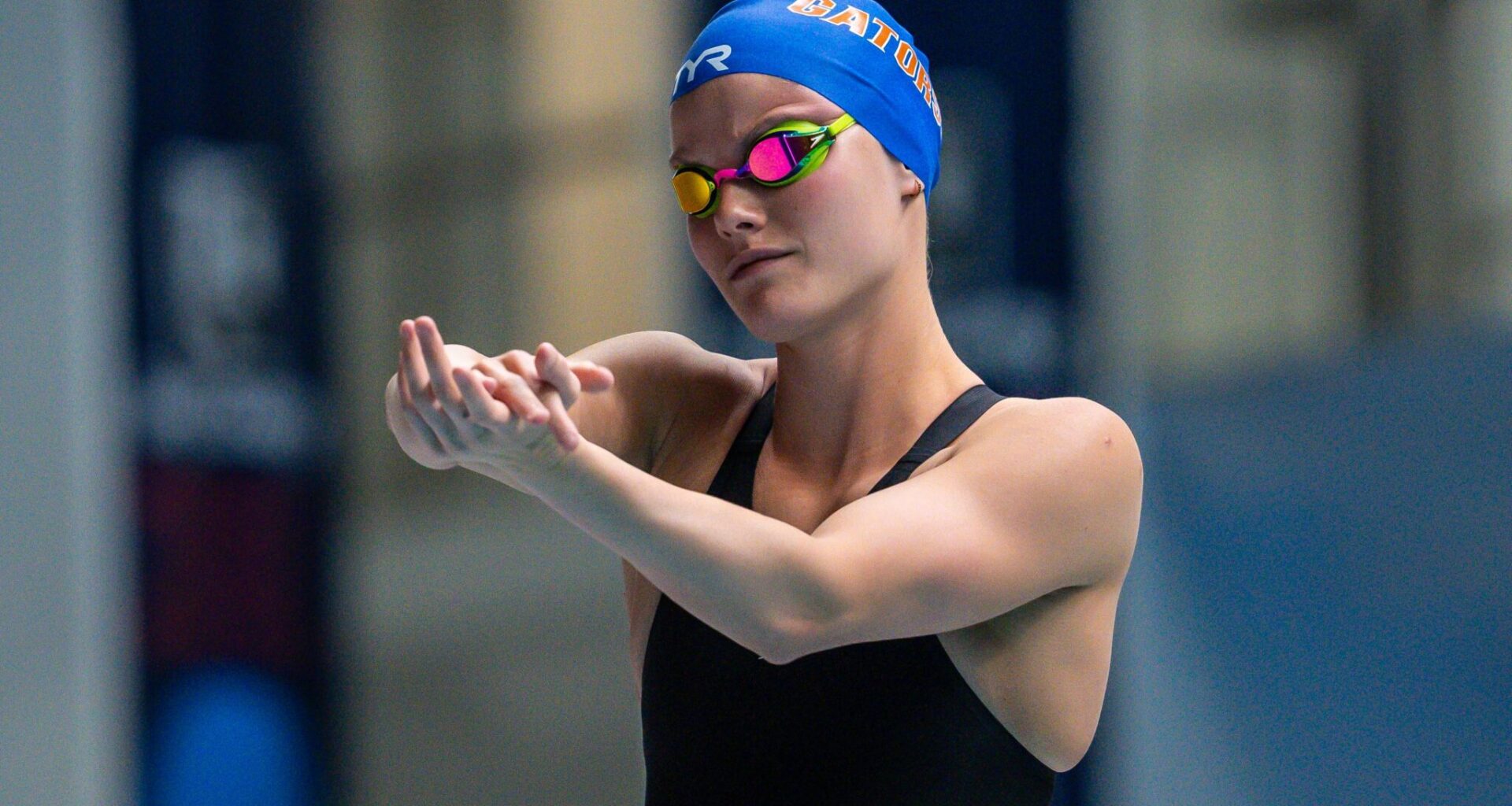
It’s that time of the year again. SwimSwam will be previewing the top 12 men’s and women’s teams (and then some) from the 2026 NCAA Championships. Follow along with the College Swimming Preview Channel. Want to read even more? Check out the latest edition of the SwimSwam magazine.
Women’s #10: Florida Gators
Key Losses: Anita Bottazzo (Transfer to Indiana – 28.5 NCAA Points)
Key Additions: Maddie Moreth (IN – breast), Francesca Zucca (Italy- breast), Valentina Procaccini (Italy – distance free), Bomin Kim (South Korea – IM/free), Carla Serra (France – distance free), Maeline Bessard (France – freestyle)
Grading Criteria
Over the years, we’ve gone back and forth on how to project points, ranging from largely subjective rankings to more data-based grading criteria based on ‘projected returning points.’ We like being as objective as possible, but we’re going to stick with the approach we’ve adopted post-Covid. The “stars” will rely heavily on what swimmers actually did last year, but we’ll also give credit to returning swimmers or freshmen who have posted times that would have scored last year.
Since we only profile the top 12 teams in this format, our grades are designed with that range in mind. In the grand scheme of college swimming and compared to all other college programs, top 12 NCAA programs would pretty much all grade well across the board. But in the interest of making these previews informative, our grading scale is tough – designed to show the tiers between the good stroke groups, the great ones, and the 2015 Texas fly group types.
5 star (★★★★★) – a rare, elite NCAA group projected to score 25+ points per event
4 star (★★★★) – a very, very good NCAA group projected to score 15-24 points per event
3 star (★★★) – a good NCAA group projected to score 5-14 points per event
2 star (★★) – a solid NCAA group projected to score 1-4 points per event
1 star (★) – an NCAA group that is projected to score no points per event, though that doesn’t mean it’s without potential scorers – they’ll just need to leapfrog some swimmers ahead of them to do it
We’ll grade each event discipline: sprint free (which we define to include all the relay-distance freestyle events, so 50, 100 and 200), distance free, IM, breaststroke, backstroke, butterfly and diving. Use these grades as a jumping-off point for discussion, rather than a reason to be angry.
Also, keep in mind that we are publishing many of these previews before teams have posted finalized rosters. We’re making our assessments based on the best information we have available at the time of publication, but we reserve the right to make changes after publication based on any new information that may emerge regarding rosters. If that does happen, we’ll make certain to note the change.
The final note is that we are not including athletes who graduated last spring after exhausting their college eligibility despite ongoing lawsuits against the NCAA regarding the new “Five-for-Five” rule.
2025-26 Lookback
The Gator women just snuck into the top 10 last season at the NCAA Swimming and Diving Championships, finishing 25 points ahead of fellow SEC opponent Alabama with 125.5 points.
A good bit of those came from Anita Bottazzo, who finished 2nd in the 100 breast and 7th in the 200 breast to bring home a big haul of 28.5 points to the Gator women.
The team also saw strong production from Julie Brousseau (14 NCAA points), Grace Rabb (13 NCAA Points), Michaela Mattes (7 NCAA points), and Catie Choate (1 NCAA point).
As a team, Florida secured only 36 points on relays, but picked up 26 points in diving.
On the conference level, the Gator women finished 3rd, only behind Texas and Tennessee with 1,015.5 points. Bottazzo won both the 100 and 200 breast at those championships.
With several new additions to the program for this upcoming season, the Gators will use a good mix of returners and
Sprint Free: ★
Florida returns its top 50 freestyler and 100 freestyler in Beatriz Bezerra and Lainy Kruger for this upcoming season. Bezerra’s top time last season came in the prelims of the 50 free in 22.25. She was one of four sub-23-second 50 freestylers for the Gators last season, and the fastest by more than four-tenths of a second. Just a sophomore in 2026-27, Bezerra was still half a second outside of what it took to score at NCAAs, though still young in her years with the Gators; a drop could be on the horizon, with potential points on the way.
Another strong sophomore, Sylvia Statkevicius, was the team’s 3rd-fastest performer in the 50 last season at 22.83; that time is still significantly outside the scoring range, though with the departure of Carly Meeting, she will have a bit more responsibility to step up for the Gator sprinters.
Kruger, Bezerra, and Statevicius were the program’s only sub-49-second performers last season. Kruger clocked her season best at a dual meet against Virginia in 48.41, Bezera was 48.78 at the Georgia Fall Invite, and Statevicius clocked 48.94 at the SEC Championships.
The 50 and 100 freestyles are not necessarily a strong suit for the Gator women; the 200 free may be a bit of a brighter spot. Kruger clocked a 1:43.69 at the dual meet with Virginia last season, a time that was just outside the 1:43.46 it took to score at the NCAA Championships.
Kruger did race this event at NCAAs, finishing 26th with a 1:44.17. Another potential riser in the 200 free for Florida this season comes in the form of Julie Brousseau, who was 1:44.20 as the leadoff leg of the 4th-place SEC Championships relay. Brousseau was slightly faster in the leadoff leg at the SEC Championships in 2025, posting 1:44.18. If she can get under that 1:44 mark, she could add some real firepower to the 200 free this season for the Gators.
Distance Free: ★★½
Brousseau may not be as big of a threat in the 200 free as she is in the 500 free. Having finished 5th at NCAAs in the 500 free in 4:34.63, the hopes for her will be to return to that ‘A’ final and contend for a national title in 2027.
She swam a lifetime best of 4:34.59 at the SEC Championships just a few weeks earlier, though it would have kept her right at that 5th place mark at NCAAs. It took 4:32.8 to finish inside the top four at the national level, but that two-second drop does not feel too out of reach for an experienced racer like Brousseau.
Michaela Mattes finished 20th at NCAAs in the 500 free in 4:40.23. Though she holds a best time of 4:37.95 from the Georgia Fall Invite in 2024, had she posted that in the prelims at NCAAs, it would have leapfrogged her into the top 13 at those championships.
Mattes also led the team in 1650, clocking the team’s only sub-16-minute time last season with her 15:56.85 at the Georgia Fall Invite, the same meet where Brousseau delivered a 16:12.05, making her the 2nd-fastest performer last season.
Mattes finished 10th at NCAAs as a sophomore in 15:59.35, picking up a big seven points for the Gators. Her best time came in 2025 at the NCAA Championships as a freshman, where she touched in 15:54.98.
This is an area where Florida’s international recruiting will really have a chance to shine, with French talent Carla Serra and Italian distance specialist Valentina Procaccini both poised to be immediate impacts in an already proven and well-established Florida distance program.
Backstroke: ★★★
Catie Choate returns for her senior season as one of Florida’s top backstroke talents, having raced both the 100 and 200 backstrokes at the NCAA Championships. However, her top finish of 16th in the 100 back only warranted one point for the Florida women.
The 100 back did not go as planned at NCAAs for Choate. Entering with a season-best of 50.95 from a dual meet against Auburn, Choate finished 30th overall in 51.99. Had she gone that seed time, she would have placed 9th.
Outside of Choate, the 100 back is a touch back of where it would like to be. Though Zuri Ferguson, who is only a sophomore this season, will return after finishing last season as the 3rd-fastest backstroker on the Gators’ team in 52.75.
The 200 back features the same name up top, with Choate’s 1:49.94 from the SEC Championships standing as the fastest time for the Gators last season. Choate did pick up a point in this event last season, finishing 16th in 1:51.97.
Again, had she replicated that season-best time at NCAAs, Choate would have been racing in the ‘A’ final.
Jojo Ramey is another strong returner for this program, as the 2nd-fastest returner from the 200 back last season for Florida with her 1:52.32 from the SEC Championships. Ramey touched 28th in the 200 back at NCAAs, in 1:53.72. She holds a career best of 1:52.02 from the 2024 NCAA Championships, which would have put her just on the outside of point scoring at NCAAs.
Breaststroke: ★★½
No more Anita Bottazzo is a MASSIVE hit to this team, and it will be felt heavily in the breaststroke room. Luckily, the Gators still have the services of both Molly Mayne and Grace Rabb and have included a rising freshman talent in Maddie Moreth.
Mayne was the program’s 2nd-fastest 100 breaststroker last season behind Bottazzo, which is still a 2-second drop-off from Bottazzo’s 56.87 to Mayne’s 58.88. Mayne is a senior this season with career bests of 58.68 and 2:07.72. She will still be heavily called upon to deliver some big breaststroke swims for the Gators.
Grace Rabb is a dynamic threat for the Gators, though her biggest possible contribution to the team is in the 200 breast, where she finished 6th at NCAAs last season in 2:06.85. Rabb ended the season as Florida’s fastest 200 breaststroker on the roster, and a very big contender to continue her rise in the national ranks.
Maddie Moreth, an incoming freshman from Valparaiso, IN, enters her college years with lifetime bests of 59.91 and 2:10.05. Both of which are more than sufficient starting points, as she could be a serviceable replacement and long-term option for Florida on both the conference and national levels.
Butterfly: ★
Each of the top three 100 butterfliers from last season will be back in Gainesville this season, two of which are sub-52-second performers. Both Beatriz Bezerra and Grace Rabb return from NCAA performances of 51.76 and 51.91, respectively.
Both times were outside the scoring range, which was 51.33. Though with both returners and another year still to come for both, it is not unfathomable to see one or both scoring in that range in 2027.
Catie Choate is the other top returner for the Gator women, with a lifetime best from last season in 52.85, which looks to be a bit too far outside of that scoring range for NCAAs.
Lainy Kruger (1:55.71), Addison Reese (1:56.28), and Michaela Mattes (1:56.50) all make returns as the top five 200 fly performers from last season.
While all times are strong, all of which were over seven tenths of a second outside of what it took to nab a single point at NCAAs.
The butterfly room was not a recruiting focal point for the Gators this past offseason, and with the amount of returning talent from a season ago, it’s easy to see why. It will be an uphill battle for the Gators to reach scoring range at NCAAs, but with past championship racing experience returning on the roster, the stage is set for the Gators to swim into some scoring.
IM: ★★
Rabb (1:55.29) and Kruger (1:55.62) spearhead the 200 IMers for Florida, both of whom were the only sub-1:56 performers in the event last season for Florida.
Kruger and Rabb finished 22nd and 23rd at NCAAs last season in this event in 1:57.41 and 1:57.43. Both of which were about a second outside of scoring in 1:56.43. Though they had both swum their seed times, they would have brought in about 10 points for the Gator team in that event alone.
Both of them are capable of scoring and potentially even faster. It took a 1:54.19 to clinch a spot in the ‘A’ final at NCAAs, and while that drop may be a bit far-fetched from 1:55-mid, the chances of some more movement are not out of the picture; the points are still on the table.
Brousseau was far and away the best 400 IMer for Florida last season, posting a 4:06.61 at the SEC Championships that earned her a 4th-place finish at that meet. Though her 25th-place finish at NCAAs left a bit more to be desired in 4:09.82.
On a national scale, the 400 IM continues to get deeper, and if Brousseau wants to contend for points, she will probably need to be somewhere in the 4:04-high range to snag some points for the Gators.
Diving: ★★★
26 points were awarded to Florida for their NCAA diving performances last year, all of which came at the hands of rising senior Camyla Monroy.
Monroy was the team’s 2nd-highest scorer (after Bottazzo), with a 4th-place finish in the 1-meter and an 8th-place showing in the platform event.
Alexa Fung was another bright spot of the Florida diving contingent, finishing 22nd at NCAAs on 1-meter.
The program will welcome Colombian talent Juliana Giron Trochez to the roster this season to help bolster the points on the diving side.
Relays: ★½
Note that the grading system doesn’t align perfectly for relays as double points.
Relay grading system:
5 star (★★★★★) – 31+ points per relay event
4 star (★★★★) – 22-30 relay points per event
3 star (★★★) – 12-21 relay points per event
2 star (★★) – 5-11 relay points per event
1 star (★) – 0-4 relay points per event
The relays only really have one spot that will need replacing: Anita Bottazzo on the breaststroke leg of the 200 and 400 medley relays. The rest of the relays stay pretty much intact.
The rest of the medley relay will likely stay the same: Choate, Bezerra, and Kruger, though the breaststroke leg will be the question mark. We touched on what the breaststroke room for the Gators will look like, as potential suitors for that spot could be Molly Mayne, Grace Rabb, or newcomer Francesca Zucca.
The 800 free relay returns all four of its 11th-place NCAA relay team members: Brousseau, Kruger, Ramey, and Statkevicius.
Florida did not have a 200 free or 400 free relay at NCAAs, which will likely be a big focal point for Florida to get some relays into the NCAA Championships in 2027.
Total Stars: 16.5/40
2026-27 Outlook
Despite Anita Bottazzo‘s departure, the Gators are in a solid position to maintain their spot in the SEC and contend nationally. With big-time returners like Catie Choate, Julie Brousseau, and Beatriz Bezerra, as well as several promising international talents still looking to explode onto the domestic scene, there is a lot to be excited about for this Florida team.
The biggest question marks for Florida will be in the sprint freestyle races and the butterfly, as the overlap between the two seems to be hindering both groups’ ceilings. Another point of emphasis, which goes hand in hand with the sprint-free woes, will be the freestyle relays. Not having either a 200 or 400 free relay is a bit of a missed opportunity at double points, which limits how far this team is truly capable of going.
The breaststroke group will take some time to rebound, at least in the 100 breast, though the backstroke and distance free events don’t look like too much of a concern.
The Gators will be hungry for a big season, and with the roster in front of them, they may have enough to get one.
WOMEN’S 2026-27 COLLEGE PREVIEW INDEX
RANK (2026)
TEAM
SPRINT FREE
DISTANCE FREE
BACK
BREAST
FLY
IM
DIVING
RELAY
TOTAL
1
2
3
4
5
6
7
8
9
10
Florida Gators
★
★★½
★★★
★★½
★
★★
★★★
★½
16.5/40
11
Alabama Crimson Tide
★★★
★
★★½
★
★★
★
★
★★★ ½
15/40
12
Ohio State Buckeyes
★★
★★★ ½
★
★★★
★ ½
★
★★ ½
★★
16.5/40