
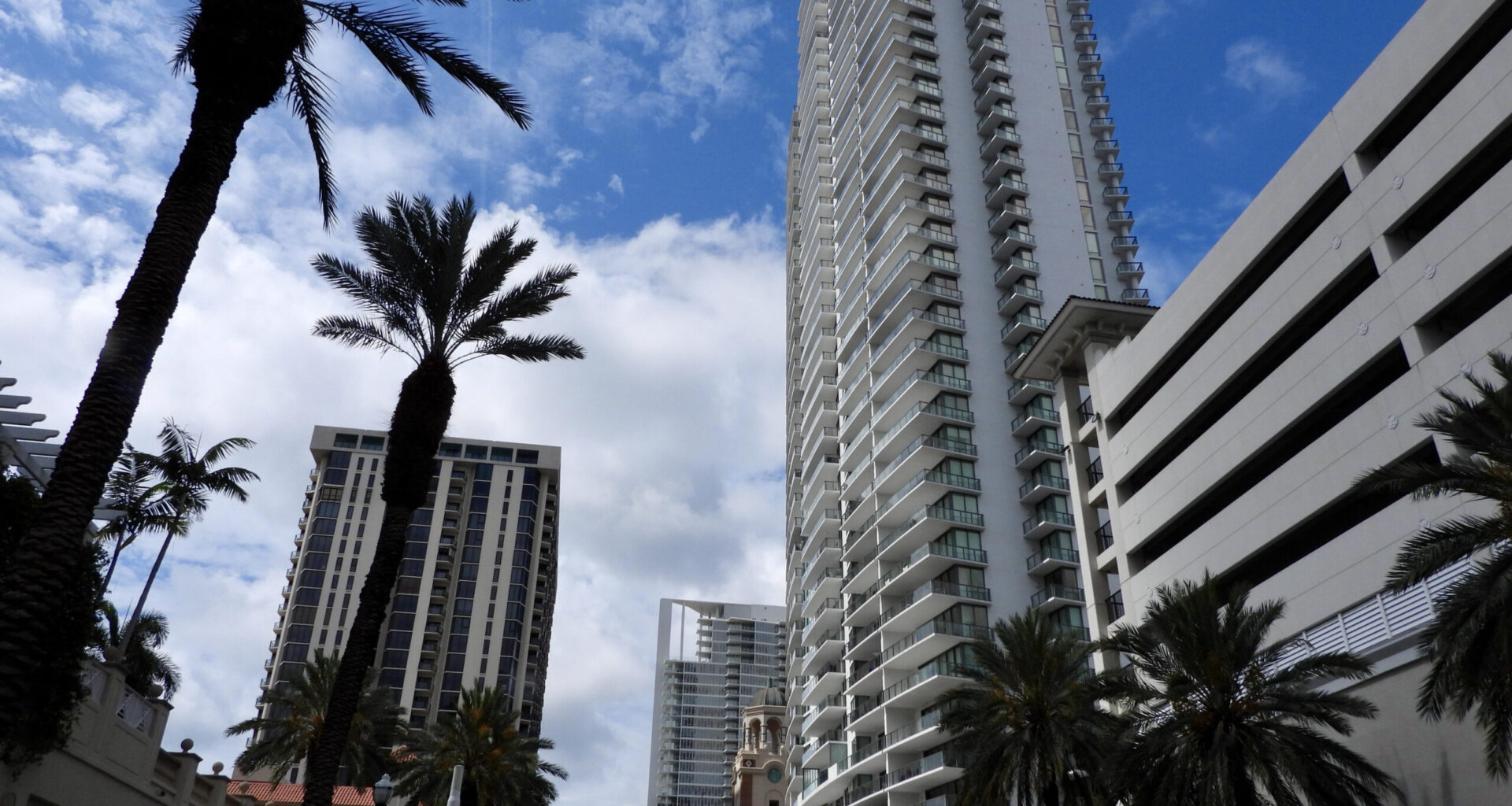
A five-story apartment building could soon become much easier to build along many of St. Petersburg’s commercial corridors.
Some members of the Development Review Commission reviewing those rules think St. Pete should make room for seven.
The question emerged Wednesday as the commission considered a broad rewrite of the rules governing development along major commercial roads. The proposal would allow more homes, larger buildings and greater heights on commercial properties outside the coastal high-hazard area.
Commissioners unanimously recommended the changes to City Council. But much of their discussion centered on whether the city’s proposed 60-foot height limit goes far enough.
Planning Director Derek Kilborn said staff arrived at 60 feet by sketching out the dimensions of the type of mixed-use building the city hopes to accommodate. A restaurant or retail space may need 12 to 14 feet on the ground floor, followed by residential floors of roughly 10 feet each.
“Sixty feet feels like it’s enough to accommodate that five-story walk-up,” Kilborn said.
The proposed changes would raise limits that now stand at 36, 42 or 48 feet to 60 feet in many locations. Some properties that currently allow 72 feet could go to 86.
Commissioner Sarah-Jane Vatelot, a local architect, said designing an actual building within those limits is not always as simple as multiplying the number of floors by their typical height.
“To accommodate a five-story, if that’s what we’re trying to do, 60 feet gives us a little more leeway,” Vatelot said.
That flexibility becomes particularly important when the first floor is intended for commercial use.
“Sometimes at the retail level, if you’re going to have a restaurant, you need kitchen equipment, and that height is always insufficient,” Vatelot said.
Commissioner William Conroy approached the question from the economics of getting such a building constructed. A five-story apartment building would likely require an elevator, he said, and the system alone could start around $250,000. More apartments would give a developer more units across which to spread that expense.
“I think the move from 50 to 60 will not unleash market forces in the way that we’re thinking,” Conroy said.
Conroy said his company has spent time and money studying projects like these and found seven-story buildings more economically viable than five-story walk-ups. He suggested allowing heights of up to 86 feet more broadly.
The proposal covers commercially zoned properties along major roads throughout St. Petersburg, rather than downtown. Instead of concentrating all of the city’s growth in its urban core, planners are trying to make room for more housing where people already shop, work and catch transit.
Some commercial properties now limited to 30 homes per acre could accommodate as many as 55. The city would also allow considerably more total building space on some parcels, giving developers room for projects that mix apartments with stores, restaurants or offices.
Over time, that could mean some one-story businesses, strip centers and parking lots giving way to buildings with commercial space at street level and several floors of homes above.
But a building that works on a developer’s spreadsheet still has to fit into an existing street and neighborhood.
Commissioner Istvan L. Peteranecz, another local architect, raised the prospect of residents feeling increasingly hemmed in as taller buildings line commercial streets.
“Oh my God, it’s getting too dense. Oh my God … we live in a canyon,” Peteranecz said, describing concerns the city hears as development intensifies.
Peteranecz said he supports allowing greater height, but commissioners discussed setbacks, landscaping, awnings and other design tools that could soften the effect at street level. St. Petersburg already uses similar approaches elsewhere, including requirements that helped shape downtown towers such as 400 Beach and Parkshore Plaza.
Commissioner David Huggleston raised a different concern. Many of the commercial properties covered by the proposal sit near single-family neighborhoods, meaning the view from a taller building would not stop at the edge of the commercial corridor.
“I could imagine some of those neighbors wouldn’t be too pleased to have the five-story building that could potentially look right down into their backyard,” Huggleston said.
Those questions come as St. Petersburg looks for places to accommodate continued growth without applying the same development pressure to every neighborhood.
The city’s Comprehensive Plan calls for concentrating denser development along major streets, around activity centers and near fixed transit routes. The commercial-corridor changes have been under consideration for years and build on previous efforts to encourage development around the SunRunner bus rapid transit line.
Bill Hillman, who owns several properties along Central Avenue, argued that the bigger problem has been how little development the city’s existing rules have produced. He pointed to the stretch of Central between 19th and 31st streets, where he said decades of planning efforts have yielded only four mixed-use buildings containing 23 homes.
Hillman tied additional housing to the health of nearby businesses and the city’s investment in transit, arguing that both need more people living within walking distance. He also urged the city to pair additional height with enough allowable building space for developers to actually use it.
The commission also advanced a related change allowing larger developments within a half-mile of the SunRunner stations at 22nd and 32nd streets, another piece of the city’s effort to concentrate growth around commercial corridors and transit.
Both measures now head to City Council. The commercial-corridor proposal will arrive with the DRC’s discussion over whether 60 feet is enough, leaving council members to decide how much additional room St. Petersburg should give these properties to grow.
DRC Chair Kevin Reali closed the discussion by reflecting on the disconnect between the dry work of rewriting development regulations and the lasting effect those changes can have on a city.
“It can seem pretty mundane,” Reali said. “But what’s interesting is these items go relatively easily and they have a big impact on the code.”