
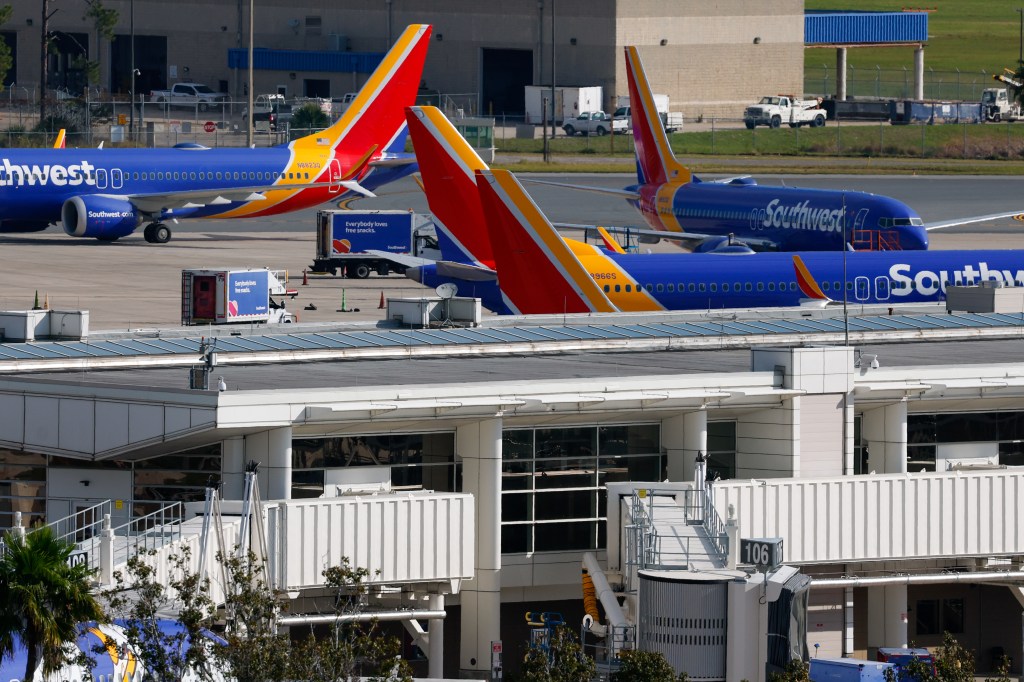
U.S. airlines again canceled hundreds of flights Saturday mostly because of the government shutdown and the Federal Aviation Administration’s order to reduce air traffic.
The number of flights affected at Orlando International Airport was trending higher Saturday afternoon compared to a day earlier.
The slowdown at 40 of the nation’s busiest airports was in its second day and so far hasn’t caused any widespread disruptions. More than 1,000 flights were canceled Friday, according to FlightAware, a website that tracks air travel disruptions.
According to the site as of 4 p.m. Saturday there had been 5,123 delays and 1,113 cancellations for flights within, into or out of the United States. For Friday the website listed 7,009 delays and 1,025 cancellations for flights within, into or out of the U.S.
For flights arriving in Orlando as of 4 p.m. the airport was tied in eighth place for delays, with 176 (30%), behind Palm Beach International, which was first with 47 (40%). It was tied at 10th for cancellations, with 25 (4%), along with Palm Beach International, with 5 (4%), Fort Lauderdale International, with 17 (4%), and Tampa International, with 13 (4%)
For flights departing Orlando as of 4 p.m. the site reported 27 (4%) canceled (tied at 10th) and 188 (32%) delayed (tied in 3rd). Orlando had a higher number of delays in flights departing than other Florida airports but tied with Tampa International, with 13 (4%), and Palm Beach, 6 (4%), in 10th place for cancellations.
Looking at flights arriving at Orlando’s airport a day earlier, the website reported 18 (2%) were canceled (19th place) and 193 (31%) were delayed (tied at sixth). It was No 1. among airports in the state for delays and second to Pensacola, with 4 (2%), for cancellations.
For flights out of the airport it reported 12 (1%) were canceled (tied at 19th) and 167 (27%) were delayed (tied at 11th). That put it first in the state for delays and third for cancellations behind Tampa, with 12 (3%), and Fort Lauderdale, with 12 (2%).
An email sent to the airport seeking comment was responded to by Lennon Batchelor, in the public affairs office, who said no one was available.
Analysts warn that the upheaval will intensify and be felt far beyond air travel if the cancellations pick up and move closer to the Thanksgiving holiday.
Already there are concerns about the impact on cities and businesses that rely on tourism and the possibility of shipping interruptions that could delay getting holiday items on store shelves.
Airports in Atlanta, Chicago, Dallas, Denver, and Orlando, Florida, were among the others with the most disruptions. Staffing shortages in Charlotte and Newark, New Jersey, slowed traffic too.
The FAA said the reductions impacting all commercial airlines are starting at 4% of flights at 40 targeted airports and will be bumped up again on Tuesday before hitting 10% of flights on Friday.
The Associated Press contributed to this report