
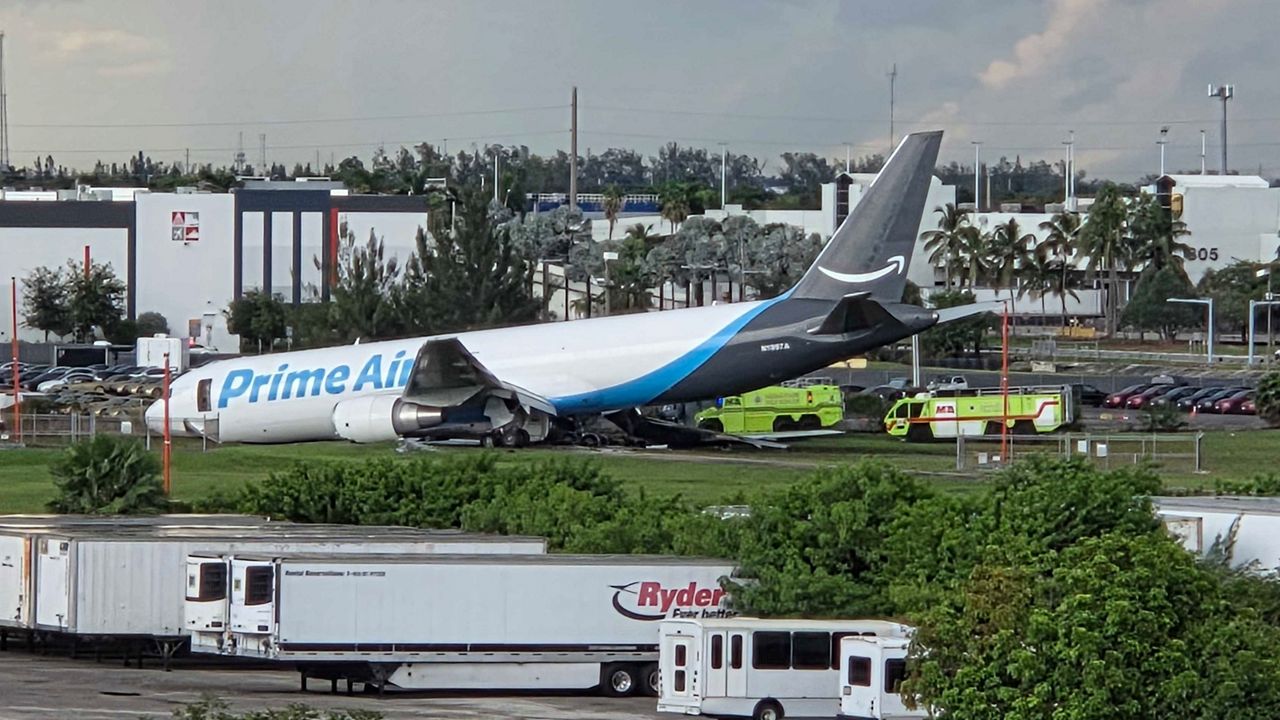
ORLANDO, Fla. — A crash involving an Amazon cargo plane at Miami’s airport Sunday caused delays, cancellations and hours-long ground stop, sending some Miami-bound flights to Orlando International Airport and other surrounding airports.
The plane overshot a runway in Miami and crashed into several cars. The crash claimed several lives and shut down the runway and airport for hours, affecting flights across Florida.
The Greater Orlando Aviation Authority said about 20 flights were diverted to Orlando International Airport.
Greater Orlando Aviation Authority Angela Starke said in a statement, “We encourage everyone who has been diverted to MCO to work with their airline to reach their destination and ask that all passengers have patience during this period.”
Starke, senior vice president of Public Affairs, added, “We also ask that outbound passengers please check with their airline before heading to MCO to ensure their flight is on time.”
Some travelers said they spent more money and time rebooking flights after the incident. Others rerouted through Orlando to continue their trips.
Howard Taikeff was traveling from Ecuador to California to visit family and had a layover in Miami on Sunday.
After learning he might not be able to fly out for several days due to the crash, he booked an early Brightline train ticket to Orlando on Monday so he could fly out of MCO instead.
“They said, ‘Well, maybe Monday, Tuesday or Wednesday you’ll get out of here,’” Taikeff said. “So I was in a jam, and I hadn’t slept for a couple of days. So, I decided that I should just go to Orlando.”
Taikeff said the disruption cost him money as he tried to keep his trip moving.
“I can’t hang out in the Miami airport for three days waiting to see if I can get out of here,” he said. “So, it cost me almost probably about $800 for a personal loss, but I must say, this airport in Orlando is fabulous and beautiful.”
Taikeff said MCO was welcoming and inviting after experiencing a stressful environment in Miami following the crash. He flew back to California on Monday afternoon.
Another traveler, Joshuia Drumm, said he was stuck at MCO Sunday night for hours but eventually got a flight back home to South Carolina.
He says he’s choosing to remain positive about the delays.
“I feel like sometimes God will end up making your situation be inconvenient for you, just so that you will be able to slow down and actually be able to pay attention to what really matters,” Drumm said. “That’s what really happened in that moment for me.”
Drumm landed back home after 1 a.m. on Monday.
Mike Slack is a pilot, aviation lawyer and former NASA aerospace engineer. Slack said rerouting planes during an incident like this requires quick coordination between flight crews and air traffic control.
“Each flight crew is going to know what they have in terms of reserve fuel, how much time they have that they can take to get to the airport,” Slack said. “They’ll be conversing about those things with air traffic control, but it’s a tremendous logistical undertaking.”
Slack said runway overruns can be caused by several factors. He said the National Transportation Safety Board’s investigation will determine what happened in Miami, a process that could take six months to a year.
“We see this weather pattern factor in, but a lot of times it’s associated with bad decision-making by the flight crew and possibly, and I think you can’t rule this out, possibly a malfunction of a system on the aircraft that was needed to slow the airplane down,” Slack said.
He said airports like Orlando and Tampa are perfect for responding to a situation like this, when an airport like Miami has to temporarily pause all flights.
“Florida has some good alternatives if something, if Miami goes down. So you have Orlando, which has tremendous capacity to take in aircraft and a lot of space on the ground to keep those aircraft until they’re able to get relocated or reposition back to Miami or elsewhere,” Slack said. “Some of these airplanes may not ever go to Miami. They may actually, stay in Orlando for a little while, and then they’ll be rerouted on another trip. It takes very quick coordination by air traffic controllers.”