
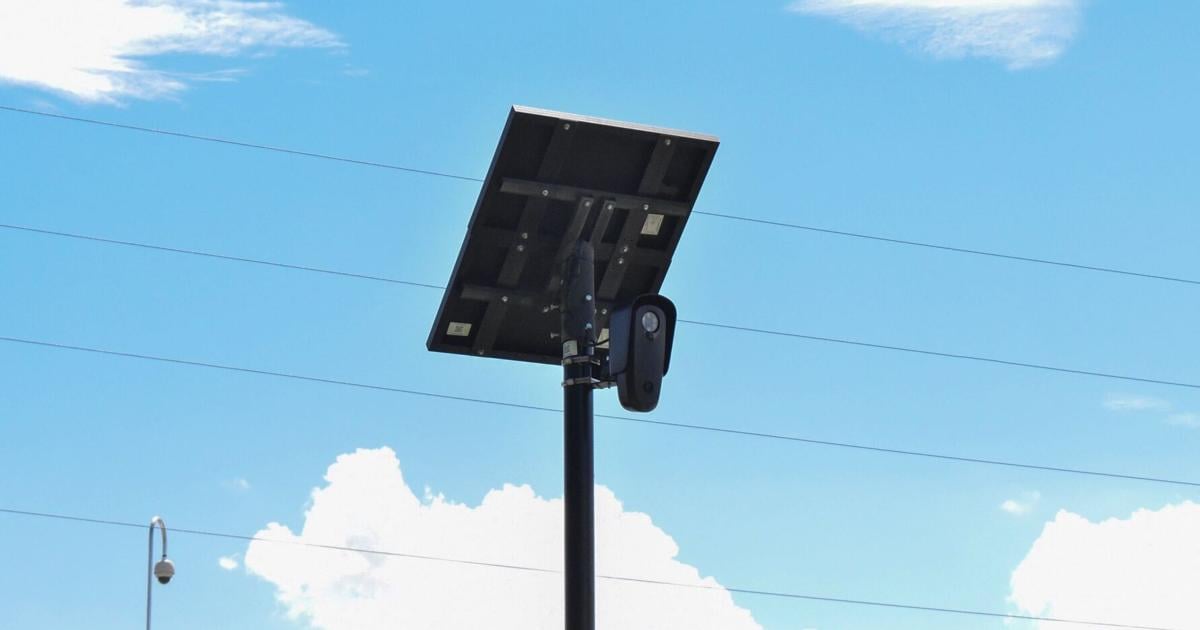

A Flock Safety license plate reader remains installed near Alafaya Trail and Waterford Lakes Parkway as of Sept. 5.
Shaelyn McClunn
Local law enforcement agencies are removing license plate readers from state highway rights-of-way across Florida, including along Alafaya Trail, the state road bordering UCF’s main campus.
The Florida Department of Transportation issued the directive Aug. 31, revoking approvals for automated license plate readers, or LPRs, and giving local law enforcement agencies 30 days to remove them from rights-of-way on the State Highway System. In its memorandum, FDOT cited the growth in LPR deployments and “reports of misuse, data privacy concerns and surveillance schemes” as reasons for the action.
License plate readers use cameras and data processing to turn images of vehicles and their plates into searchable information. Flock Safety provides LPR technology, which is why the devices are commonly called “Flock cameras.”
Alafaya Trail, State Road 434, is under FDOT jurisdiction from Colonial Drive to McCulloch Road, according to UCF’s 2025-35 Campus Master Plan. That portion includes the stretch bordering UCF’s main campus.
The Orange County Sheriff’s Office told The Charge by email that it will remove LPRs from locations affected by FDOT’s directive but plans to continue using the technology where it remains permitted.
OCSO said its LPR network has helped investigators locate suspects in violent crimes, find missing and endangered people and recover stolen property. The agency also said it maintains policies governing use of the technology, and that Orange County Sheriff John Mina “has made clear that misuse will not be tolerated.”
Yusuf Zaghloul, junior information technology major, said he supports continued use of LPRs when they are limited to public safety purposes.
“If it’s used for finding missing people, all that stuff, then they should,” Zaghloul said. “But they shouldn’t use it for anything else that’s not necessary.”
Questions remain over who can access information collected by the systems. Flock Safety said organizations using its systems control who within their organization is authorized to access collected data and whether that information is shared with other Flock customers. The company’s published policy also says searches are recorded in audit logs identifying who conducted them and the purpose of the search.
Gov. Ron DeSantis raised concerns about both law enforcement and private companies potentially misusing LPR data during an Aug. 31 press conference at Florida State College at Jacksonville’s Cecil Center.
“I guarantee you every sheriff in Florida can point to examples where it’s been used appropriately and probably effectively, and I have no doubt that that’s the case,” DeSantis said. “But you also have to say, ‘OK, how could this be misused? And how could a private company misuse the data, but also law enforcement?’”
Abigail Braglia, junior legal studies major, said access to information collected by LPRs is one of her concerns, and that she supports FDOT’s decision.
“I think it’s just too much information that is easily accessible to people that shouldn’t always have access to it,” Braglia said.
A recent Brevard County Sheriff’s Office investigation provides a Florida example of questions surrounding access. WKMG News 6’s ClickOrlando reported that an agency audit found former Deputy Michael Fultz searched his ex-girlfriend’s license plate through its Flock system while off duty. According to records obtained by News 6, investigators wrote that Fultz could not explain why he conducted the search. He later resigned during a broader misconduct investigation.
Orange County District 5 Commissioner Kelly Semrad, whose district includes UCF’s main campus, said she believes LPR use should be suspended until additional safeguards are established. Semrad is also an associate professor at UCF’s Rosen College of Hospitality Management.
“I think that we should suspend their use until we have guardrails in place,” Semrad said.
Semrad said her concerns include who can access collected information, why it is accessed, where it is stored and what happens to it. She said residents should have an opportunity to participate in decisions over how LPRs are used.
Orange County officials had begun considering those questions before FDOT issued its directive. District 1 Commissioner Nicole Wilson requested a Board of County Commissioners discussion in an Aug. 4 memorandum asking county officials to examine who deploys LPR systems, who can access the data, how long it is retained and whether additional oversight is needed.
Semrad explained that the issue had not yet been placed on the commission’s agenda and that her District 5 office was discussing a supplemental memorandum supporting further consideration of LPR policies.
“People deserve a seat at the table if we’re tracking their information,” Semrad said. “And that just hasn’t yet occurred.”