
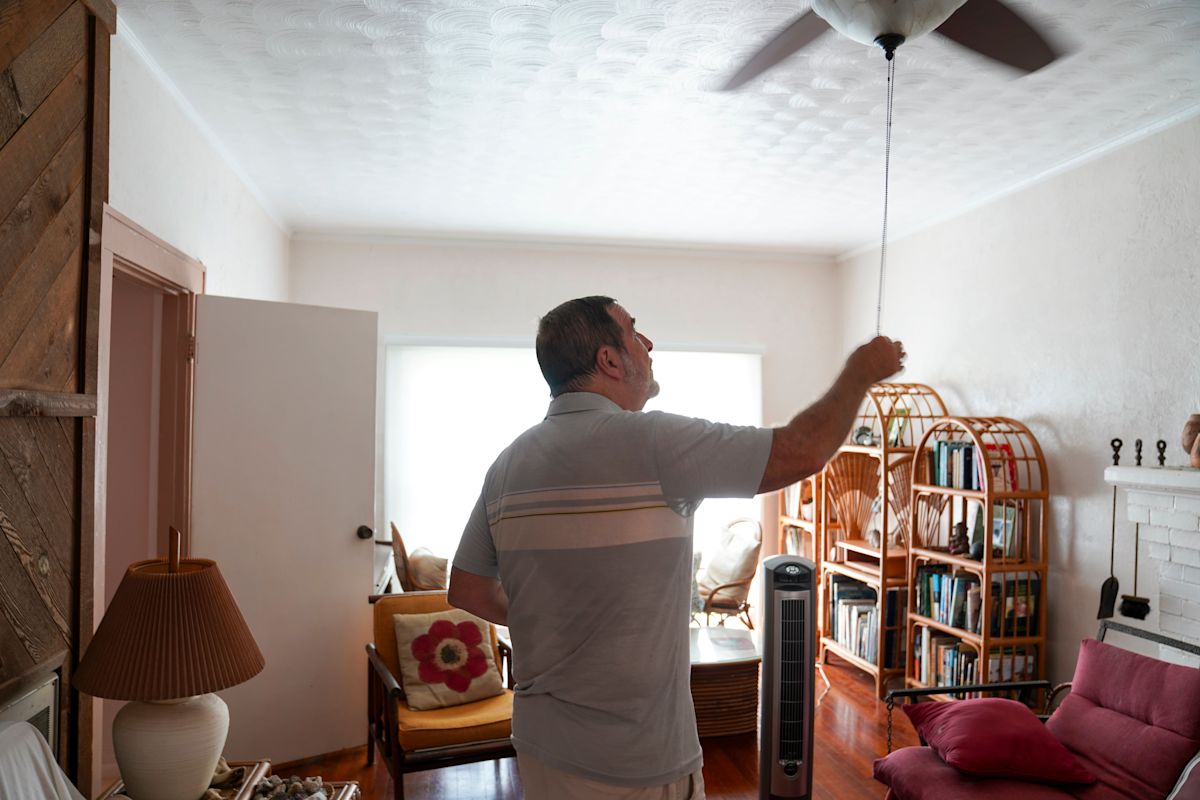
The historic Kenwood home in St. Petersburg was built with Florida’s sweltering summers in mind.
It has a sloping roof that draws indoor heat up and away from the downstairs. A screened-in porch with tiles that remain cool to bare feet. And eaves that shield the home from direct sun.
The home was built in 1925, a year after the Gandy Bridge opened to connect St. Petersburg to Tampa.
Sheila and John Stewart, who are both 71, have lived in the home for 42 years.
In its 100 years, it has never had air conditioning, save for rarely used window units for guests or the hottest nights of the year.
Despite the home’s features, summer days inside are not exactly comfortable, especially withrecord-high temperatures,which means even nighttime lows don’t cool like they used to.

Sheila and John Stewart sit on the front porch of their home where they spend a lot of their day. A flag for “world peace” hung on the porch helps block the late-afternoon sun. The couple live largely without air conditioning even as climate change has caused temperatures to rise.
An estimated 1% of homes in Pinellas County have no kind of air conditioning, according to the U.S. Census Bureau. To go without AC is rare in Florida. And often it’s not a choice — the state doesn’t guarantee renters access to AC, and the cost to cool homes has risen.
The Stewarts say they have no plans to add air conditioning, despite the perils persistent heat poses to older people like them. They have made the calculations and found it’s not worth it.
There’s the price.
“It’s a 100-year-old house; it would cost an enormous amount of money,” said John Stewart.
But there is also a deeper undercurrent of beliefs.
“I don’t believe in cooling major spaces and wasting all the air conditioning, but I do believe in cooling people,” Sheila Stewart said.
So how do they do it?
There was a time when every Floridian lived like the Stewarts.
The origins of the most rudimentary artificial cooling date to Apalachicola in the 1830s.
Florida physician John Gorrie wanted to lower the bodytemperatures of patients battling malaria and yellow fever. He created a crude device that forced air over ice buckets, according to Ray Arsenault, author of “The End of the Long Hot Summer: The Air Conditioner and Southern Culture.”
The term “air conditioning” wouldn’t enter the vernacular for decades, much less become a staple of American life.
In its earliest forms, air conditioning was used to chill products like train cars filled with meat or in textile plants to control the moisture in fibers.
Around the turn of the 20th century, Florida was one of the least populated states east of the Mississippi River and was “isolated,” said Rodney Kite-Powell, a historian for the Tampa Bay History Center.
Disease-carrying mosquitoes and poor transportation options were major problems.
Kite-Powell isn’t entirely convinced that heat alone kept people away, but he said AC was likely a major draw to bring people in decades later.
“There were more people in Arkansas than there were in Florida,” Arsenault, a professor emeritus of Southern U.S. history at USF St. Petersburg, said. “It was still the last frontier east of the Mississippi River.”
Cooling people didn’t become a part of the equation until the mid-1920s, and it was used almost exclusively in theaters.

A 1942 exterior image of the Tampa Theatre shows the business advertising air conditioning. Theaters were among the first places to install air conditioning meant to cool people.
The Tampa Theatre became the first commercially air-conditioned space in the city in 1926, Kite-Powell said. St. Petersburg’s Florida Theatre debuted AC that same year. Women in evening dresses “almost froze,” according to newspaper clippings.
For the first time, air conditioning had stemmed the tide of people leaving the South, and more people were coming in, Arsenault wrote.
Florida’s residential AC use was slightly slower to catch on, but by 1980 the state had the highest percentage of homes with air conditioning at around 84%.
When the Stewarts bought their home four years later, they were not among them.
The Stewarts sat on their front porch on an August afternoon. John wore a loose shirt and shorts. Sweat was beginning to form at the nape of his neck.
Sheila sat across from him, her foot still in a boot while recovering from surgery. She was staying in their air-conditioned apartment garage — a comfort the agingcouple have allowed forthemselvesto dealwith the increasing medical procedures they require.

Sheila Stewart enjoys sitting on the front porch at the home she shares with her partner, John, on Aug 31 in St. Petersburg. The couple have lived in the home 42 years largely without air conditioning.
A fan whooshed overhead, taming the bite of the steamiest part of the day. Much of the porch is shaded by greenery and a large tree in their front yard.
Inside the home, the air feels thicker and smells of aged wood typical of older homes. It’s warm and slightly humid, like the inside of a bread proofing drawer.
“I love days like this, where you’ve got blue skies, white clouds and a breeze,” John Stewart said from his patio. “Nowhere else I’d rather be.”
He can’t recall being uncomfortable as a kid growing up in Florida. Most of his childhood was without AC. Sheila’s childhood was similar, having grown up in Madeira Beach near the cooling sea breeze.
The couple have been connected since their youth. Sheila bought collectable salt shakers from a store in John’s Pass owned by John’s father. Later, they created art for a junior high band show. By college, they were a couple.
The Stewarts bought the Kenwood house with another couple in 1984, where they all lived together for a time.
They didn’t set out to live without AC. They were teachers without money to spare on cooled air.
Now, they have routines to make the home livable for themselves.
On that August afternoon, they had closed up the house, sealing it from outside temperatures that reached into the low 90s. But soon, the sky blackened and the air smelled like rain.
When a downpour started, John opened the front door, then the back, allowing cool air to pass through the house.
He walked upstairs, where there’s what the Stewarts refer to as an attic fan in the ceiling, and opened its grates. An electric hum began, similar to standing next to an outdoor AC unit. The fan pulls in cooler air from outside and pushes out stale air through the attic.
“You have to be aware of your temperature, and you have to be mobile,” he said.

The upstairs landing at the home of Sheila and John Stewart, who do not have central air conditioning, has an attic fan, which sucks hot air from inside and expels it out the top of the house.
Even after living decades without artificial cooling, the Stewarts are not immune to a warming world.
Over the past three years, they have felt temperatures climb. Nights are hotter and muggier, so much so that they bought a window unit for their bedroom to use on the most uncomfortable nights of the year.
It’s a concession they have made as they’ve aged. By morning, they typically turn off the unit and will go about their day, moving from room to room. Other upstairs rooms have small window units meant for guests that Sheila will turn on occasionally.
Tampa’s top five warmest yearly average summer nights have all occurred since 2020, according to weather data gathered by Jeff Berardelli, chief meteorologist for WFLA.
Heat waves have worsened from human-caused climate change. In 1984, the year the Stewarts bought their home, the average temperature in Tampa was 72.2 degrees. Last year, it was 75.7 degrees.
And it’s not just in Florida. About 16,000 more people than usual died during a European heat wave in June, according to reporting from The New York Times. Many of the deaths were in northern countries not accustomed to extreme heat.
Just 23% of European homes have AC, compared to 90% in the United States, according to the International Energy Agency. In the U.S., a fifth of residential energy use comes from air conditioning, reported the U.S. Energy Information Administration.
Artificially cooled air is a paradox. It saves lives, but contributes to burning fossil fuels that warm the planet. A recently published study from Yale showed that AC saves more than 5,000 lives a year in the United States.
Heat is the leading cause of weather-related deaths globally, largely because hot temperatures can exacerbate underlying health conditions.
Older people are particularly vulnerable to extreme heat, said Dr. Evelyn Huang, an emergency physician at Orlando Health Bayfront Hospital. She said their bodies have more trouble regulating their temperatures.
“That involves your brain talking to all the organs in your body, saying, ‘Hey, we need to sweat a little more, or we need to dilate our blood vessels so that we can get rid of some heat,” Huang said.
Older adults can face other complications when it comes to heat, like medications that affect their ability to regulate temperature, or a diminished sense of thirst that makes it harder to realize they are dehydrated.
Aging is one reason the Stewarts have added a window unit to their bedroom.
“I’m thinking through getting older,” Sheila Stewart said. “What do we need?”
Despite rising temperatures and their aging bodies, the Stewarts plan to spend the rest of their lives in their Kenwood home, and they don’t plan to add more AC.
Cost is a factor, they said.
They aren’t the only ones fretting about electric bills. The Tampa Bay Times heard from residents shocked by their electricity bills last year as part of a series called “Power Struggle.”

A Riverview resident’s Tampa Electric bill from 2025. Hundreds of Tampa Bay residents told the Tampa Bay Times last year about how their electric bills had increased. Many of their stories were featured in a Times series called Power Struggle.
Jeff Johnson, state director ofAARP Florida, said people on fixed incomes, particularly older adults, are forced to make tough decisions when bills rise.
“If they don’t have enough money to afford their prescriptions and afford their air conditioning, they’re going to do without one of those things, and it’s going to have an impact on their health,” Johnson said.
That’s especially true if they live in older homes.
To air-condition a leaky, older home can be cost prohibitive, said Taryn Sabia, a University of South Florida assistant dean who specializes in urban planning and heat resilience.
Older homes were made to “breathe,” she said. Now, Florida homes are built to “seal the envelope” for more energy efficiency.
If we’re going to use air conditioning, Sabia said, we should seek ways to make it as efficient as possible.
“Finding ways that you can also incorporate the use of alternative energies with solar, and things like that, to help bring down some of the fossil fuel use is another way we can do that,” Sabia said.
Inside the Stewarts’ house, they have a “Happy Birthday” banner still set up for when they celebrated the home’s 100th birthday.
Throughout the house are relics, some personal, or replicas based on Weedon Island culture, where Sheila worked as an archeologist between her time as a teacher.

A fan sits in the kitchen in Sheila and John Stewart’s St. Petersburg home. The couple turns them on when they have guests over, as their home does not have central air conditioning.
Small electric fans are set up throughout the house, which the Stewarts use to cool guests who come over — though they typically don’t invite anyone inside during the summers.
It’s unclear how hot their home gets. They have no system to measure it. Instead, they go by feel.
They know their lifestyle isn’t for everyone.
In 2006, the St. Petersburg Times published a story about people in the Tampa Bay area who don’t use AC. The Stewarts were among those featured.
They became an oddity. Their story spread so far that Sheila later jokingly introduced herself at a statewide archeology society meeting as the woman who lives without AC.

A 2006 photo shows John and Sheila Stewart on their front porch. In a St. Petersburg Times article about residents living without AC that year, Sheila said: “I find it more comfortable to sleep at night with the wind and the air.”
Arsenault, the USF professor and author, said Sheila was his daughter’s teacher, and he’s known the Stewarts for years, even attending parties at their home. He can’t remember ever being too hot, but then again, the parties were likely in the winter.
“I probably could not do what John and Sheila Stewart have done,” he said.
“I confess, I’ve never really been a fan of Florida heat.”
The Stewarts’ view of their lifestyle has never changed. They admit it’s not easy going without cooled air.
After John spends all day in AC for his volunteer work as a docent at local museums, the heat feels that much more oppressive.
To live without AC means finding small reprieves where you can. Like wearing loose clothing. Never turning on the stove. And more showers in the summer.
The choice is part philosophy, part cost, part lifestyle.
The Stewarts don’t want to use a lot of resources. And they also enjoy the simplicity of it.
“I don’t mind being weird,” Sheila said. “That’s part of the joy of our lives.”
• • •
The Tampa Bay Times launched the Environment Hub in 2025 to focus on some of Florida’s most urgent and enduring challenges. You can contribute through our journalism fund by clicking here.