
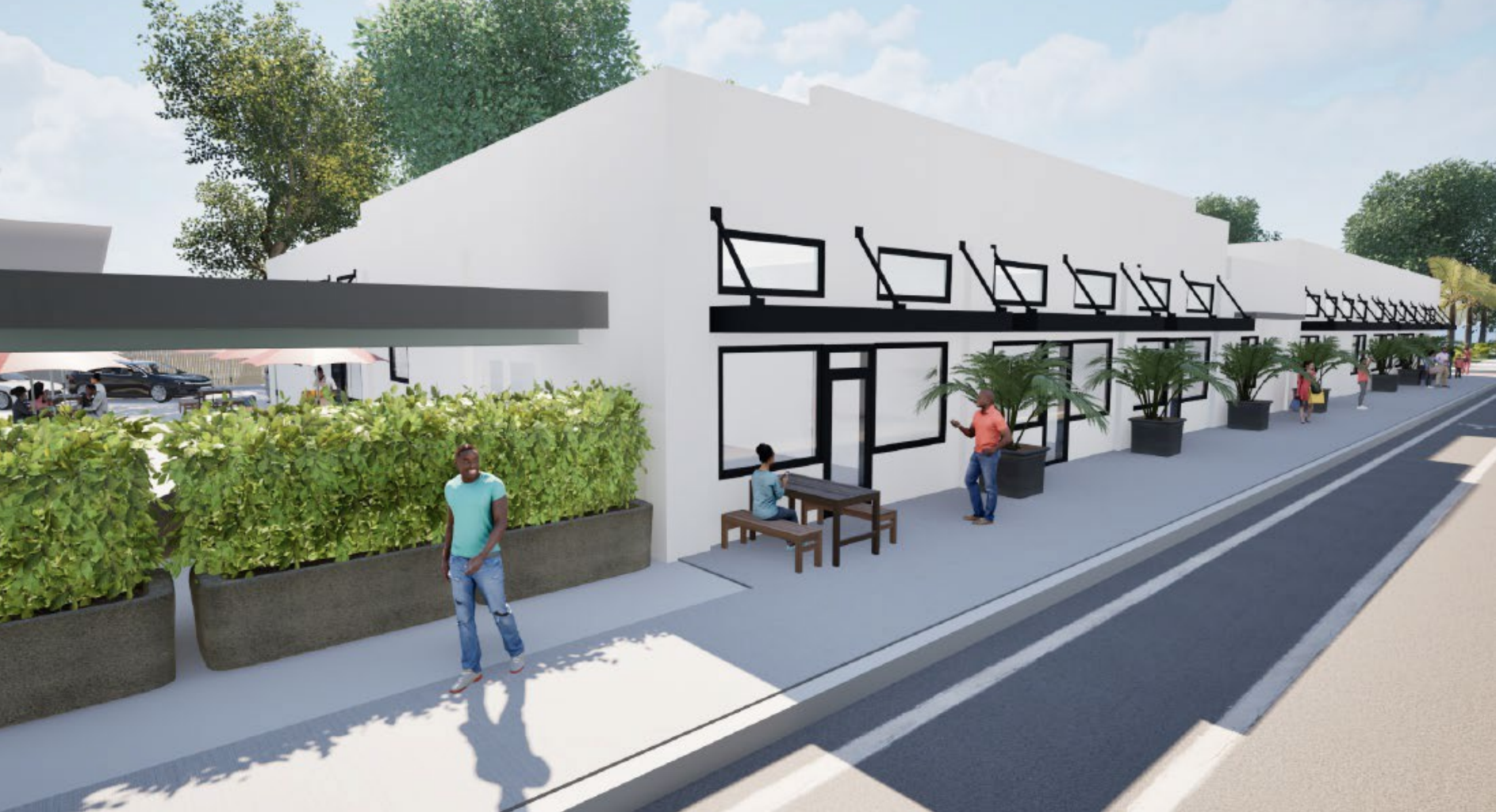
A few blocks south of downtown St. Petersburg, the 900 and 1000 blocks of Dr. Martin Luther King Jr. Street S. sit at a transition point.
MLK runs into South St. Petersburg, where the city’s history of segregation, Black entrepreneurship and uneven investment remains visible in the neighborhoods and commercial corridors around it.
The Looking Glass Initiative is taking shape at that threshold, across several long-neglected properties on both sides of the street.
Developer John Barkett has driven past those blocks for more than two decades. He told members of the South St. Petersburg Community Redevelopment Area Citizens Advisory Committee Sept. 1 that the location helped inspire the project’s name, a nod to Through the Looking-Glass and the idea of reversing what people have come to expect when they cross into the area.
For Barkett, that expectation has long been defined by what was missing.
“What’s been expected when you drive over that bridge is that the community really has kind of forgotten,” Barkett said. “There hadn’t been investment on those, you know, two to three city blocks in decades.”
Barkett said his family is investing roughly $3.5 million of its own money into the properties. The city could soon put public money behind the effort as well.
Mayor Ken Welch has made a funding determination of $325,000 through the South St. Petersburg CRA’s Economic Development Incentive Program. The money is available in the city’s fiscal year 2026 CRA budget, but City Council must still approve the award. City staff found the project supports the CRA’s goals of reducing blight, revitalizing commercial corridors and creating jobs.
The support would mark the first use of the economic development program, which City Council created in 2023 to help finance private projects through tools that can include bridge loans, loan guarantees and low-interest or forgivable loans. The program targets projects that create jobs and support economic development within the CRA.
At Looking Glass, much of that work is already underway.
The project began with an aging retail strip on the east side of MLK and expanded across the street to include the former Twigs & Leaves Nursery property at 10th Avenue S. and a deteriorating former American Legion building at 927 MLK S. Barkett said the buildings have required extensive work, including new plumbing, electrical and mechanical systems, storefronts, doors and portions of the walls. A masonry and parking change order alone reached about $350,000.
What moves into those spaces is central to Barkett’s pitch.
The retail side is being divided among neighborhood-oriented businesses and services. Plans include Café Aura, a Black-owned coffee shop and art gallery from Meiko and Simone Seymour; CodeWiz, which will offer computer coding and robotics programs for children; The Nest, a social-skills and therapy space for children on the autism spectrum; and a physical therapy and wellness business.
Barkett said three of the project’s seven businesses are Black-owned and described a deliberate effort to recruit within the Black business community. One storefront was reworked into a roughly 600-square-foot business incubator after Barkett said the original 1,000-square-foot space proved too large for Sober Roots, a Black woman-owned business operated by Monica Smith. The change cost an additional $45,000.
That effort is unfolding in a part of St. Petersburg shaped by a long history of segregation and Black entrepreneurship. City historical research shows that beginning in 1936, African American residential and business properties were largely restricted to an area southwest of the Looking Glass site, between 6th and 15th Avenues S/ and 18th and 31st Streets S. Those restrictions helped foster the growth of the Deuces along 22nd Street South, which became the commercial heart of St. Petersburg’s Black community.
Questions about who benefits from new investment remain part of the conversation in South St. Petersburg. At a June CRA meeting, Historic Roser Park Neighborhood Association Vice President Meiko Seymour urged officials to direct more resources toward residents and small businesses along MLK. He also raised concerns about the potential displacement of longtime residents as property values rise and asked committee members to consider whether CRA investments are benefiting the people they were intended to serve.
Barkett addressed that concern directly while presenting Looking Glass, saying the goal is to build wealth and opportunity within the surrounding community.
“This isn’t a re-gentrification project,” Barkett said. “This is an intentional project to create generational wealth, to level the playing field from an educational perspective.”
The economics of the storefronts are part of that approach. Barkett said rents are being structured around what the project’s lender needs to cover its debt rather than what the surrounding market could command. He estimated tenants will pay roughly 55% to 60% less than they would for comparable new space about a mile and a quarter away on Central Avenue, with substantially lower pass-through expenses as well.
Barkett said the project also reflects a broader approach to redevelopment that puts some value on what remains in the neighborhood after construction is finished.
“There’s other types of return,” Barkett said. “And if you do it the right way and you listen, the return will be there for everybody.”
Looking Glass extends beyond the storefronts.
Across MLK, the Healthy Roots Garden & Community Center is planned around a teaching garden, produce stand and rehabilitation of the former American Legion building. Garden Life, a Black woman-owned business relocating from Atlanta, is expected to operate within the garden and help teach families how to grow and prepare fresh food.
The community center is envisioned as a place for meetings, cooking classes, computer access and, eventually, health services. Barkett said the project is in conversations with Orlando Health and Johns Hopkins All Children’s Hospital about bringing services into the neighborhood. Orlando Health has already provided a small contribution toward getting the garden started, he said.
The private redevelopment is also beginning to overlap with public investment along MLK. St. Petersburg’s proposed CRA spending includes about $1.05 million for crosswalks at 9th, 10th and 14th Avenues S., including crossings around Looking Glass, and another $175,000 for a study of potential lane changes between 9th and 18th Avenues.
For Barkett, those smaller pieces are part of the larger project. He pointed to safer crosswalks, a bus stop, better sightlines and easier access to the businesses as ways to reconnect neighborhoods on either side of a busy roadway where he said motorists routinely travel well above the speed limit.
Construction is moving ahead as the proposed city contribution awaits City Council approval. Barkett told the committee the first retail space, CodeWiz, was expected to turn over before the end of September. Work would then move into the garden, while plans for the community center were already being prepared for permitting.
For all the buildings, businesses and money involved, Barkett said he has a simpler measure for whether Looking Glass ultimately works. The test will come when the people who started it are no longer needed to keep it going.
“It’s not my community center. It’s the community’s center,” Barkett said. “We’re building scaffolding. When we can pull the scaffolding away and the community center continues to run, we’re successful.”