Sonia Stolar | Staff Writer
At the Young Democratic Socialists of America (YDSA) FIU chapter’s introductory meeting, the majority of newcomers expressed their interest in joining due to seeing the organization actually take action.
The student organization participated in multiple causes in the past three years, ranging from calling for free Plan B at FIU’s clinic, rallying for abortion rights, and the more recent anti-ICE protests against the 287 (g) agreement in collaboration with another student group ICE Breakers.
On the forefronts of the same fight stand FIU’s Dream Defenders, who rally to uplift internationalism, voices if Black women, queer individuals. While also organizing education events, food distributions, housing aid and more.
It became apparent that youth activism is on the rise on campus as a reflection of weariness from the echoing of nationwide tensions gathering in the bubble of Miami-Dade and particularly FIU.
A defining moment in the timeline of such prominent advocacy was the disciplinary action taken by FIU’s administration against seven students who were a part of a demonstration organized by a student group ICE Breakers. On March 13, 20 students silently protested at an indoors on-campus event, in front of university’s President Nuñez, wearing “ICE OFF FIU” t-shirts. The “FIU Seven” filed a lawsuit against the school’s response, which was won by the group under the clause of diminished freedom of speech rights.
In contrast to the seven students, those who participated in the College Republicans racist and xenophobic group chat would not receive any consequences for weeks after being exposed.
Observing the university administration’s actions, what they seemingly keep failing to consider is where the frustration comes from. The methodology of following orders that should not exist in an educational environment will cause nothing else but expressed outrage from those who care.
Taking action does not just come from a faith in a better future—it stems from facing a present that does not align with morality.
Whether one is a big part of the community or not, being involved becomes a must. The university’s actions such as aid to a facility like Alligator Alcatrz, messing around with students’ freedom of speech right, or on the outside the questionable environmental politics of the county’s commissioners—all belong to a bigger picture which won’t leave anyone untouched in the long run.
Thus, the biggest struggle is to unfreeze from the monotony of commuting to classes, barely conversing with each other and leaving once the clock strikes a particular time. All in all, as we exist in post-Covid times, there is no surprise in the superficial functions of day-to-day interactions, including a world of activism that unfolds exclusively online. Yet, it does not have to remain there.
The emergence of larger participation of political groups on campus sends a message not strictly of ideology, but of a passion towards change. It is a unique phenomena in the world of the digital age and indulging in a performance, rather than genuine action. Nonetheless, by placing themselves in the center of the public eye and creating a conversation on what matters to them, the youth activists are actively in danger of scrutiny and unfavorable consequences. Their position of speaking out despite the risks and a trend of censorship on the college campus, is particularly admirable.
Establishment fatigue is overtaking the youth and being in the epicenter of implemented destructive policies, the selfless nature of activism merges with a caring nature for fellow students, faculty, human beings.
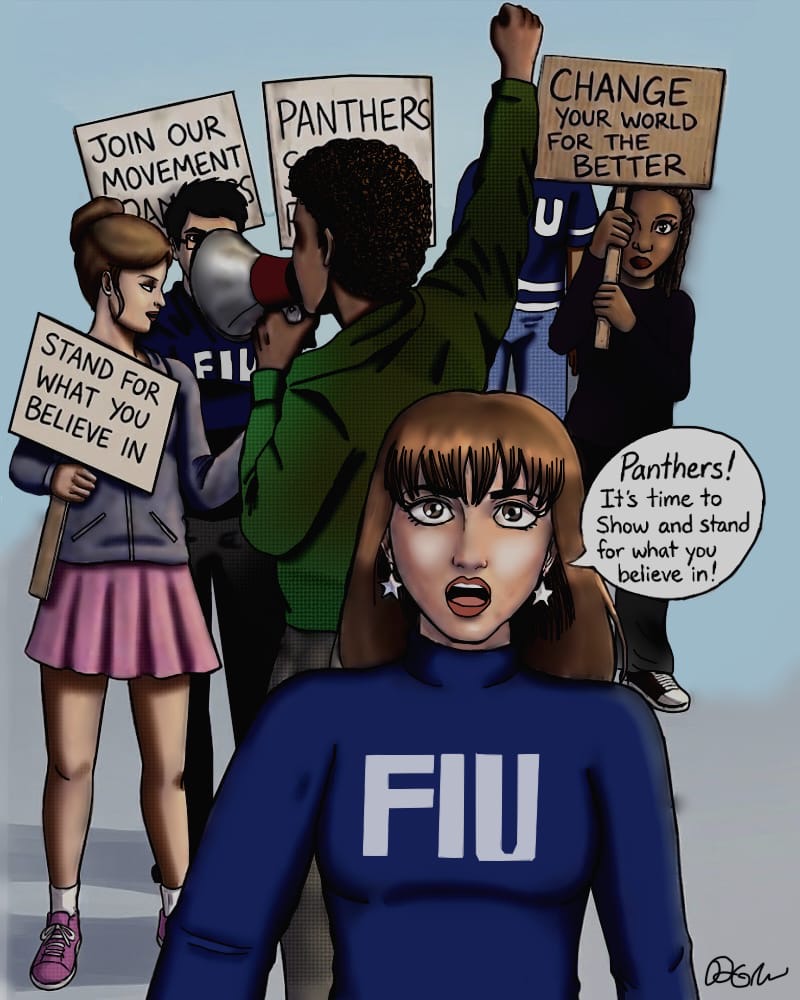
I remember the first time I saw a group of students convene at Graham Center lawns with a megaphone and placards. This became a recurring event in the light of a university administration that refuses to listen. Still time after time, the placards are brought out, the chants fill up the space, news crews gather around the source of youthful energy determined to create change.
DISCLAIMER:
The opinions presented on this page do not represent the views of the PantherNOW Editorial Board. These views are separate from editorials and reflect the perspectives of contributing writers and/or university community members.
About Post Author