
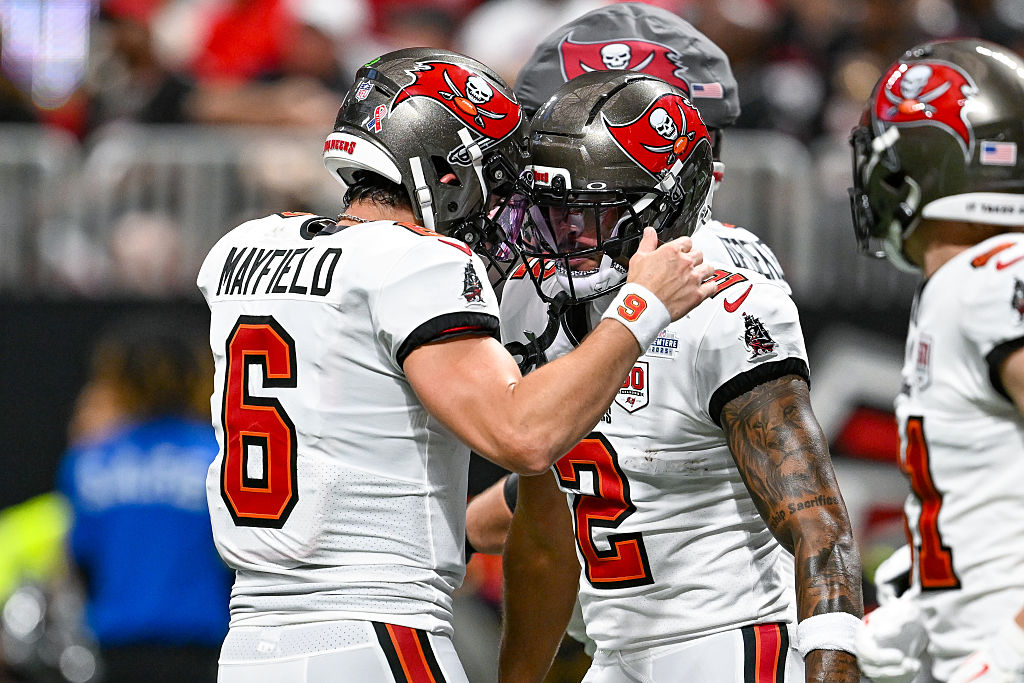
Dan Johnson takes you through his preview, prediction, and pick for NFL Week 9’s game between the Tampa Bay Buccaneers and the New England Patriots.
Raymond James will shimmer in late-autumn heat, a humid bowl that shortens rotations and magnifies composure. The window feels bigger than Week 10 because Tampa protects NFC standing while New England chases seeding oxygen. Both lead their divisions on form—Tampa at 6–2 off a bye, New England at 7–2 on a six-game surge. Todd Bowles has hardened Tampa’s defensive spine, while Mike Vrabel has retooled New England’s culture around detail and bite. The air remembers 2021’s tight finish—19–17 in rain—when a 56-yard kick kissed the upright and froze the building, the noise cresting on every third down, and the anxious pauses before any new long kicks. Different faces hold the levers now, but the mandate stays the same: sustain, finish, and command situational football. Expect a restless building, a brisk script, and staffs that reveal intent inside the first fifteen. Below is my prediction for NFL Week 10’s game between the Tampa Bay Buccaneers and the New England Patriots.
Here’s how I’ll play it. I’ll be pumping out these predictions for individual games all season, with plenty of coverage here on DraftKings Network. Follow my handle @dansby_edits for more betting plays.
First thing’s first: the quarterbacks bring live-wire form that can tilt an afternoon. Drake Maye has been incandescent, hitting 74.1% with 17 touchdowns, 4 interceptions, 2,285 yards, and a 74.2 QBR; he’s stacked eight straight games with 200+ yards and a 100+ rating, tying the franchise record. Baker Mayfield answers with ruthless control, sitting at 1,919 yards, 13 touchdowns, 2 interceptions, and a 61.1 QBR, plus a Week 5 clinic at 29-of-33 for 379 yards, 11.5 yards per attempt, and a 134.7 rating that fueled his fourth comeback by early October. Maye’s rhythm even flashed +0.71 EPA per dropback across a blistering first-half stretch against Atlanta, while Mayfield’s precision under the intermediate ceiling keeps Tampa ahead of the sticks.
New England’s receiver geometry shifts because Kayshon Boutte is out, and Rhamondre Stevenson sits too; both were ruled out Friday. Kyle Williams steps into expanded snaps after logging 31 last week, a season high. Those changes tighten the tree toward Stefon Diggs and DeMario Douglas while giving Williams a speed release in stacks and trips. The personnel note isn’t subtle; it shapes target distribution and route tags in humidity. New England arrives 7–2 on a six-game run; Tampa stands 6–2 and favored at −2.5 with a 48.5 total.
Coverage dictates clarity. Tampa toggles man and zone near league averages, while New England lives heavier in zone; that blend points to in-breakers, whips, and pivots for Diggs and Douglas when Todd Bowles shows single coverage. Diggs has punished man with a 26.7% target rate and a 0.66 per-route scoring clip across 60 charted routes, then held volume versus zone at a 22.8% target rate with 31 for 313 on 162 routes. Douglas spikes versus man with a 24.3% target rate and a 0.69 per-route clip over 37 routes, which turns Tampa’s man snaps into chain-moving oxygen. Williams becomes the accelerator against zone voids as rotations tire, especially if Tampa drifts softer on money downs. Those distributions keep the ball in front of the sticks and protect against sack-induced stalls.
Tampa’s passing rhythm funnels through Emeka Egbuka’s zone craft and Rachaad White’s underneath heartbeat. Egbuka holds 31 receptions for 505 yards against zone on 212 routes at a 21.7% target rate and a 0.50 per-route clip, a clean answer against a defense leaning over 70% zone. Tez Johnson adds 12 for 180 on 98 zone routes at a 17.3% target rate, steady auxiliary work that freezes safety hips and opens dagger windows. Tampa returns from the bye with third-down and red-zone sequencing circled; that’s where short-area accuracy becomes a metronome. The more Tampa stacks eight-to-twelve-yard completions, the fresher its defense plays in the fourth.
The ground games tilt the script without stealing it. New England has stifled backs on the ground, allowing 53.8 rushing yards per game to the position at 3.10 yards per carry, while ceding 6.11 receptions and 40.8 receiving yards per game. That split invites White as the weekly valve; Tampa can trade raw carry volume for swing, screen, and choice touches that chew downs and mute rush. Tampa’s front replies with sturdy figures of its own: 741 rushing yards allowed on 191 carries at 3.9 per rush, part of a 92.6 opponent rushing-yards-per-game profile. Those numbers nudge New England toward perimeter quicks and angle routes rather than a pure downhill diet. The trench math whispers pass-centric afternoons that still prize run integrity as tempo ballast.
Personnel stress pinches Tampa’s perimeter, but the core identity holds. The Buccaneers ruled out Bucky Irving, Chris Godwin Jr., Haason Reddick, and Markees Watts on Friday, compressing explosive manufacturing and edge rotation. The defense still carries continuity through Lavonte David and Antoine Winfield Jr., and Bowles will lean disguise and simulated heat to muddy Drake Maye’s eyes. Tampa’s offense slides to Egbuka first reads and White’s volume to sustain chains and keep variance in check. That blueprint survives in humidity because it trades bravado for possession.
Patriots vs. Buccaneers pick, best bet
Counters live in trench volatility and situational slippage. If Tampa misfires on third down again, drives can bog; recent form dipped to 25.0% and 23.1% on third-down conversions before the bye, with a season clip at 36.3%. If Bowles’ pressure hits the wrong landmarks, explosives can flip field position and stoke New England’s sideline. The rebuttal comes from structure and climate. White’s receiving volume cushions variance, Egbuka’s zone precision sustains chains, and Tampa’s defense plays cleaner situational ball with rest. New England has allowed opponents to convert only 33.7% on third down, but Tampa can flatten that with stronger first-down efficiency and a lower average third-down distance. The stadium heat adds invisible yardage to every tackle, and that favors the deeper rotation.
Here’s how that math will manifest on grass. Tampa will open in eleven, motion to dictate leverage, and feed White on swings and choice to grind second-and-six. Egbuka will work through stacks and bunch, read rotation, and carve space into New England’s zone lean. New England will answer with tempo toggles, condensed splits, and Diggs on man beaters that should travel on rhythm. Williams will expand as legs tire, finding soft corners at the numbers for five to nine yards. Those should keep the pulse even. The fourth quarter should become a tackling test, not a sprint. The team that captures yards after contact without turnovers will stitch together the last scoring drive. The details will ride on third-down math, catch-tackle clarity, and the quiet violence of humidity.
The weather adds texture: 82°F with humidity and widely separated afternoon storms in the window, which can push coaches toward ball security and YAC over vanity shots. Injuries on both sides compress explosives while sharpening drive stability, which favors the more settled defense at home. The spread asks for a clean field-goal margin; the profile supports it.
The momentum ledger tilts toward Tampa by inches. The bye sharpened self-scout in the red zone; the operation returns home to a building that swallows visiting lungs at 1 p.m. local. New England arrives hot but thinner, missing a touchdown leader and its primary back, which narrows play-calling latitude. Tampa counters with defensive continuity, live legs, and a short field or two from special teams. Stadium mood matters here; it pushes decisions toward the home team.
I’m on Tampa Bay −2.5, anchored by post-bye sequencing and a usage edge that survives variance. White’s route volume against a defense allowing 6.11 running-back receptions per game and 40.8 receiving yards per game keeps chains moving. Egbuka’s zone precision sustains the rest, and Bowles’ defense closes with fresh snaps.
Final: Buccaneers 26, Patriots 23.
Best bet: Buccaneers -2.5 (-110) vs. Patriots
Tail it with me in the DKN Betting Group here!
For a prop lean, Rachaad White over 3.5 receptions at −115 because the structure and climate will funnel touches to him. New England has allowed 6.11 running-back catches per game, most in the league, and 40.8 receiving yards per game to backs. That profile marries perfectly to Tampa’s post-bye emphasis on third-down clarity and red-zone sequencing. Tampa’s implied 25.5 points signal sustained drives and ample checkdown volume in sticky air. White will live on swings, screens, and choice, punishing linebackers who widen with motion. Heat will spike substitutions and compress route depth, which pushes targets to the backs. New England’s front squeezes pure rushing value, so Bowles will weaponize White’s receiving to stay on schedule. I expect five to seven targets as tempo breathes, and four to six catches land before the fourth.
Best prop lean: Rachaad White o3.5 receptions (-115)
Tail it with me in the DKN Betting Group here!