
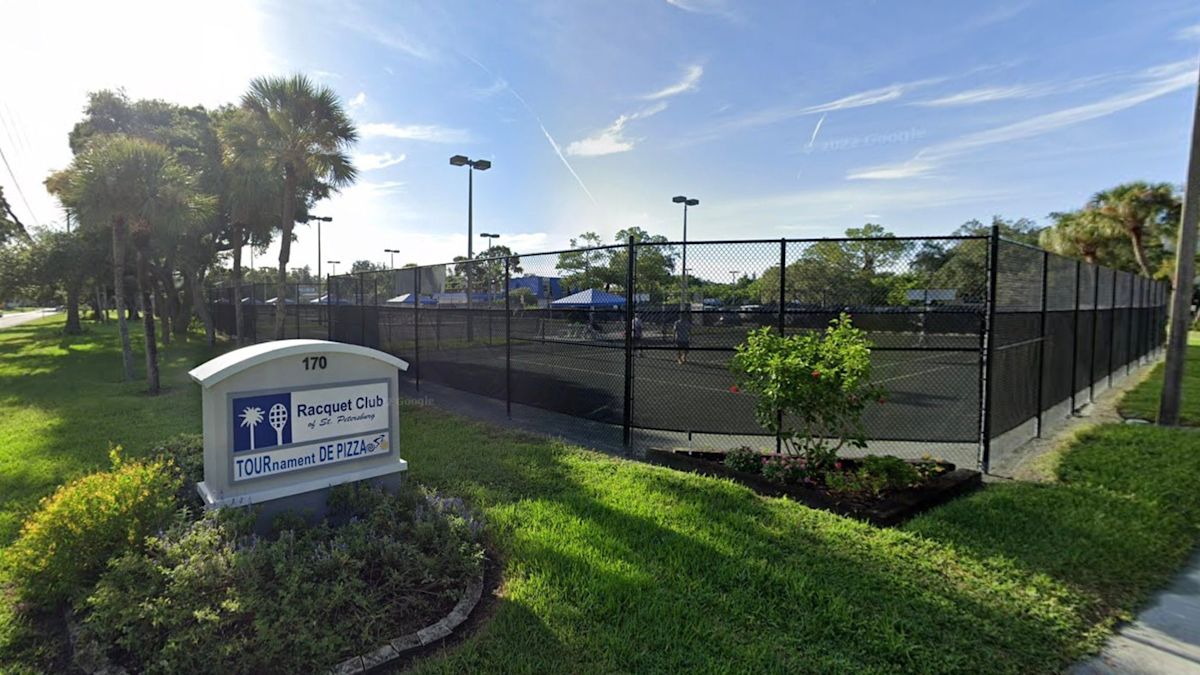
Four pickleball courts installed at a longtime St. Petersburg racquet club without the required city approval can remain, but their distinctive “pop” will now be put to the test.
The city’s Development Review Commission unanimously approved the St. Petersburg Racquet Club’s request Wednesday to keep four pickleball courts created from an existing tennis court at 170 47th Ave. NE. Commissioners rejected a city staff recommendation for a 10-foot sound barrier around the courts, deciding instead to let professional testing determine what noise controls are needed.
The club must measure sound while the courts are both active and empty, including at several locations across the canal along 45th Avenue Northeast. It must then make the changes recommended by the study, test the noise again and make additional improvements if the second round of testing calls for them.
The four courts have been operating since January 2024. The club converted a cracked concrete tennis court into four pickleball courts without first getting the required city approval. A code complaint eventually brought the issue to the city’s attention, requiring the club to come before the Development Review Commission to keep the courts.
The Racquet Club has operated at the site since 1968. City planning staff noted that pickleball generally generates more noise than tennis because of the equipment, how close players are to one another and how frequently the ball is struck. Homes surround the club, putting noise at the center of the city’s review.
Opposition began building before Wednesday’s hearing. City staff had received 30 emails objecting to the request when its report was prepared, compared with one phone call in support. Most of the written objections centered on noise.
Winston Park resident Judy Henzel was among those who wrote to the city. She offered a blunt comparison for what she feared nearby residents would have to hear.
“Who would want to listen to the equivalence of a ping-pong tournament all day long every day?” Henzel wrote.
Another written objection came from Cathy Vogel, who connected the debate to the neighborhood’s recovery from the 2024 hurricanes.
“We are just moving back into our homes from the flooding from the 2024 hurricanes,” Vogel wrote. “Please allow us to enjoy our quiet homes.”
The club said some of the written opposition was based on a misunderstanding. Matt Walker of Aligned Engineering and Design, representing the club, said some nearby residents initially thought the club wanted to add another group of pickleball courts. The application instead sought approval for the four courts already operating.
Walker also brought preliminary sound measurements to the hearing. He said all four pickleball courts operating at once registered about 48 decibels, while background noise along 47th Avenue Northeast registered about 53 decibels.
A visit to the property while both sports were underway gave Walker another point of comparison.
“With the existing tennis courts in operation, I couldn’t hear pickleball over the tennis courts at all,” Walker said.
The testimony inside City Hall showed how differently people living near the same courts can experience them.
Phil Dickhaus, who lives immediately east of the club and said his property is less than 100 feet from the courts, supported the request. He described what he can hear from different parts of his home.
“When our doors are closed, we can’t hear it,” Dickhaus said. “But when we’re on our back porch or if we’re in our pool, we certainly hear the pickleball noise.”
For Dickhaus, the activity carries other sounds with it.
“I hear people having fun,” he said. “I hear people encouraging each other and congratulating each other.”
Jesse Mitsch, who lives across the canal on 45th Avenue Northeast, offered commissioners a considerably different account.
Mitsch bought his home in 2023, before the tennis court was converted. He said he knew he was moving near tennis courts, but pickleball changed what he heard from his property.
“You listen to pop, pop, pop all day long,” Mitsch said.
Mitsch also described previous problems with court lighting and difficulty determining whether police or code enforcement should handle his complaints.
Eventually, he said, the frustration changed how he felt about his home.
“After a while, you kind of just give up,” Mitsch said. “You’re like, I wish we never bought this house.”
City officials said they were not aware of an official noise citation issued by St. Petersburg police. The violation that brought the club before the Development Review Commission was simpler: The city had approved tennis courts at the property, not the conversion to pickleball.
That left commissioners with two questions: whether the courts could stay, and what the club should have to do about their noise.
Commissioner Michael Kiernan questioned requiring a 10-foot barrier before the professional sound study. Testing, he said, could show that a different height, location or approach would work better.
He argued that commissioners shouldn’t try to answer that technical question from the dais.
“Essentially it needs to be studied by a professional,” Kiernan said, adding that following those recommendations would be “a lot more impactful than arbitrarily prescribing a 10-foot fence.”
Commissioner Charles Flynt brought the discussion back to residents along 45th Avenue Northeast, where homes sit across the canal from the courts.
“I can see the frustration of people when you have the pickleball courts because it is a completely different sound,” Flynt said.
Flynt and other commissioners also questioned whether putting a 10-foot barrier around the courts could create other problems, including blocking neighboring properties or sending sound in another direction.
Rather than settle those questions themselves, commissioners chose to have the sound study drive the solution. They unanimously removed the automatic 10-foot barrier requirement and added testing along 45th Avenue. The club must install whatever noise controls the first study recommends, test again and make further changes if needed.
The vote settles whether the four courts can stay, but the coming sound studies will determine what the club must do to lessen their impact on the people living around them.
Kiernan summed up the balance commissioners were trying to strike.
“It’s a classic example. There’s got to be some give and take.”
This content provided in partnership with stpetecatalyst.com.