
BOCA RATON, Fla. (CBS12) — A runway safety system designed to stop planes when they run out of runway is getting new attention following the deadly cargo plane crash at Miami International Airport.
It’s called an Engineered Material Arresting System, or EMAS — a bed of lightweight, crushable material installed beyond the end of a runway.
The Federal Aviation Administration says the material crushes beneath an aircraft’s landing gear, absorbing its energy and slowing the plane much faster than an open safety area could.
Miami International Airport did not have EMAS at the end of Runway 30, where Amazon Air Flight 7598 overran the runway Sunday.
The Boeing 767 cargo plane was arriving from San Juan, Puerto Rico, when it went beyond the end of the runway. The National Transportation Safety Board is investigating the crash.
Just about an hour north, Boca Raton Airport has the technology — and CBS12 News has seen it work.
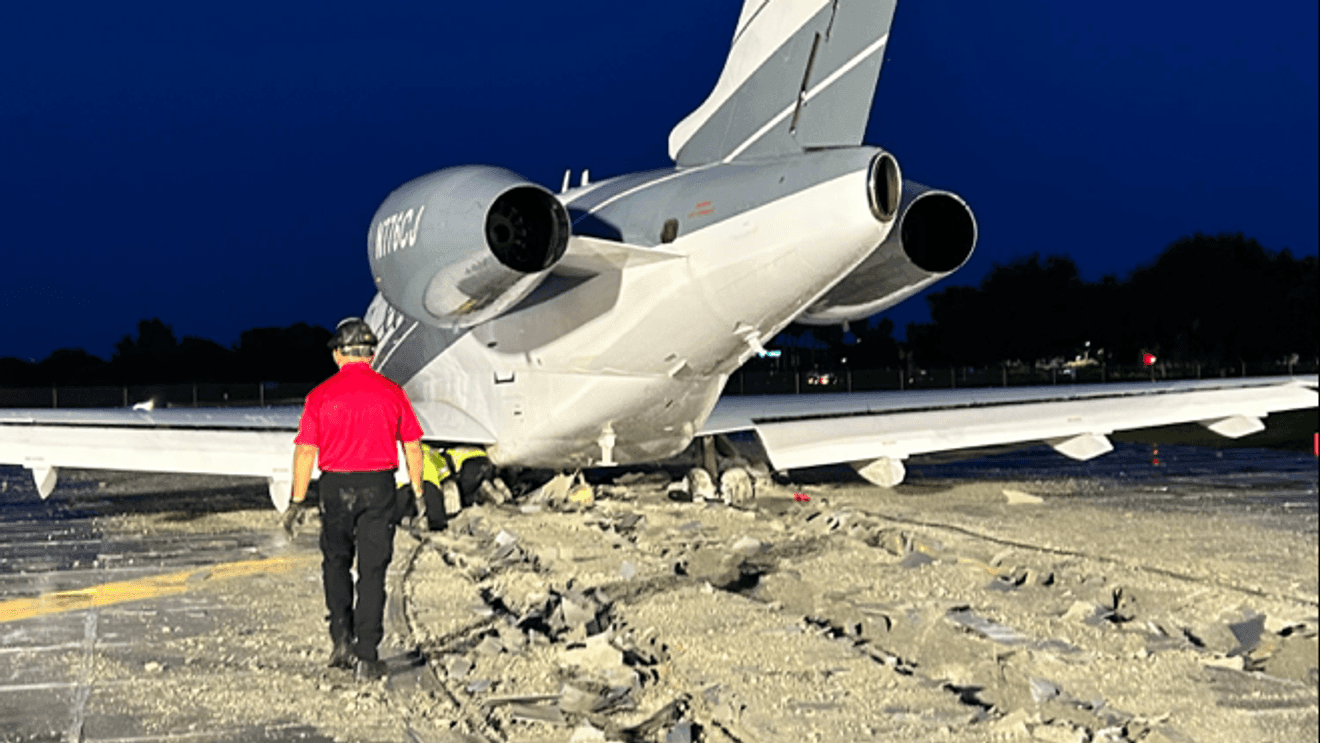
Last September, a Challenger 300 overran the runway while landing at Boca Raton Airport and entered the EMAS bed. The system brought the aircraft to a stop before it could leave airport property and potentially reach busy Spanish River Boulevard.
Four people were on board. No serious injuries were reported.
“It was critical,” Boca Raton Airport Authority Deputy Director Scott Kohut told CBS12 News. “Without this system, that aircraft would have wound up off airport property, through the fence, possibly onto Spanish River Boulevard.”
Kohut showed CBS12 News the system Tuesday, explaining that Boca has EMAS at both ends of its runway because the airport does not have enough space for a traditional 1,000-foot runway safety area.
“It’s basically made of a very lightweight, crushable concrete,” Kohut said. “In the event an aircraft cannot come to stop on the runway, it will absorb its energy and bring the aircraft to a stop before it leaves airport property.”
The two EMAS systems at Boca Raton Airport cost about $13 million to install, according to Kohut.
The FAA says a standard EMAS installation is designed to stop most aircraft entering the system at 70 knots — roughly 80 mph. Even above that speed, Kohut said the system can still have an effect.
“If an aircraft is going faster than that, it will still have some effect,” Kohut said. “It just may not stop it within the bed length, but it will keep it from going even further.”
That raises the question following Sunday’s crash: Could EMAS have changed the outcome in Miami?
CBS12 News aviation analyst and pilot Kyle Bailey said it is impossible to know whether the system would have completely stopped the Boeing 767 given its speed.
“I’m not sure if that system would have completely stopped the airplane at that speed,” Bailey said, “but it could have mitigated the fatalities and definitely slowed that airplane down a lot more.”
EMAS is generally used where an airport cannot provide enough open space beyond the end of a runway.
The FAA says runway safety areas can extend 1,000 feet beyond a runway, giving an aircraft additional space to stop. Where that full safety area cannot practically be built because of roads, water, development or other obstacles, EMAS can provide similar protection in significantly less space.
Kohut said that is exactly why Boca Raton has the system.
“The road is very close to the runway here,” Kohut said, referring to Spanish River Boulevard. “That doesn’t allow us to have an adequate FAA safety area, and so we use the EMAS to be able to meet those standards without having the additional space.”
Miami airport officials have said Runway 12/30 has the full runway safety area required by the FAA. EMAS is typically installed as an alternative when an airport cannot provide that space.
According to the FAA, EMAS has safely stopped 26 overrunning aircraft carrying a combined 497 crew members and passengers.
Florida has already seen several of those saves, including incidents at Boca Raton Airport, Witham Field in Stuart, Fort Lauderdale-Hollywood International Airport and Palm Beach International Airport, now President Donald J. Trump International Airport.
At Boca Raton, Kohut said the system has only been needed once.
But when it was needed, it worked.
“If we didn’t have this safety system here, this EMAS, the aircraft likely would not have stopped before leaving airport property,” Kohut said.
The NTSB investigation into the Miami crash remains ongoing.