
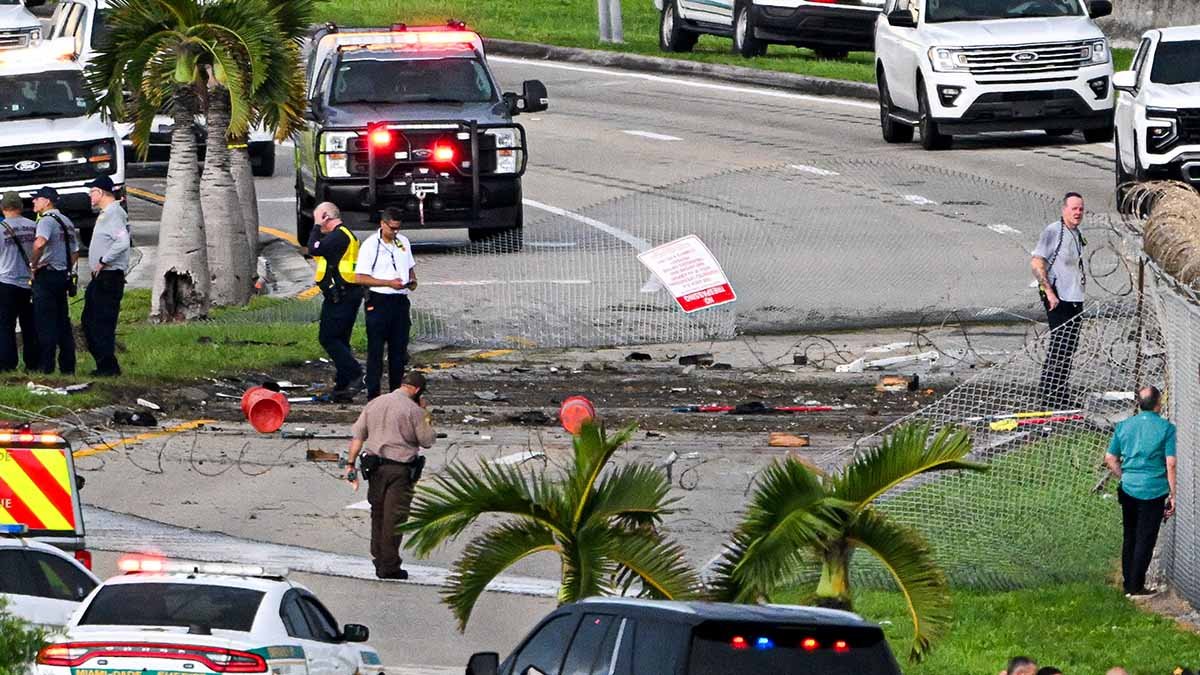
Federal investigators revealed new details Tuesday in the investigation into a deadly plane crash at Miami International Airport that left five people dead.
The Amazon cargo jet, a Boeing 767, hit a van on Miami International Airport property on Sunday before ramming through a fence and hitting an SUV on a public street. Five people who were a part of a cleaning crew in the van died while two survived. The pilot and co-pilot also lived.
The National Transportation Safety Board said Chairwoman Jennifer Homendy that their focus remains on collecting perishable evidence following Sunday’s crash involving the aircraft that overran a runway while landing at MIA.
Homendy called the scene at the airport “utter devastation.”
The crash closed the Miami airport for hours Sunday. Parts of the affected runway have since reopened while investigators continue their work. More than 225 flights were canceled, and hundreds more were delayed, officials said.
Here’s what to know about the crash.
Pilots will be questioned about the crash
Homendy described Tuesday as the first full day of the agency’s on-site investigation.
“You would not think riding in a van to clean an airplane that this would happen,” Homendy said.
Investigators recovered the aircraft’s cockpit voice recorder and have begun reviewing flight data. While authorities have not yet released any audio from the cockpit recordings, preliminary data from the aircraft’s final moments raised new questions.
According to NTSB investigator-in-charge Chihoon Shin, the aircraft’s recorded ground speed was 65 knots at the final moment of available data.
“There was no indication in the recorded data that speed brakes or thrust reversers were deployed,” Shin said.
Federal investigators are expected to interview the 55-year-old pilot and 37-year-old co-pilot on Wednesday as they work to determine what contributed to the crash.
“We do have questions for the pilots,” Homendy said.
The NTSB is also planning interviews with air traffic controllers to determine whether communications may have played any role in the incident.
Authorities urge public for information
Authorities are urging anyone who may have information related to the investigation to come forward.
“If you think anything is relevant to this investigation, anything, please send it to us,” Homendy said.
The NTSB said cockpit voice recorder information could be made public after investigators complete interviews with the flight crew. Officials cautioned that the investigation remains in its early stages and that no conclusions about the cause of the crash have been reached.
Jet spent a long time over the runway before touching down
The NTSB said the plane barreled roughly 1,300 feet (396 meters) past the end of the runway.
It was landing after a two-hour flight from Puerto Rico as storms brewed around the Miami airport.
Homendy called the scene “utter devastation,” with pieces of the vehicles, air bags, destroyed navigational equipment and fencing along the plane’s route. She said she had to be careful because jet fuel was still all around 24 hours after the crash.
Strong winds over 25 knots were reported Sunday afternoon. Experts who viewed video of the landing said it appears that a strong tail wind propelled the plane far down the runway past the point where it was supposed to land. The plane remained airborne without flaring the nose to force the wheels onto the ground.
It is not immediately clear why the pilot didn’t abort landing and go around to try again.
Air traffic controllers also had not changed the approach to the runway to allow the plane to land into a headwind. Airports routinely change which direction planes land on a runway when the winds shift.
New cellphone video captured a pilot jumping out of an Amazon cargo jet moments after it overran a runway at Miami International Airport and crashed on Sunday. NBC6’s Trish Christakis reports
All the people killed were in a cleaning service van
Amazon said in a statement that it is cooperating with the investigation and the company’s deepest sympathies go to the victims and their families.
The five people killed were all in a van owned by Professional Ocean Service Corp., a company that cleans planes. The company said it wouldn’t comment on the crash out of respect for the families who lost loved ones.
“Our employees are far more than the people who work beside us each day, they are family, and they are deeply loved. Our hearts and prayers are with every employee and every family whose lives have been forever changed,” the company said in a statement Tuesday.
The Miami-Dade sheriff identified the deceased as Rolando Aleman Leon, 55; Yoel Rodriguez Naranjo, 53; Julio C. Pineda, 75; Carlos Acosta Fajardo, 53; and Javierkys Reyes Quevedo, 47.

Getty ImagesGetty Images
An Amazon cargo plane crashed after overshooting the runway at Miami International Airport (MIA) in Miami, Florida, US, on Sunday, Sept. 6, 2026. The Boeing 767-300, operated by 21 Air as Prime Air Flight 7598, overshot the runway and burst into flames on Sunday, killing at least five people and shutting down the airport’s runways. Photographer: Eva Marie Uzcategui/Bloomberg via Getty Images
The jet started as a passenger plane before converting to cargo
The 32-year-old Boeing 767 was originally built to carry passengers and flew for several airlines in foreign countries for more than two decades before being converted to a cargo plane in 2015, according to flight-tracking site Flightradar24.
The final flight was operated by 21 Air, a cargo carrier based in North Carolina.
Homendy said the jet’s ownership history, maintenance records and operations by 21 Air would all be reviewed by NTSB investigators.
It’s the second crash of a cargo jet in the U.S. in less than a year. A UPS plane crashed after losing its engine while accelerating down the runway at Louisville’s Muhammad Ali International Airport in October. The crash killed all three pilots and 12 people on the ground. Twenty-three more were injured.
Miami airport lacked system to stop speeding jets
One focus of the NTSB investigation will be on the lack of a system to slow and stop speeding jets at the end of runways.
About 120 airports in the U.S. have the lightweight, crushable material that the Federal Aviation Administration says has saved around 500 lives. Miami does not.
Even without a runway excursion system, Miami’s airport appears to be compliant with federal rules because it has a 1,000-foot (305-meter) safety buffer at the end of its runways, experts said.
Homendy said her agency’s goal is to prevent tragedies, but runway excursions continue to happen even after the board has suggested installing the systems in the past.
“Our recommendations must be implemented or we’re going to be here again,” she said.