
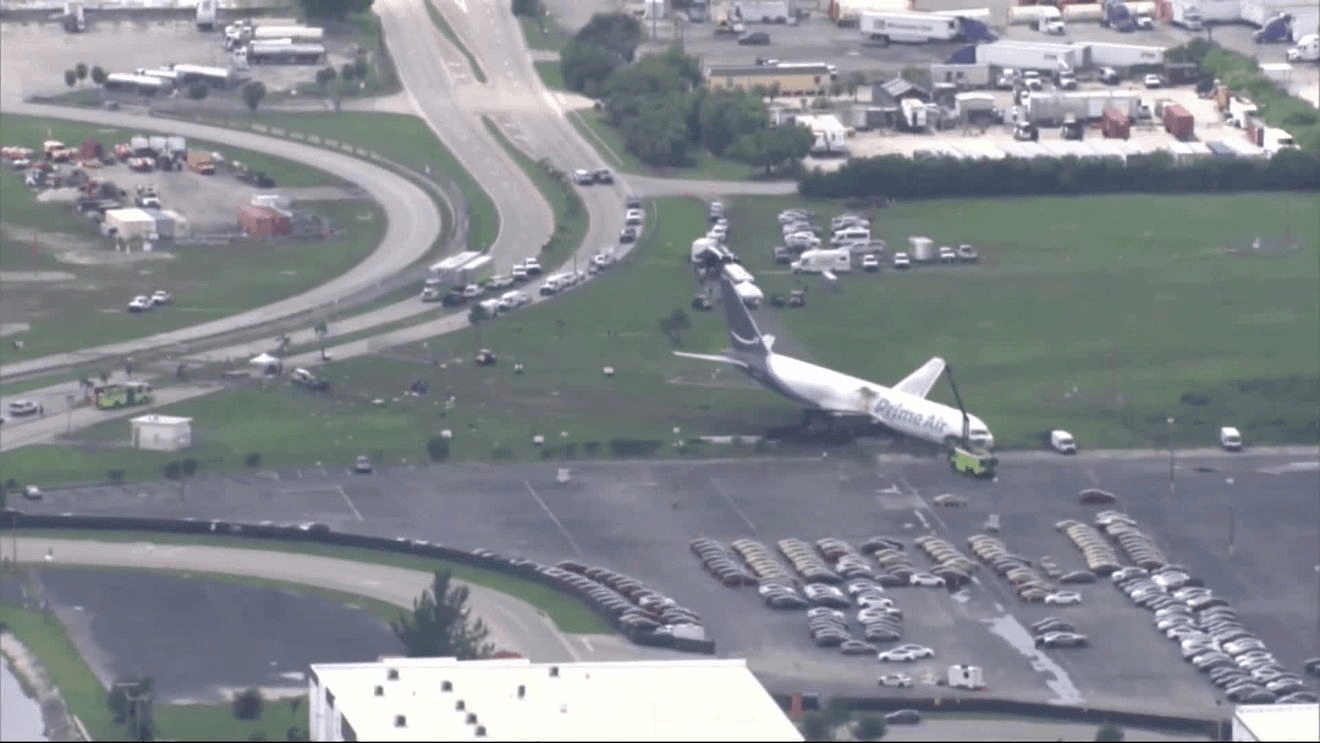
LAS VEGAS (KSNV) — Authorities have identified the five people who were killed on the ground after an Amazon cargo plane overshot the runway at Miami International Airport Sunday.
According to the National Transportation Safety Board (NTSB), the aircraft overshot the runway by approximately 1,300 feet before coming to rest in a grassy area.
Aviation expert and former airline pilot Daniel Bubb, an Honors College professor at UNLV, is weighing in on what factors may have contributed to the deadly incident.
One question he is raising is whether the flight crew attempted to initiate a go-around before the aircraft left the runway.
“There was no declaration of a go-around or an emergency on the part of the pilots with the tower. It sounded like communications were normal. So, it is interesting that the pilots did not tell the tower, ‘Hey, we are going to go around, and we are going to set up for the landing and do the approach again.’ To me, that is a little curious as to why that did not happen.”
Bubb says the go-around procedure is one of the fundamental safety procedures pilots learn early in their careers. If a pilot determines that an aircraft cannot safely complete a landing, the crew can apply full power and climb away from the runway before attempting another approach.
“You have what is called the touchdown zone, which is basically about the first 3,000 feet of the runway where the plane touches down,” Bubb explained. “If you go beyond the touchdown zone, you should be thinking about doing what is called a go-around.”
Preliminary information from the NTSB indicates the aircraft’s throttles were briefly increased to settings consistent with “go-around thrusts.”
However, Bubb says several other factors could have contributed to the crash.
Among them are weather conditions and the aircraft’s approach speed.
“One is there were thunderstorms in the area, so I am wondering if they might have encountered wind shear when they were coming in to land,” Bubb said. “Secondly, I think the approach speed of the plane was fairly high, which caused them to float on the runway a little bit.”
Bubb says wind conditions, including a tailwind, can also affect how much runway an aircraft needs to land safely.
“It is also situational awareness,” he added. “If we are landing and the airplane seems like it is floating, part of which can be brought up by wind shear, like a tailwind, tailwind is going to make the airplane use up more runway. It is going to push it further down the runway, so that could potentially create a shortage.”
Another issue being examined is the safety infrastructure available at the airport.
According to the Federal Aviation Administration, about 120 airports across the United States have Engineered Material Arresting Systems, or EMAS. The systems are designed to help slow and stop aircraft that overrun a runway.
Miami International Airport does not currently have an EMAS system.
“It is like an arrestable device that basically enables airplanes to stop if they are going to run off the runway,” Bubb explained.
Some airports, including Harry Reid International Airport in Las Vegas, do not have the system because of the length and configuration of their runways.
“We have very long runways we have got a 14,000-foot-long runway, 15,000-foot-long runway so that is not really a problem here you would have to land pretty far down runways in order to encounter any kind of runway problems so that is one of the benefits of having really long runways,” Bubb added.
The NTSB’s investigation remains ongoing. Investigators are expected to conduct additional interviews with the flight crew and air traffic controllers as they work to determine the sequence of events leading up to the runway overrun.