
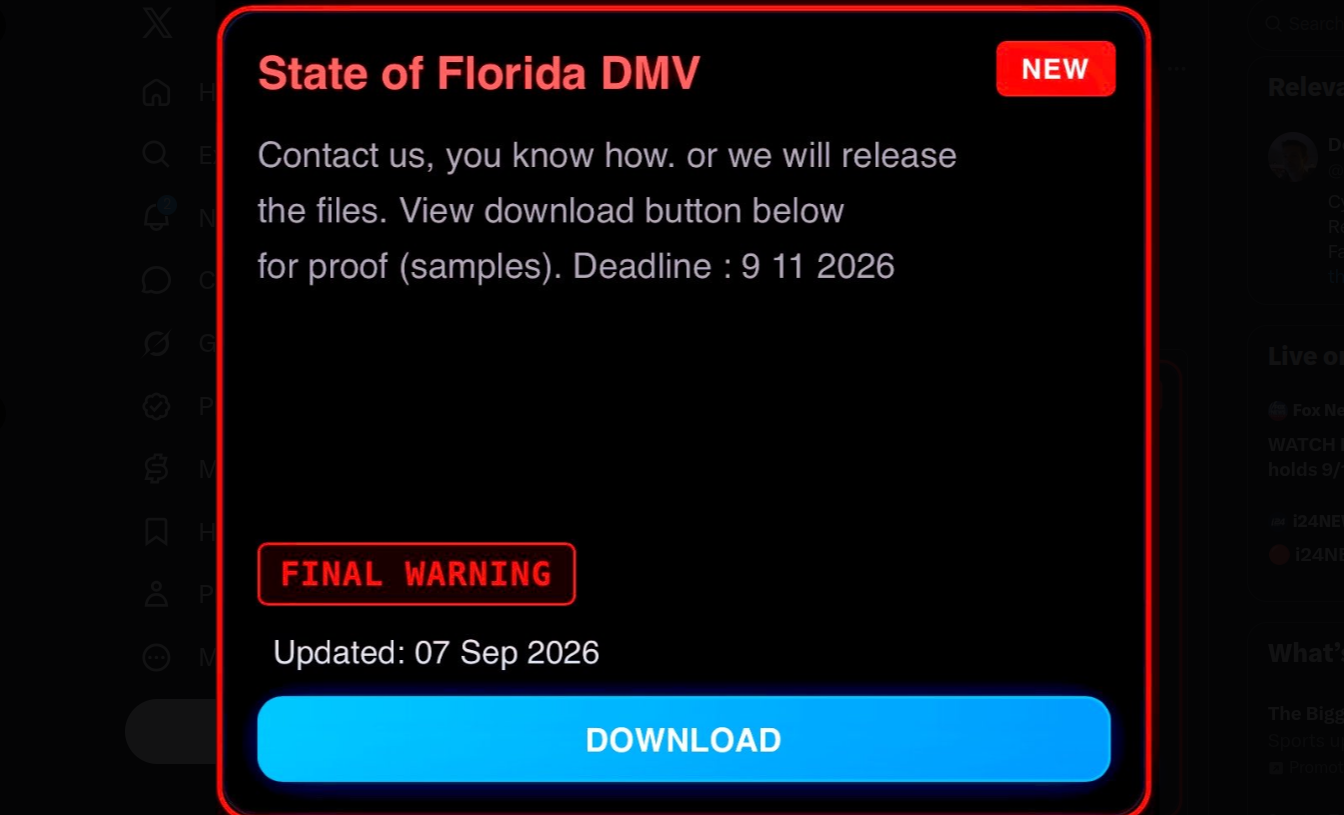
Florida’s driver’s licenses are allegedly at the mercy of hackers while the Seminole County Supervisor of Elections page is showing Japanese characters on Google search, in an unwelcome post-Labor Day double play exposing major tech security concerns.
Per Dark Web Informer and other sites, the black-hat hackers at ShinyHunters have obtained a trove of driver’s licenses, which one theory holds were secured as part of the mammoth Nexus hack and dark web sale of 153 million driver’s licenses nationwide.
One license displayed as part of the database is not current: that of dead Palm Beach sex offender Jeffrey Epstein. So the database may or may not be current.
The extortion group SLSH is also circulating the data set, according to another source.
The Florida Department of Highway Safety and Motor Vehicles did not answer the phone or respond to emails from Florida Politics Tuesday morning asking what data was hacked, whether it was current or legacy, or what protections will be given to drivers whose data was exposed.

The Department has until Friday to contact the hacker, or the “files,” including those of Epstein and other past and present Florida motorists, could be released.
Beyond sensitive data being brokered on the dark web, the Seminole County Supervisor of Elections’ website features Japanese writing on the first page of Google search results.
Office employee Jennifer Carroll attributed the issue to “updates on the website.”
It is uncertain how quickly it will be resolved. Reindexing can take days or even weeks.
The actual spokesperson for the office, D’Anne Mica, said voters need not be concerned even though search results appear to be about Japanese flutes.

She stressed that all voter data is secure.
The office of Secretary of State Cord Byrd said the issue has been addressed.
“The Department of State was notified earlier today that a Japanese e-commerce site appeared in an Internet search for Seminole County Supervisor of Elections. The Department’s Cyber Security Team quickly worked with Seminole County Supervisor of Elections IT staff to triage the issue and to ensure no election security infrastructure was impacted. The web site acts as a hub for public information but is not associated with the Elections database. Additionally, the website was not defaced, but instead, the search index on Google was impacted,” a spokesperson said.
Google’s own AI suggests the anomaly is “almost certainly the result of a cyberattack known as the ‘Japanese keyword hack’ (or Japanese SEO spam) targeting the Florida election supervisor’s website.”
“Hackers found a vulnerability in the content management system (like WordPress or Drupal) used by that specific county’s Supervisor of Elections website. Once inside, they inject malicious code that generates thousands of fake, spammy web pages filled with Japanese text and links to e-commerce stores. The ‘flutes’ you see are just whatever random product the spam network is currently trying to promote or sell counterfeit versions of.”
The “cloaking” masks the pages from public view but lets Google index them, hijacking the government site’s authority to boost placements for e-commerce products.
___
Janelle Irwin Taylor of Florida Politics contributed to this report.