
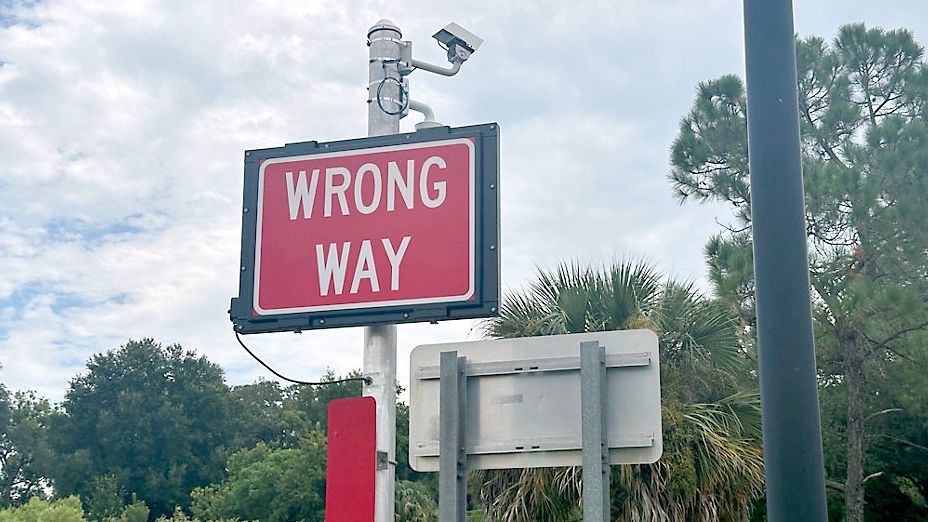
ORLANDO, Fla. — The Central Florida Expressway Authority has completed an expansion of its wrong-way driving detection and prevention system to all of the 102 active off-ramps it controls.
The expansion is part of a yearslong effort with University of Central Florida researchers to reduce wrong-way crashes on area toll roads.
The system is in place on toll roads operated by CFX, including state roads 408, 417, 429 and 528. It is designed to detect drivers entering an off-ramp in the wrong direction and alert them before they reach the mainline.
A study from the AAA Foundation for Traffic Safety found 406 deadly wrong-way crashes in Florida between 2014 and 2023 It found Texas, California and Florida had the highest numbers of fatal wrong-way crashes.
UCF engineering professor Haitham Al-Deek, who has spent years working with CFX on wrong-way driving prevention, said the goal is to stop drivers before they continue onto the expressway.
“The idea is to prevent drivers from continuing going the wrong way all the way to the mainline,” Al-Deek said.
When a driver enters an off-ramp the wrong way, red lights activate on a wrong-way sign and cameras notify the Regional Transportation Management Center. The Florida Highway Patrol is contacted, and message boards along the expressway alert other drivers.
CFX has also installed illuminated raised pavement markers on some ramps. UCF researchers found the markers have helped wrong-way drivers turn around earlier on ramps compared with locations without the markers.
Brian Hutchings, with the Central Florida Expressway Authority, said delineators have been added at some locations to guide drivers toward the correct ramp.
“Previously, cars could more easily take that left turn and go down the wrong way on the ramp,” Hutchings said. “Now with those new traffic delineators, it pushes the folks that are going to take the eastbound 408 on the correct ramp.”
Hutchings said the deterrents have caused more than 2,500 wrong-way drivers to turn around before entering the expressway, an 88.6% turnaround rate. He said the agency’s goal is a 100% turnaround rate.
CFX is also testing a new pilot program to detect wrong-way drivers on the mainline system, not just on off-ramps.
“It helps use some AI technology, and it really fills in some of the blind spots that we have,” Hutchings said.
For drivers such as Jose Velazquez, the issue is personal. Velazquez said he once encountered a wrong-way driver on Colonial Drive traveling at high speed.
“If that guy would have hit me the way, I mean, at the speed that he was going to, I probably wouldn’t survive,” Velazquez said.
Velazquez said he has noticed the wrong-way driving additions on the road.
Five locations do not yet have the wrong-way driving technology completed because they are in construction zones. Those locations will be added during construction, according to CFX.