
Fire Station 22 was showing its age long before Hurricanes Helene and Milton sent several feet of water through the St. Pete Beach structure.
Nearly two years after the 2024 storms, the old station at 1950 Pass-A-Grille Way is gone and the city is ready to start over. St. Pete Beach will break ground Sept. 16 on a roughly $10.5 million replacement designed to better withstand hurricanes and meet the needs of a fire service that has changed considerably since the original station opened in 1974.
Fire Chief Adam Poirrier said construction should begin within about two weeks of the ceremony. The current schedule calls for a roughly 14½-month build, putting firefighters on a path out of the temporary quarters they have occupied since the storms.
What will rise on the small Pass-a-Grille property bears little resemblance to the building it replaces.
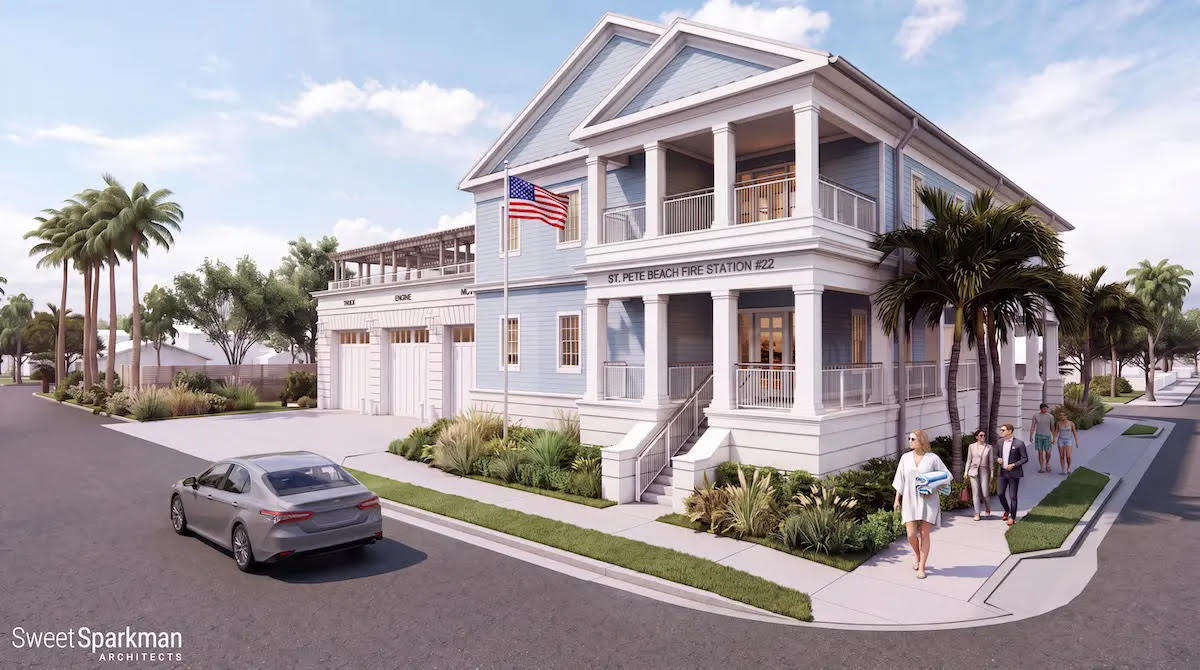
A rendering from Sweet Sparkman Architecture & Interiors shows a two-story, pale blue and white station with broad porches, columns, railings and pitched gabled roofs. The apparatus bays sit along one side rather than dominating the front, giving the building more of the appearance of a large coastal home than a conventional firehouse.
That was a consideration from the start.

Adam Porrier, St. Pete Beach Fire Chief. Photo provided.
“We really wanted to fit in with the fabric of the community,” Poirrier said. “I think when people drive past that they may mistake it for a house. It should really blend in with the community that it’s serving.”
Behind that exterior, the station is being built around lessons learned from the building it replaces.
The site lies in a FEMA Coastal A flood zone, and the new station will raise its living quarters above the floodplain. Early architectural work also identified foundation design and the potential for soil scour during flooding as considerations.
For Poirrier, the measure of that work will come when another major storm reaches the barrier islands.
“The goal [is] that if a hurricane were to strike our area again, we can get our firefighters right back into that station as soon as it passes and provide service to the south end of our city, and really the south end of Pinellas County,” he said.
Station 22 serves Belle Vista, Vina Del Mar, Don CeSar Place and historic Pass-a-Grille. Its crews can also respond elsewhere through Pinellas County’s closest-unit dispatch system.
The problems with the old station went back much further than Helene and Milton.
A 2011 structural analysis found the 1974 building could not withstand minimum hurricane-force winds of 130 mph and recommended replacing it with a Category 5 hurricane-resistant facility. Hurricane Irma delivered another warning in 2017, when a generator failure and other damage left Station 22 uninhabitable for weeks. Moving crews to Station 23 significantly increased response times, according to city documents.
By 2019, St. Pete Beach had made replacement part of its resiliency planning. Early estimates put construction at about $4 million, and the city hired Sweet Sparkman to design the replacement.
Then Helene and Milton settled the question of how much longer the old station could remain.
Poirrier said between three and four feet of water entered the building because it had been constructed at grade.
“It was identified for replacement before the storms,” he said. “So that really kind of expedited the need to rebuild the facility.”
A post-storm assessment estimated repairs at about $251,000, but that work would not have brought Station 22 into compliance with current codes. City officials determined the damage exceeded 50% of the building’s value, triggering requirements to meet current building and fire standards.
Those requirements also showed how far the fire service had moved beyond a station built more than half a century ago.
The old building could house no more than five firefighters, with three sharing a bunkroom smaller than 160 square feet. It lacked modern contamination-control areas and separation between sleeping quarters and the apparatus bay. Bringing it to current standards would also have required new fire alarms, sprinklers, an emergency generator and separate ventilation for areas where contaminated equipment is handled.
Poirrier, who has spent more than 25 years in the fire service, remembers when departments relied more heavily on volunteers and stations were built largely around male firefighters who did not necessarily spend the night.
“You know, where we would just have male restrooms in the 1970s, we need, you know, male and female facilities,” Poirrier said. “Back then they had volunteers. So a lot of times the firefighters didn’t even stay at the station overnight. Whereas now, you know, they spend over a third of their life in these stations.”
Today, firefighters work 24-hour shifts in buildings that serve as both workplaces and homes. Concerns about what they carry back from emergency calls have also changed the way those buildings are laid out.
“Probably the most significant thing of recent times is the focus on the health and safety of the firefighters,” Poirrier said. “Two of the biggest ones are cancer prevention and mental health.”
The new Station 22 will separate potentially contaminated areas from living quarters. Plans also include a balcony and rooftop outdoor area, giving firefighters somewhere to get outside during long shifts.
Building that station has become considerably more expensive than St. Pete Beach first expected. The city’s presentation attributes the increase from an early $4 million estimate to inflation, delays and other factors, with the project at one point estimated between $10 million and $12 million. Poirrier said the approved contract, including contingencies, is now about $10.5 million.
The city has secured outside money to absorb much of that cost. Poirrier said more than $6.5 million in state appropriations will go toward the project, while expected insurance proceeds from the damaged station should further reduce the city’s share.
“Between that six and a half million dollars that we got in state appropriation money plus the insurance, the expected insurance contributions due to the damage to the previous building, we’re really reducing the overall cost on the St. Pete Beach taxpayers,” he said.
For now, Station 22’s firefighters remain in temporary quarters. Poirrier described their current home as essentially a doublewide trailer.
The arrangement is far removed from the station they are preparing to move into, but Poirrier said the crews have kept working through it.
“Obviously not optimal for our firefighters,” he said. “They continue to show up each day with a smile on their face even though they’re in some tough living conditions.”
The Sept. 16 groundbreaking will start the clock on getting them back into a permanent home. It will also begin the city’s attempt to make sure that when the next major hurricane crosses St. Pete Beach, Station 22 is part of the response rather than part of the damage.
For Poirrier, the new station will ultimately belong to the firefighters who spend their shifts there and the community waiting on the other end of their calls.
“For me, it’s a source of pride that we’re able to provide such a safe, resilient and I think healthy fire station for our firefighters to again continue to serve this community with pride each and every day,” he said