
If Amendment 3 passes in November, it would reduce taxes for many homeowners. However, it would also cut revenue for cities, counties and other local taxing authorities.
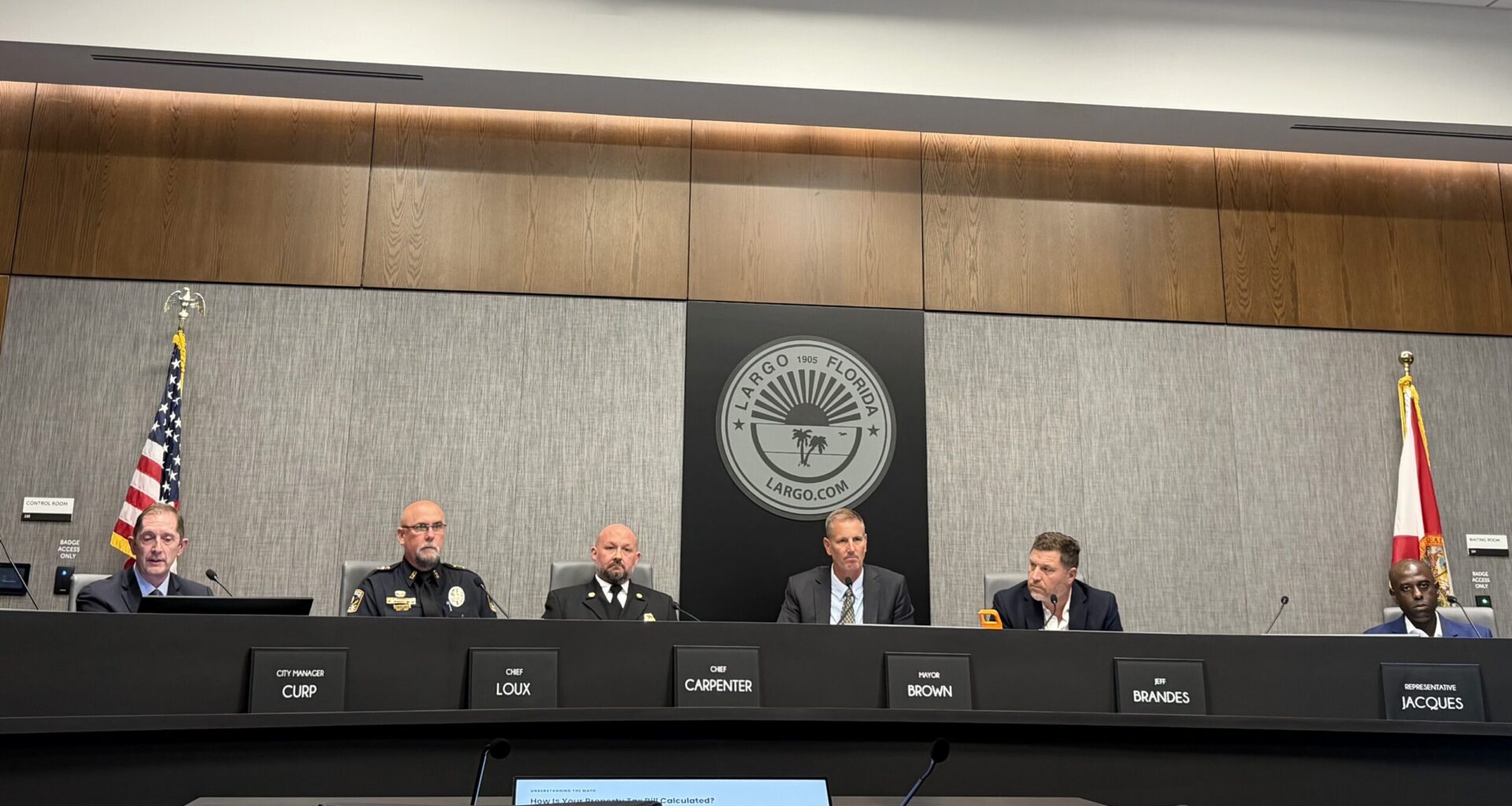
The City of Largo hosted the “Community Town Hall: How Property Taxes Fund City Services” event Wednesday evening at the Horizon West Bay development.
State Representative Berny Jacques of District 59, which includes Largo, and former Florida senator Jeff Brandes were guest speakers at the gathering. Largo City Manager John Curp, Police Chief Mike Loux, Fire Chief Matt Carpenter and Mayor Woody Brown also participated.
Prior to the town hall, Jacques criticized the fact that Brandes, an outspoken critic of Amendment 3, was invited to participate in a public forum. This led the City of Largo to include Jacques in the conversation as well.
READ MORE: Largo’s property taxes forum becomes a political flashpoint
Qualifying Florida homeowners can receive a homestead tax exemption up to $51,411 for the 2026 tax year. A homestead property is a person’s primary residence and permanent legal home.
If passed, Amendment 3 would increase Florida’s homestead exemption for non-school property taxes to $150,000 in 2027 and $250,000 in 2028. Inflation adjustments would follow. However, people who are not Florida residents as of Dec. 31, 2026, would receive only the existing exemption if they qualify. They would become eligible for the increase “beginning with the fifth year of exemption,” according to the amendment’s language.
Curp explained to the attendees that City operations are mainly financed through the municipality’s general fund. The Largo government also has other funds to pay for services such as wastewater, risk management and trash and recycling. He added that property taxes are not the City’s only revenue stream. However, they “make up about 50% of our general fund.”
Curp said that Largo’s current millage rate is 5.5200. Homeowners pay “on average $1,046 a year or $87 a month in property taxes.” Currently, 53% of homes in Largo are considered homestead residences.
“The current proposal would, over two years, expand the property tax exemption to $250,000 for a homestead parcel,” Curp said. “So, at the end of two years, the City of Largo would see a $15.7 million reduction in revenue annually.”
This is about a 26% reduction in the municipality’s general fund. He explained that the amendment will also impact Pinellas County’s funding. As a result, some Largo services could be affected.
To show the potential impact, Curp explained that if the City decided to stop funding library and recreation services, this would only save $10.2 million. The municipality would have to “come up with $5.5 million from the budget in reductions.”
Any potential cuts will be made throughout the budget process, Curp emphasized. The police and fire departments are not exempt.
“In reference to budgeting, about 81% of the police department’s budget is directly tied to personnel costs,” Loux explained. “If the police department were to reduce the amount of money in our budget, it would more than likely have to come directly from the reduction of personnel.”
Additionally, the force would have to consider how it prioritizes services and determine what operations are critical.
Carpenter echoed similar concerns. He argued that reductions could lead to longer response times. More than 90% of Largo Fire Rescue’s budget is reserved for personnel.
“I have to start my remarks by saying how disappointed I was in the City attempting to campaign against Amendment 3 using your taxpayer dollars,” Jacques said. “As I sit here this evening, I gotta say something tells me that they’re still trying to do it and this is evidenced by the fact that the leaders of City Hall brought forth and featured the chiefs of the two most popular departments of the City to tell you that property taxes, if they are cut, will somehow harm the things that we care about the most.”
He emphasized that public safety should not be used as a voting “scare tactic.”
“If there is a revenue shortfall, these great guys would be the last people to see any cuts,” Jacques said. “The commissioners are smart enough to know that defunding the police is a bad idea, especially when it would be against your wishes.”
Additionally, he argued that the State of Florida would “never allow public safety to be harmed.”
If the City of Largo was forced to make changes, Jacques explained, leaders would have a choice in what reductions they select, if any. As a result, if they decided to decrease funding for police and firefighter personnel, he said that “that’s a choice that you can hold them accountable to.”
Jacques believes there are “a lot more wasteful things” that could be cut if needed. City leaders will have to review their budgets, he added, and determine their priorities just like families do.
“The great poets Paul Simon and Art Garfunkel, in the song ‘The Boxer,’ gave us the lyrics that I think we should talk about a little bit tonight,” Brandes said. “They are ‘a man hears what he wants to hear and disregards the rest.’”
“I am somebody who believes that the current system is not working and it creates huge inequities throughout our community,” he continued. “The question that we should be talking about is this the right reform?”
Brandes believes that lawmakers do not know how Amendment 3 will impact home affordability, renters and small businesses.
“My argument all along has been that what you’re being proposed with is not a tax cut,” he said. “It’s actually a tax shift and we’re already seeing this. St. Petersburg is already discussing a fire fee. Counties and cities throughout the state of Florida are discussing fire, wastewater and transportation fees. Basically a lot of things are going to shift to non-ad valorem. The challenge with non-ad valorem taxes is there are no exemptions.”
According to Property Exemption.com, non-ad valorem assessments are “are special charges for specific services or improvements that appear on your property tax bill but are calculated using a flat fee, per-unit basis, or other measurement completely independent of your property’s value.”
“Those non-ad valorems can stack together,” Brandes said. “Could the County create an emergency medical services non-ad valorem fee and then the Fire Department create a non-ad valorem fee? Absolutely. And this is what you are going to see.”
He argued the inflation component of Amendment 3 could further have a negative impact on local governments.
“Understand that city inflation is not like the core consumer product index,” Brandes said. “The City isn’t out here buying TVs and apparel. It’s buying health insurance, firefighters, fire trucks, concrete and police officers. Those things actually cost and rise more than inflation. So, what ends up happening is that cities get squeezed from both ends. Their taxable revenue is declining every year and their costs are going up every year at a rate greater than inflation. So what happens? They have few choices.”
Brandes believes that the City of Largo will survive if Amendment 3 passes. However, he said that some municipalities may have more difficulty if the law takes effect.
When asked about why the City chose to build the over $80 million Horizon West Bay facility when the funds could have been used elsewhere, Curp explained that Largo’s former City Hall “was beyond its useful life.”
While the municipality could have constructed a new building on the site, it chose to acquire another property. As a result, Horizon West Bay was designed to be mixed-use development with retail space options. He said that this will “generate property taxes.”
Curp argued that such an investment in the City could increase property tax revenue across Largo’s boundaries over time as well.
The former City Hall site flooded during Hurricane Milton in 2024, Brown added. Horizon West Bay is located about 72 feet above sea level. “That’s important because if we want to keep the City running during a storm,” he said, “it’s nice to be actually able to be in the building that you run things from.”
Additionally, Brown believes Horizon West Bay “has better connected us to the community.” He explained that the former City Hall building was not in the downtown area.