
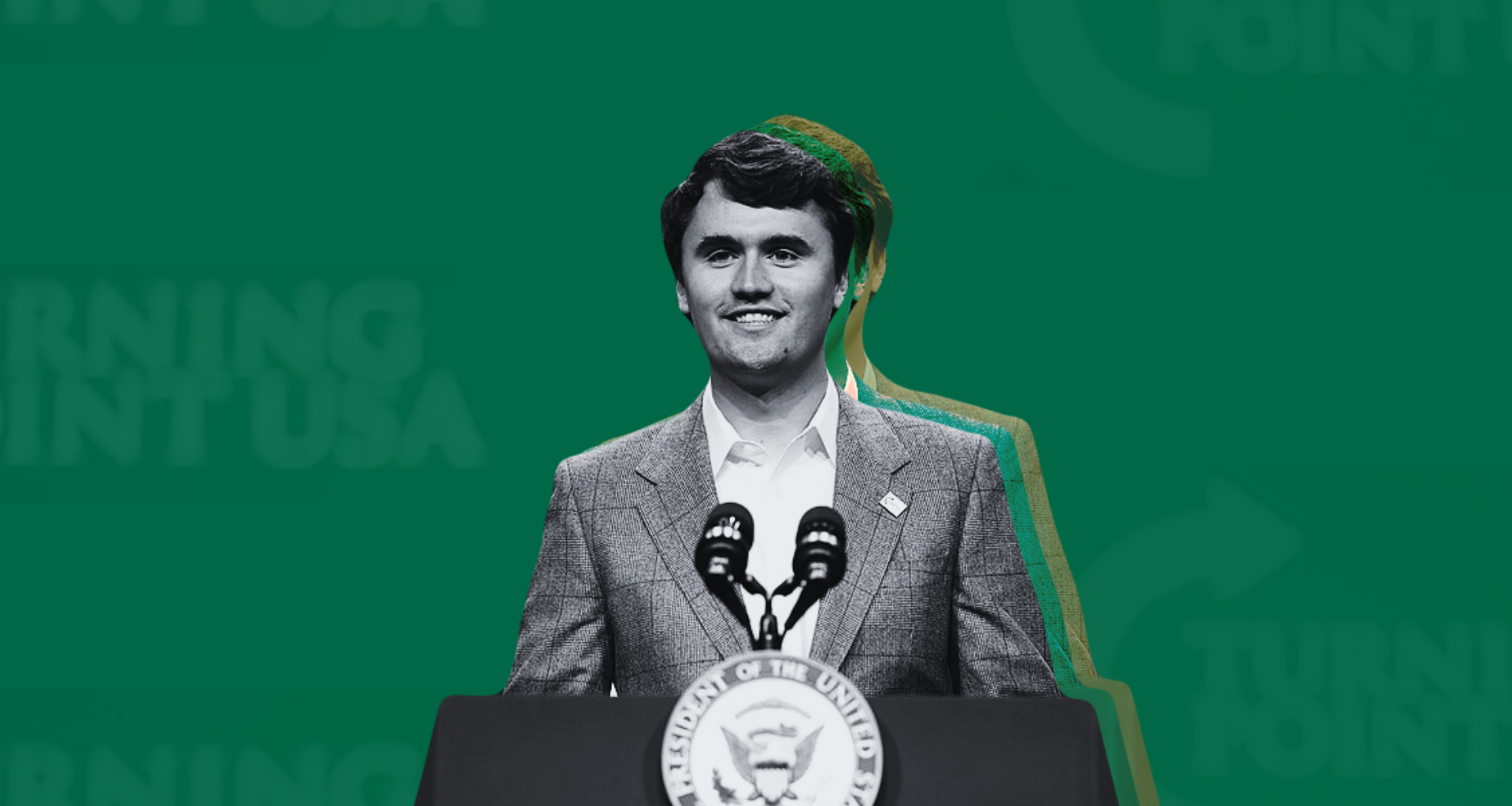
 A year after his death, Kirk’s complicated relationship with college campuses continues to spark debate among USF students. ORACLE GRAPHIC / AMARIS BAEZ
Where were you when Charlie Kirk died?
For some USF students, Sept. 10 holds importance as the anniversary of the death of conservative activist Charlie Kirk. For others, it may be a day they barely notice.
The importance of the date to some students is an example of how political events increasingly follow students into classrooms, group chats and social media feeds.
On Sept. 10, 2025, Kirk was fatally shot while speaking to students at Utah Valley University during an event organized by Turning Point USA, the conservative youth organization he co-founded.
Kirk had become a prominent figure among young conservatives, building a large social media following and gaining national attention for his campus appearances, where he regularly debated students who disagreed with his views.
A week after his death, USF became one of the campuses where Kirk’s supporters gathered to remember him.
A vigil organized on Sept. 17, 2025, by Turning Point USA at USF, USF College Republicans and the Network of Enlightened Women drew in hundreds of students, with 934 USF students registering to attend.
The turnout was a reminder that Kirk’s relationship with college campuses did not end with his death. In fact, it may have become even more complicated.
There is an irony in Kirk’s relationship with higher education. He repeatedly criticized the value of college— at one point calling it a “scam” in his book “The College Scam”— while making college campuses a central stage for his political activism.
Kirk had already made his mark on USF before his death. On Feb. 20, 2025, he brought his American Comeback Tour to campus, where he debated students at the same spot where hundreds would later gather to mourn him.
After his death, his influence reached even further. A Florida bill proposed renaming USF’s Alumni Drive after Kirk, along with roads at public colleges and universities across the state.
A man who called college a “scam” could potentially have his name permanently attached to a college campus.
His campus appearances were not accidental— they were central to his political activism, and that is what makes his relationship with higher education so complicated.
He knew students would challenge him, but kept showing up anyway. He traveled across the country, campus to campus, putting himself in front of students who disagreed with him.
For college students, that may be the more important part of his legacy to examine.
Not whether we agreed with Kirk. Not whether we liked him.
But whether we are still willing to engage with people whose ideas we strongly disagree with.
Related: Charlie Kirk vigil at USF draws thousands of attendees
For Katie Campbell, a sophomore biomedical science major, Kirk was never someone she followed closely.
She first heard about his death while studying in her dorm with friends and said she was surprised, but not entirely shocked, given how polarizing his public presence had become.
“He didn’t mean anything significant,” Campbell said. “He was kind of, to me, just ignorant. I didn’t give him that much attention.”
Yet dismissing Kirk did not mean dismissing the effect he had on students.
“If anything, I think he’s made people more passionate, just about what they believe in, whether they agree or disagree,” Campbell said.
That may be one of the more complicated parts of Kirk’s legacy. A person can reject everything someone stands for and still recognize that their presence forced people to think more seriously about what they believe.
Campbell also sees a lesson in how students respond to people they disagree with.
“Try to be respectful, even if you disagree with someone, but stand your ground for what you do believe in,” she said.
But there is a limit to how much engagement everyone is willing to give. Asked what she would say if Kirk were standing on USF’s campus today, challenging students to “prove me wrong,” Campbell’s answer was blunt.
“Shut up,” she said.
Abbie Kent, a sophomore biomedical sciences major, approached Kirk’s legacy from almost the opposite direction.
To Kent, Kirk’s campus appearances were an exercise of his right to express his political views, even when those views upset people who disagreed with him.
And, in her view, there was a certain logic to Kirk choosing college campuses as his stage.
“Because if you’re gonna talk about and have a big opinion on higher education, I might as well go talk to the people that are getting one,” Kent said.
Kent said she believed Kirk was willing to stand behind his own views without dismissing the people challenging him.
“He understood that the other people had some views,” she said. “So he took the right approach to it.”
Kent believes students should take that willingness to engage from Kirk’s campus debates. Political disagreement does not have to mean refusing to listen.
When asked what she would say if Kirk returned to USF and told students to “prove me wrong,” Kent said she would try.
“I’d try my best to prove him wrong, but also be more objective to his point of view,” she said. “Obviously, he’s right in his mind, and I’m right in my mind.”
And perhaps that is the tension at the heart of Kirk’s legacy on college campuses.
One student would tell him to shut up. Another would try to prove her point of view.
Both are responses to the same challenge: What do we do when someone says something we fundamentally disagree with?
That is where college should matter most.
Related: USF students criticize bill that could rename Alumni Drive after Charlie Kirk
Whether you agreed with Kirk or not, his invitation was simple: “Prove me wrong.”
There is something worth examining in that approach. His politics were controversial, his rhetoric was provocative and his presence on campuses could be deeply divisive.
But he understood the power of putting ideas in a room with the people who challenged them.
However, disagreement does not have to mean division. Debate does not have to mean treating the person across from you as an enemy.
That is where I think Kirk’s legacy becomes more complicated.
College is supposed to be a place where ideas are challenged— including the ones we hold most strongly. Sometimes that means hearing something you hate. Sometimes it means defending a belief you have never had to defend before.
Maybe that is exactly why college campuses became Kirk’s stage.
He knew that college students would challenge him. But he kept showing up.
Sometimes, it means realizing the person across from you has a point.
Kirk spent years standing on college campuses asking students to “prove me wrong.” A year after his death, that challenge is no longer his to give.
It’s ours.
Are we so convinced that we are right that we no longer want to hear anyone prove us wrong?
That may be the real legacy of Kirk’s campus debates.