
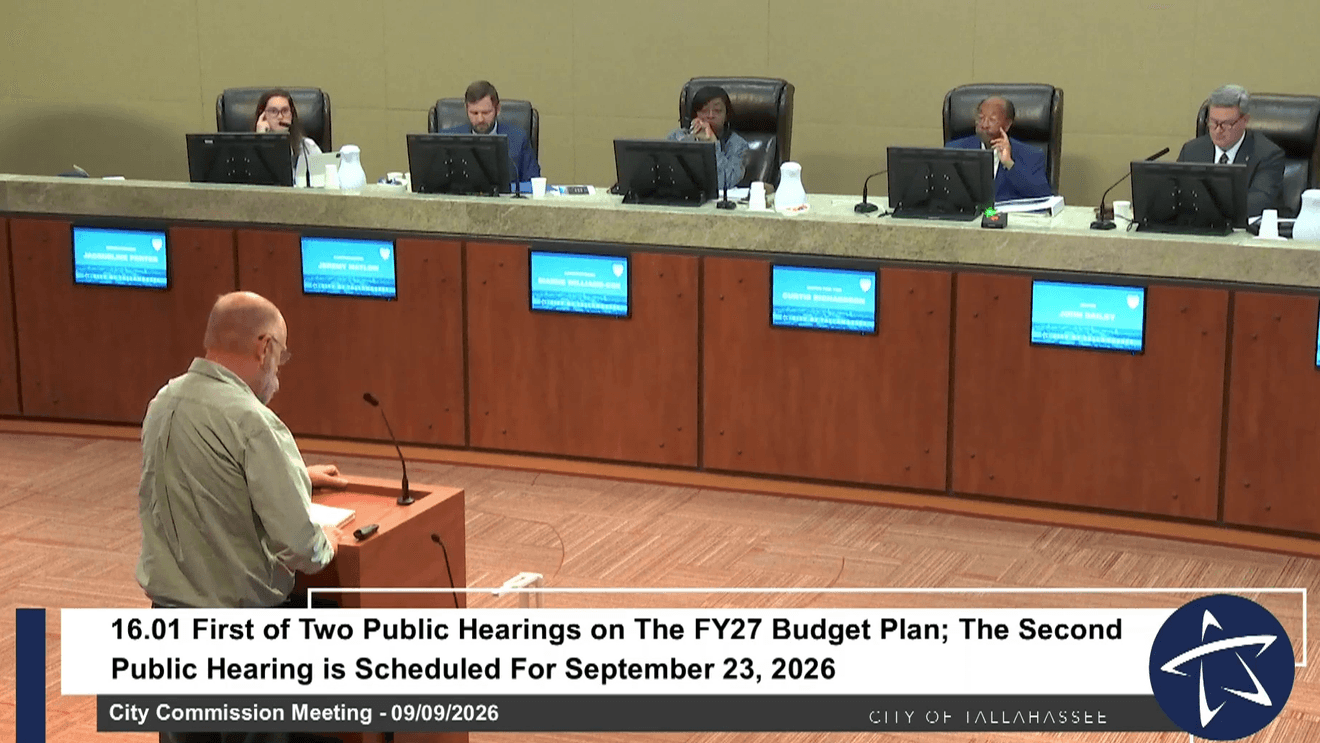
Tallahassee commissioners advanced the city’s fiscal 2027 budget and a 4.4072-mill property tax rate, but the hearing exposed unresolved questions about a $15 million employee buyout, how many positions have already been refilled and a more than $1 million HUD repayment that is not included in the spending plan. The final budget hearing is Sept. 23.
TALLAHASSEE, Fla. — Tallahassee is one vote away from locking in its next city budget, but Wednesday’s first budget hearing revealed something taxpayers may not see by simply looking at the bottom line: some significant financial questions remain unresolved.
The City Commission tentatively approved a 4.4072-mill property tax rate, above the rollback rate of 4.2782 mills, as well as the city’s fiscal year 2027 budget.
The proposed aggregate millage rate is 3.47% above the aggregate rollback rate, according to the city. The higher rate required a supermajority and passed 4-1, with Commissioner Jeremy Matlow opposed.
The tentative budget ultimately passed 4-1, with Commissioner Jack Porter voting against it after asking that the record be corrected to reflect her intended vote. Matlow, Mayor John Dailey, Mayor Pro Tem Curtis Richardson and Commissioner Dianne Williams-Cox supported the budget.
But the debate that preceded those votes exposed several issues likely to follow commissioners into their final budget hearing Sept. 23.
Among them: What did Tallahassee actually get for a $15 million employee buyout? How many of those jobs have already been refilled? And where will the city find more than $1 million if it ultimately has to reimburse the federal government over a HUD lead-abatement grant?
Right now, city officials don’t have final answers to all three.
$15 million buyout, 171 employees — but how many jobs came back?
One of the most consequential exchanges involved Tallahassee’s voluntary employee separation program.
City officials confirmed 171 employees took the buyout.
The discussion became complicated as officials worked through several different numbers associated with the program — its cost, projected savings and savings ultimately reflected in the proposed budget.
Staff said the original savings associated with the departures were approximately $14 million. That was later projected at roughly $8 million to $8.45 million after accounting for positions that would need to be refilled to maintain services.
The fiscal 2027 general fund ultimately reflects about a $4.45 million reduction in personnel services tied to the process.
But another number emerged during questioning that is critical to understanding the program.
The total cost of the buyout was approximately $15 million, according to staff.
Officials said participating employees received $25,000 payments, with health care coverage also included in the overall cost discussion.
That prompted Matlow to press staff on a basic question: How many of the 171 positions have already been refilled?
The city did not have an exact number.
Human resources officials said the figure is still changing as departments determine which positions are critical, which can remain vacant and which can be reorganized or refilled at a lower cost. Staff said they could provide commissioners with updated numbers.
Matlow argued that without that information, it is difficult to determine whether the buyout delivered the savings taxpayers were promised.
“Can you understand how it’s difficult to understand if this buyout makes financial sense?” Matlow asked.
The unanswered question matters because the buyout is being used as part of the city’s case that it has reduced spending and positioned itself for future financial pressure.
City: Most vacated jobs have not been filled
City Manager Reese Goad pushed back on the suggestion that the city is simply paying employees to leave and then replacing them.
Goad said the vast majority of vacated positions have not been filled and have been “zeroed out” for budget purposes.
The full-time positions have not necessarily been formally eliminated, but departments will not have money available to automatically refill them. Any critical positions that need to return will have to be worked through the budget and human resources process.
The Tallahassee Police Department illustrates the complexity.
Goad said some critical TPD positions were immediately refilled, but because the department frequently promotes from within, filling one position can create another vacancy farther down the organization. The result, he said, is that TPD still has net vacancies.
Staff also said positions that are refilled can be brought back at lower salaries or departments can reorganize rather than replace every employee who left.
What commissioners still did not receive Wednesday was a definitive accounting showing how many of the 171 positions remain vacant, how many have been refilled and what the actual net savings will ultimately be.
That information was requested before the budget process is completed.
More than $1 million HUD repayment is not in the budget
A second financial issue emerged when Porter asked about money the federal government has told Tallahassee must be reimbursed in connection with a HUD lead-abatement grant.
Porter said the city received notice that more than $1 million in federal grant funding must be reimbursed.
She asked a straightforward question: Is that money in the proposed budget?
The answer was no.
City staff said they want more certainty about the ultimate outcome before setting aside money that could otherwise be used elsewhere.
“So that is not reflected in the budget at this time,” staff told commissioners.
Matlow returned to the issue later.
He noted that the HUD letter said the money would be required to be reimbursed and asked where Tallahassee would find the money if the repayment becomes final.
Staff said the city would evaluate spending across departments at that point and determine what money remained available.
That means the proposed budget commissioners advanced Wednesday does not currently contain a dedicated appropriation for the more than $1 million HUD repayment.
For taxpayers, that creates an important distinction: the budget may be balanced as proposed, but a potential seven-figure obligation remains outside it.
City says higher millage gives Tallahassee a head start
City administrators defended the financial plan as preparation for what could be a much more difficult fiscal year ahead.
Staff said savings from the voluntary separation initiative and other efficiencies have produced a fiscal 2027 surplus.
Officials also said the additional revenue generated between the rollback rate and the proposed millage rate amounts to approximately $2.8 million.
The city wants that money available as a head start on fiscal 2028, particularly because of uncertainty surrounding a November vote that could affect future property tax revenue.
The budget also represents a milestone for Tallahassee’s reserves.
Staff said the city expects to enter a fiscal year with its deficiencies fund fully funded for the first time in 10 years, after rebuilding it through reimbursements, land-sale proceeds and other financial actions.
The city also pointed to Fitch Ratings’ reaffirmation of Tallahassee’s AA credit rating and stable outlook, saying Fitch gave the city its highest possible assessment for financial resilience.
Matlow pushes rollback rate
Matlow argued the unresolved costs and buyout questions showed there was still room to cut.
He pushed for the 4.2782 rollback rate rather than 4.4072 mills and suggested commissioners continue reducing expenses — potentially looking at half-percent or 1% reductions by department.
“What people are asking us to do is get our fiscal house in order, stop increasing taxes,” Matlow said.
He argued taxpayers believe they are reaching a “breaking point” after repeated increases.
The rollback proposal did not replace the millage ultimately advanced.
Porter supports millage but opposes budget
Porter took a different position.
She supported the proposed 4.4072-mill rate because of concerns about future revenue losses, but said she could not support the spending plan itself.
Porter argued the city needs to reconsider spending priorities and questioned whether enough alternatives had been explored before reaching the first public hearing.
“I really don’t support this budget,” Porter said, while acknowledging there was also “a lot of good” in it.
She said she was uncomfortable moving forward while significant questions remained.
That distinction ultimately produced the night’s split result: the millage passed 4-1 with Matlow opposed, while the budget passed 4-1 with Porter opposed.
Hospital money also helping balance general fund
The discussion also revealed another piece of the budget equation.
Matlow asked where revenue associated with the hospital sale was being placed.
Staff said it is represented in the general fund and acknowledged that revenue is part of what allowed the city to bring commissioners a balanced budget.
When Matlow asked whether the city was using the hospital revenue to shore up existing general fund expenditures, staff responded that the money is being used as one of the revenue sources to balance the general fund.
That creates a broader financial picture than the millage rate alone shows.
Tallahassee is relying on personnel savings, hospital-related revenue and a property tax rate above rollback while simultaneously rebuilding reserves and preparing for possible revenue changes in fiscal 2028.
At the same time, the precise final savings from the employee buyout remain unsettled and the potential HUD repayment remains outside the proposed budget.
Utility, garbage and parking costs also changing
The budget discussion isn’t limited to property taxes.
City staff also recommended rate changes intended to recover the cost of specific services rather than shift those expenses onto general property owners.
Solid waste costs are increasing primarily because of higher disposal fees charged by Leon County, according to staff. Parking rates are also being adjusted.
The city is additionally proposing what staff described as nominal utility increases of approximately 25 cents per month for water and $2.58 per month for wastewater, based on an independent rate study.
Sept. 23 is the final vote
Wednesday’s action was tentative.
The Tallahassee City Commission’s final budget hearing is scheduled for Wednesday, Sept. 23, at 6 p.m. at City Hall. Commissioners will consider final approval of the millage rate and fiscal 2027 budget at that meeting.
That hearing now carries additional significance because commissioners asked for information they did not have Wednesday — particularly a clearer accounting of the employee buyout.