
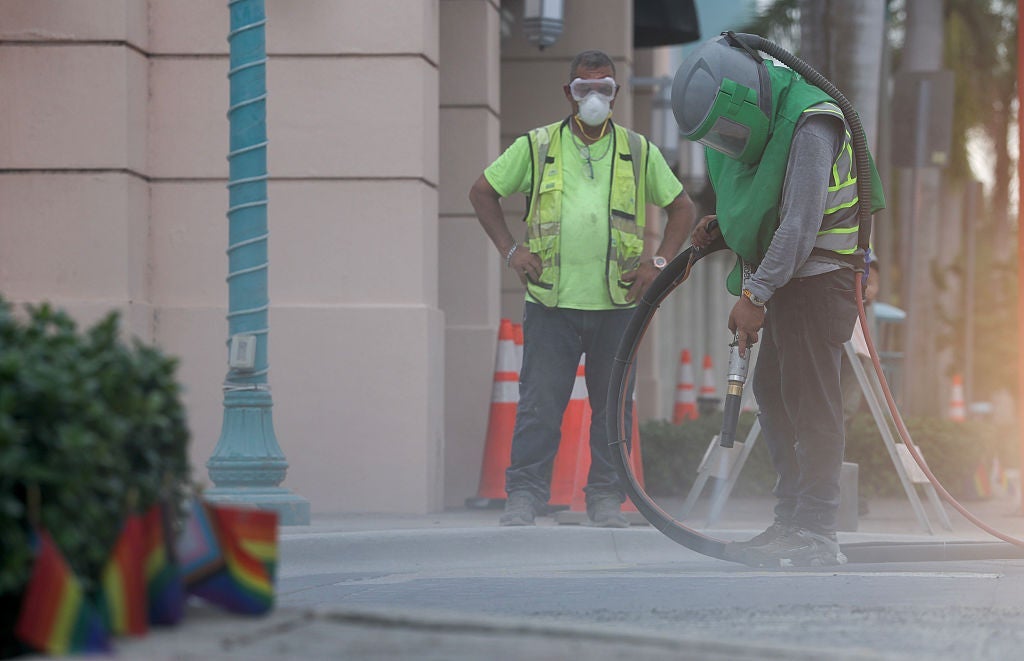
The Florida Department of Transportation blacked out two St. Petersburg street murals a second time. Parts of the original artwork had pushed through. The intersections at Central Avenue and 25th Street and Central Avenue and 5th Street received fresh coatings in recent weeks.
Traffic wore through sections of the covering over the Progressive Pride mural by late August. Traces of the rainbow began peeking through again. Common Ground — a multicolored geometric mural created by artist Cecilia Lueza — showed similar wear before workers returned with more paint.
According to the St. Pete Catalyst, FDOT first painted over both installations in August 2025, turning down a city request to exempt five street installations from new state requirements governing pavement markings. The agency warned it could withhold state transportation funding if the city refused to follow orders.
The Progressive Pride mural went up in 2020 near the birthplace of the city’s Pride celebration. Common Ground has occupied its intersection since 2016. That makes it the city’s first intersection mural.
Mayor Ken Welch’s administration declined to fight the order last year. City personnel wouldn’t remove the artwork themselves, Welch said at the time. That left FDOT to do the work.
The state claimed its crackdown was about roadway safety. FDOT maintained that nonstandard pavement markings could distract drivers and pedestrians or create confusion.
City Transportation and Parking Management Director Evan Mory told FDOT something interesting. A three-year before-and-after analysis of Common Ground showed a 70% drop in crashes at the intersection. Over the same span, crashes jumped 100% and 25% at the two adjacent intersections without similar treatments.
Welch pointed to those numbers while pushing back against the state’s safety argument. The city had presented the data to FDOT while seeking exemptions for the murals. The agency said no.
The state’s reasoning seemed tied to Senate Bill 1662, which Gov. Ron DeSantis signed in June 2025. FDOT Secretary Jared Perdue described it as keeping transportation facilities clear of political ideologies. An internal department memo identified social, political, and ideological messaging as examples of noncompliant street art.
More than 100 people gathered at the Progressive Pride intersection as the state’s removal deadline approached in 2025. They left chalk drawings and messages of support nearby. City Council passed a resolution in June opposing state legislation restricting municipal diversity, equity, and inclusion programs. The vote was unanimous.
New restrictions take effect Jan. 1, 2027. They don’t prohibit private Pride events and preserve content-neutral permitting and public safety services, but they restrict municipal funding and promotion of DEI initiatives.