
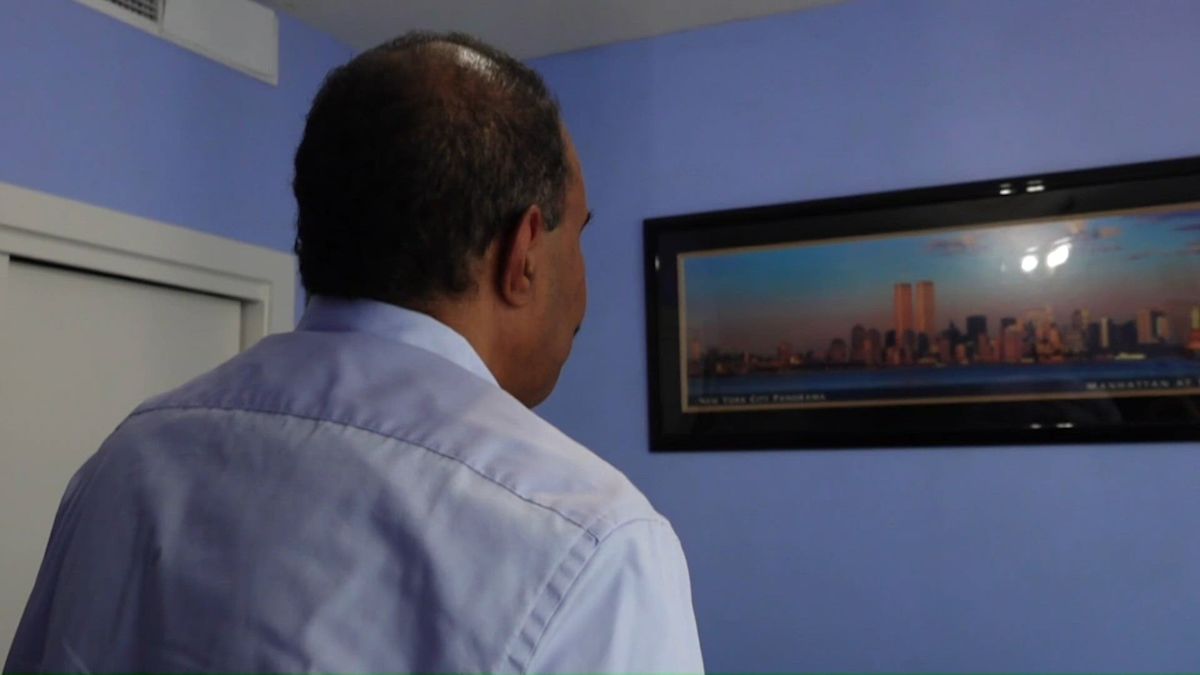
A photograph hanging in Ken Greene’s Tampa apartment contains dozens of faces he never wants to forget.
They are his former colleagues at the Port Authority of New York and New Jersey who died in the Sept. 11, 2001, terrorist attacks.
Greene looks at the photograph every day.
“Sometimes for a few seconds, sometimes for longer,” Greene said. “And it centers. It centers me.”
Twenty-five years after narrowly escaping the World Trade Center, Greene says remembering those who did not make it out — and making sure others understand what happened that day — remains part of his life.
Greene, a Bronx native, was working as an assistant director of aviation for the Port Authority on Sept. 11, 2001. His office was on the 65th floor of the World Trade Center’s North Tower.
He remembers looking out his office window that morning and noticing how clear the sky was.
“I was thinking about what a beautiful day it was just getting started,” Greene said.
Then, at 8:46 a.m., American Airlines Flight 11 struck the North Tower.
The impact shook the building, and Greene and his colleagues headed for the stairs. As they descended, he remembers smelling smoke and jet fuel and seeing people helping others make their way down.
Greene eventually reached the mezzanine level, just above street level. By then, he said, people had begun jumping from the floors above.
Rather than immediately leaving the building, Greene stayed behind to help police and firefighters manage the flow of people evacuating as emergency crews headed upstairs.
“It was instinct,” Greene said. “I worked there all those years.”
At the time, Greene said he did not know a second plane had struck the South Tower.
As Greene continued helping, he heard what he described as a “thunderous roar.”
He looked over his shoulder and saw the South Tower collapsing.
The force blew him off his feet. Greene said debris from the South Tower and portions of the North Tower’s mezzanine ceiling came down around him.
“I was crawling, trying to breathe, hoping that it wasn’t my last breath,” Greene recalled.
Through the debris, Greene heard a firefighter calling out and telling anyone who could hear his voice to crawl toward him.
Greene followed the voice and eventually made it outside. His years working in the World Trade Center helped him remember a stairwell that led from the plaza to street level.
“When I got down to the street, the North Tower collapsed,” Greene said. “So I beat it by maybe five minutes, if at all.”
Greene was eventually taken to a hospital in Jersey City. He said it was not until later that evening that someone explained the full magnitude of what had happened.
“The towers are gone,” Greene remembers being told.
Greene said the Port Authority lost 75 employees and nine contractors that day.
“They were family,” he said. “They were with us every day. They were part of our team.”
Greene later left New York and eventually moved to Tampa in 2019. But reminders of Sept. 11 remain throughout his home.
Along with the photograph of his colleagues, Greene keeps photographs of the World Trade Center, an FDNY hat and a replica of the towers in a corner of his den.
“A day doesn’t go by when I’m at home and I just take a look,” Greene said. “It’s somber, but it tells a story.”
Greene believes he has a responsibility to continue telling that story.
“I share it because I believe it’s important for people to understand what happened,” Greene said. “I think it’s important for people not to forget what happened, and I’m here to tell it.”
His story, however, is not only about what he survived. Greene also hopes people take away a message about what can happen after experiencing tragedy.
“You can come through something that is absolutely horrific, survive it, work your way through it, and then maybe life can be good again,” Greene said.
Each Sept. 11 in Tampa, Greene has his own quiet tradition. He walks the Tampa Riverwalk alone and stops at times corresponding with significant moments from the attacks.
During those stops, Greene said he gives thanks for still being alive and having another opportunity to get out of bed and walk — something thousands of people who died that day never had the chance to do again.
Twenty-five years later, the faces on the wall of Greene’s Tampa apartment ensure the people he lost remain part of his everyday life.
For Greene, remembering them also means making sure their story continues to be told.