
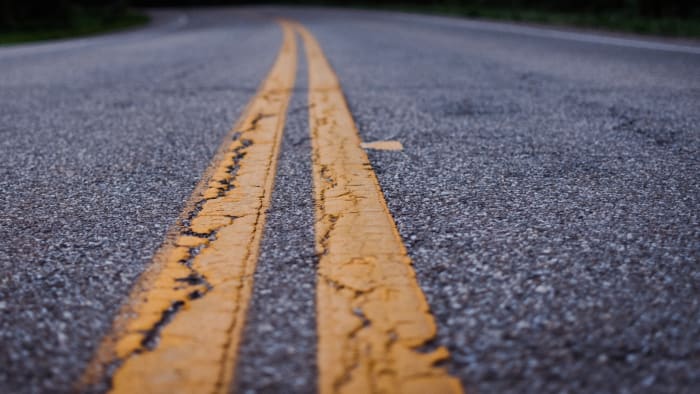
POLK COUNTY, Fla. – On a small plot of land in Polk County, a company is hard at work studying a road crafted from radioactive materials.
But is it something that local residents should be worried about?
The company, dubbed “The Mosaic Company,” told News 6 that the road is made using phosphogypsum (PG), a waste byproduct of processing phosphate ore into phosphoric acid, which itself is used in fertilizer.
However, the EPA notes that PG contains radium: a radioactive material that can potentially cause cancer. This radium can decay and form radon gas, which can cause lung cancer, though dried PG forms a crust that usually prevents much of this radon from escaping.
[EXCLUSIVE: Become a News 6 Insider (it’s FREE) | PINIT! Share your photos]
According to Mosaic, the road is constructed entirely on the company’s property near Mulberry, and it uses a mix of PG and several other materials for its road base. For now, the road is only being used for testing, so it’s not available to public traffic.
(Left) Location of the demonstration road at the Mosaic New Wales facility; (Right) Configuration of the 3,200-foot-long test road, which is set to feature alternating segments — some to contain the PG mix, and some without (University of Florida/Environmental Protection Agency)
EPA officials reported that PG is only being used in the road base, covered in 4-inch-thick asphalt pavement.
A Mosaic spokeswoman explained that once construction finishes this fall, each section of the test road will be evaluated over the course of 18 months to determine what impacts it may have on the environment, as well as how effective PG works as a road base.
“During this period, we’ll be working closely with and providing data to multiple regulatory agencies, including the EPA,” she told News 6.
A model from the EPA showing the formulation of a two-lane test road project in Central Florida (Environmental Protection Agency)
The project was officially approved by the EPA last year after the agency determined that “the proposed use of phosphogypsum is as protective of human health as placement in a stack.”
That approval came after weeks of public comment, the majority of which opposed the use of PG in public roads.
“Some comments were critical of the current state of phosphogypsum management and regulation,” EPA officials stated. “These comments were determined to be outside the scope of this action, which is limited to this small-scale pilot project on a private road.”
Another model of the test road released by the EPA (Environmental Protection Agency)
But despite the pushback, researchers with the University of Florida said the project could help determine a new use for PG, potentially turning the waste material into a sustainable building block for future roadways.
In 2023, Gov. Ron DeSantis signed off on a bill (HB 1191) that pushed for researching PG use as a building material and allowed its use in roadways. Legislative analysts at the time pointed to the 1 billion tons of PG in Florida taking up space.
“PG is a durable product,” analysts wrote. “It is stacked while wet and hardens to hold its shape. In the United States, the use of PG has been limited to certain agricultural applications and scientific research. In other countries, PG is looked at as a beneficial material that can be used in agriculture, forestry, building materials, concrete, and more.”
Phosphogypsum stack located near Fort Meade, Florida. These contain the waste byproducts of the phosphate fertilizer industry.
Mosaic Spokeswoman Chloe Renard recently noted that PG is already being reused “safely and effectively” in over 20 countries, involving projects like agriculture, road construction and reforestation programs.
“Countries like Canada and Belgium, for example, have successfully used (PG) in construction,” she explained.
In March, Mosaic provided the following statement to News 6 regarding the test road project:
“Trust the science. A host of regulators are involved throughout the process. Federal regulations require the EPA to perform a rigorous scientific risk analysis when evaluating a request to use phosphogypsum beneficially. The impacts to human health and the environment are the primary focus of that analysis.
At the end of the day, we welcome robust testing. We want people to know this is a safe and worthwhile resource not a waste, and we are decades behind others who long ago realized just that.
We believe there is great value in the principles of a circular economy whereby materials formerly viewed as wastes can be used or recycled beneficially. PG has value in the right circumstances, and we expect the results of the road trial to reflect that.”
The Mosaic Company
Copyright 2025 by WKMG ClickOrlando – All rights reserved.