
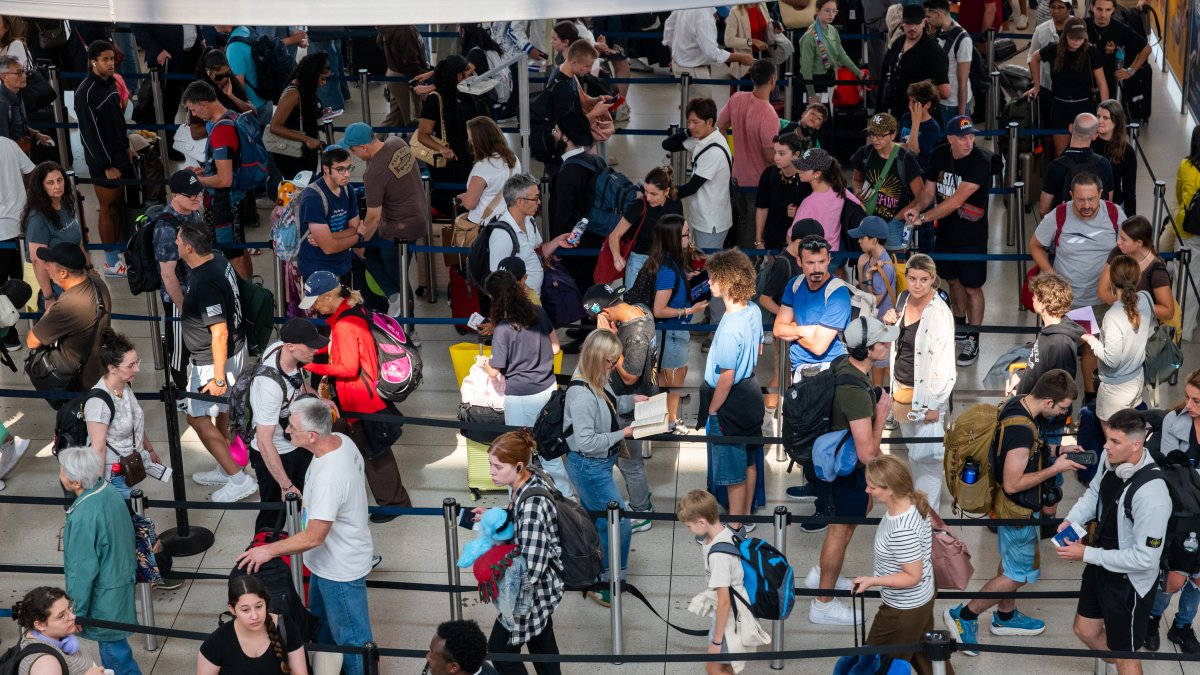
At any American airport, it’s hard to imagine air travel without TSA.
But before 9/11, the Transportation Security Administration (TSA) did not exist.
“The FAA was in charge of security screenings,” explained Angela Gittens, former director of Miami International Airport (MIA). She served as CEO of MIA from 2001 to 2004.
Flying was a lot different then. You could bring your 20 oz shampoo bottle, water bottle, or just about any-liquid bottle inside your carry-on just fine.
Screeners were “private contractors of the airlines back then,” Gittens said. And those screeners had different objectives than today. In a sense, they were looking for the wrong thing.
“The issue was to make sure that guns didn’t get on the plane,” Gittens said. Hijacking a plane was a concern, not using the plane as a killing machine.
Then came Sept. 11, 2001. The weapons: box cutters, not guns.
Gittens remembers her head of operations running into her office and mentioning an accident at the World Trade Center.
“We turned on the television, and we see this plane,” she said. “Then we saw it turn.” She recalled how the TODAY Show host at the time – Katie Couric, said it was the “second plane,” and the shot was “live.”
That’s when Gittens made the call.
“I said shut the airport down, now,” she said. “We didn’t know what was happening.”
Through an act of Congress signed into law by then-President George W. Bush, the Transportation Security Administration was born weeks later.
Gittens presided over changes at MIA in the aftermath with major security overhauls, including stricter screening protocols that required all passengers and carry-on luggage to pass through rigorous metal detectors and x-ray devices.
Nearly 25 years after its inception, the TSA keeps adjusting its methods.
“TSA has continuously upgraded the screening technology,” noted TSA Deputy Assistant Federal Security Director Gendry Quiroga. “Moving from the basic metal detector to what you see now, which is the advanced imagery technology.”
And the security is more than meets the eye, with undercover officers through the Federal Air Marshal Service, and vigilance behind the scenes.
“TSA is not just what you see at the checkpoint, or at the airport,” said Quiroga. “It’s also in cargo, we also have a K-9 unit… transportation explosives unit.”
So are travelers safer now, than on 9/11?
“In some ways we’re safer, in terms of the protocols and procedures,” said Gittens. But she said we’re also less safe in ways, too.
“If we didn’t have people hating us that had all kinds of resources, then we’d be pretty safe even if we didn’t have all these protocols and processes,” she said.
Gittens is also looking ahead to the next big security challenge: artificial intelligence.
“With AI coming very fast, that opens up a whole new element of risk,” she said. “How are we doing? And what are we doing to mitigate that level of risk? Do we have to wait for something horrible to happen to focus on it?”
They are difficult questions even Gittens can’t answer.