
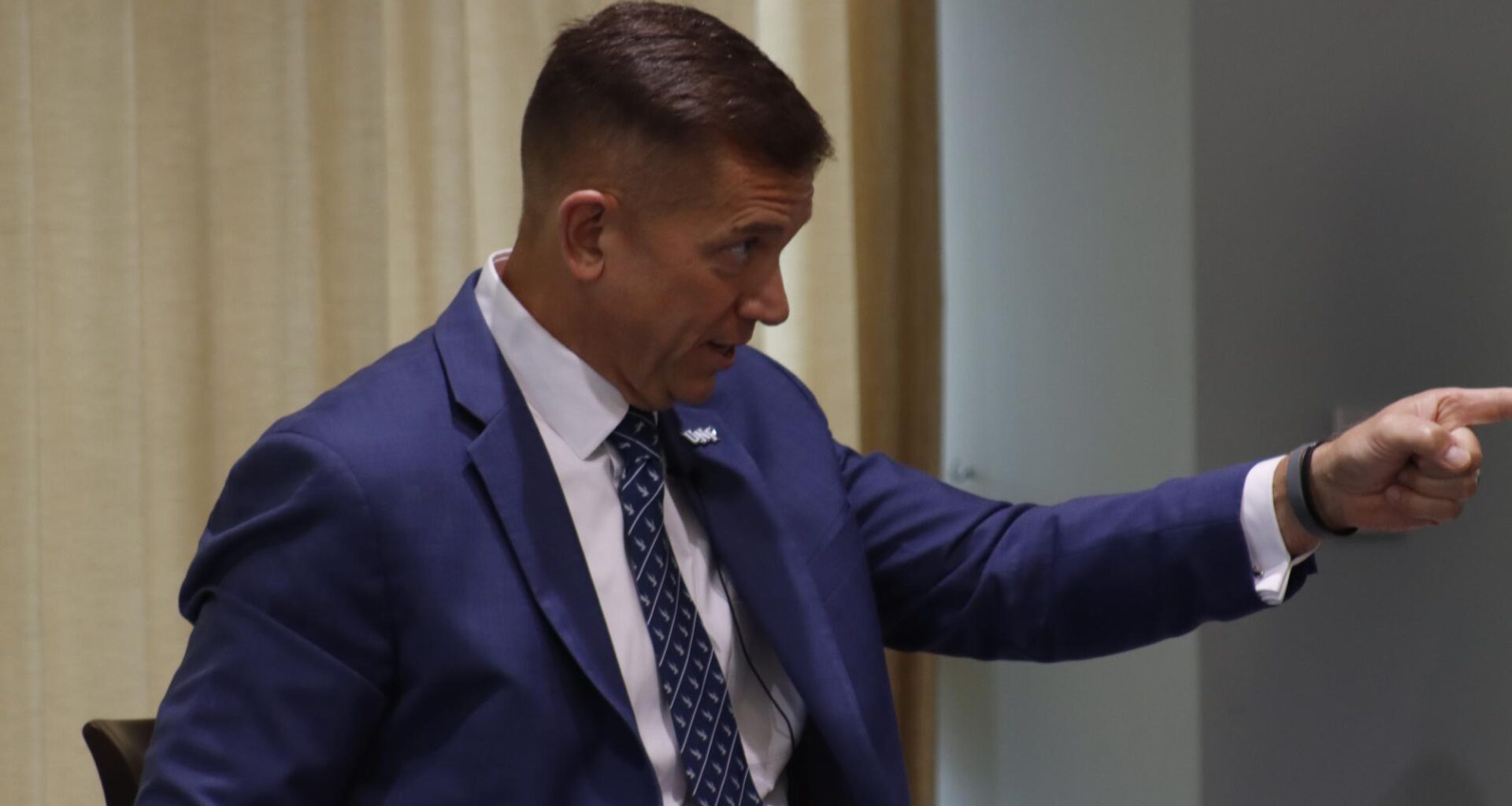
On Wednesday and Thursday, the University of North Florida hosted public forums with Michael P. Shannon, the sole contender for the vacant university president position, so the UNF community could address key institutional priorities before the upcoming confirmation process.
During designated forum sessions, UNF faculty and staff had the opportunity to speak directly with Shannon, asking questions about his approach to academic and intellectual freedom, the university’s prominence in research, and how Shannon plans to support students, staff, and faculty as the university continues to funnel in hundreds of new students each semester.
Despite making what he called an “incredibly difficult” decision to leave the University of North Georgia mid-tenure, Shannon currently stands alone in the running. The UNF Board of Trustees is scheduled to interview Shannon and deliberate on his candidacy on Sept. 16, with the Florida Board of Governors holding final confirmation authority.
Shannon, who has served as president of the University of North Georgia since July 2023, said UNF’s recruiting firm first called him in April. He said making the decision was “incredibly difficult, the hardest of my professional life,” in an email released to UNG students in August.
“The [UNF] Provost asked me earlier today, ‘Why did you answer the phone?’ And I think that really gets to the heart of [the] question, because of what’s here and the opportunity here,” Shannon said during the forum.
In a later session, Shannon said, “What draws me is the place, the people, the history of the institution; it’s still a young institution in the context of others I’ve been part of. The opportunity to be part of building something here is what matters most.”
He said that UNF’s relative youth as an institution offers a unique opportunity for strategic growth.
“I think the University of North Florida can rewrite the American playbook on what an American university looks like in 2026, and going into 2030,” Shannon said.
Defining UNF’s Identity: R1 Research vs. Teaching
“You want to butter my bread, baby; let’s talk about research,” Shannon said.
Inga Timmerman, an associate professor of Finance, said that while UNF wants to be a research institution, the university still sells itself as a teaching institution, asking Shannon whether UNF can pursue R1 research status without abandoning its identity as a teaching-focused university.
“We can’t pretend like we want to be doing both and doing well. What is your vision for UNF?” said Timmerman. “Are we going to become an R1?”
Shannon said he believes that the university can handle both.
“I think you can be R1, moderately selective, and have a teaching and learning environment,” Shannon said.
Shannon said UNF’s on-campus research labs and environment create opportunities for students to engage in “the greatest experiential learning”.
Shannon pointed to Georgia Tech, where he worked for nearly eight years, as evidence that a university can double-dip and be both research-intensive and teaching-focused.
“I came from the most research-intensive R1 in the country by any measure [Georgia Tech], grew up in that environment, worked in it, was on the administrative side of it — and I’ll tell you, this place has that DNA. It has that capability,” Shannon said.
Georgia Tech currently is outranked by Johns Hopkins University as the most research-intensive R1 in the country, with Georgia Tech ranking second nationally for federally sponsored research expenditures.
Addressing concerns over long-term commitment
Alexander Achorn, from UNF’s Development and Alumni Marketing office, asked Shannon what happens if another job calls once he’s a few years into UNF’s upcoming growth campaign, as North Georgia’s call pulled him away mid-tenure.
“You get a call, you have to take it,” Achorn said. “But then midway through the campaign, you’re going to get another call and take it. So what is your long-term goal, either being here or in your career?”
“It’s a good, fair assessment of my journey and one that I’m very cognizant of when coming here,” said Shannon. Shannon called it the “hardest question of the day,” and thanked Achorn for the inquiry.
“I recognize the commitment here, and I’m not saying I don’t have a commitment in my current place,” Shannon said. “This opportunity is different, and I’m telling you like it is.”
Navigating political pressure and academic freedom
UNF history professor Phillip Kaplan asked Shannon about his strategy for addressing what Kaplan called “unprecedented challenges” facing higher education, including long-term national enrollment declines and “political pressures restraining funding from federal and state sources, including pressure on curriculum.”
Shannon said that while “no question we are living in an unprecedented time,” the pressure isn’t limited to the government and the interworkings of politics.
The pressure comes from parents of incoming students who question the value of a college degree and donors who ask why they should give their money to universities, Shannon said.
“Why is the juice worth the squeeze?” Shannon said.
Upholding educational standards requires actively demonstrating the value of academic programs to both internal and external stakeholders, Shannon said.
“That cuts at the heart of everything that we’re facing right now across the enterprise — academic freedom, intellectual freedom, the conversations around content,” Shannon said.
Shannon said defending academic freedom means confronting real fights over curriculum and content, not just endorsing the principle.
“The context of it for me is: the students we were inspiring and training in that curriculum need to know about that content, whether we have an opinion about the content or not,” Shannon said.
According to Shannon, during his time at UNG, his office received a call from an elected official asking that a professor’s textbook be removed from the curriculum because of its content.
“I went over to the college and sat down with one of the leaders. This colleague is brilliant. We talked, we looked at data, we looked at context before I gave an answer to the call,” Shannon said. “Let’s understand the context and let’s understand why the textbook is being used.”
“We came to a compromise. The textbook is still used today,” Shannon said. “The person on the other end of the call was very pleased with the conversation I had back with him.”
While Shannon did not disclose the textbook’s name, in September 2025, UNG made headlines after a UNG senior claimed an assigned textbook, “International Public Relations: Negotiating Culture, Identity, and Power,” labeled Christianity as a white supremacist group.
The senior posted a TikTok about the alleged passage in an assigned public relations textbook, drawing coverage from Fox News and other national outlets.
UNG issued a statement clarifying the passage, saying the student had misinterpreted the content and that the textbook remained in use.
Shannon said addressing the pressures facing higher education will require the university to rethink itself rather than defend the status quo.
“We have to redefine ourselves. We have to think creatively. We have to be innovative,” Shannon said. “We have to work on it and work on the pieces together and fight for the non-negotiables.”
“We have to protect the sanctity of who we are — shared governance, academic freedom, intellectual freedom — which I agree with strongly. I spent 20 years in the military, and I take academic freedom seriously. You will have no more staunch ally. You will have nobody who fights more than this guy,” Shannon said.
Maria Atilano, the Student Success and Engagement librarian at the Thomas G. Carpenter Library, said they appreciated Shannon’s commentary on the importance of academic freedom in higher education.
“Only time will tell, however, if he can or will stand up for such protections when faced with pressure from Florida’s Board of Governors,” Atilano said.
During the forum, Shannon also expressed admiration that the Carpenter Library still carried physical books.
“Plus, although our library has much more to offer than just books, his spoken admiration for libraries and their resources was well taken,” Atilano said.
Tackling student enrollment and retention
UNF enrolled about 18,900 students this fall, its largest total in school history for the second consecutive year, up from about 17,600 in fall 2025, according to the UNF website.
The UNF 2023-2028 strategic plan sets a goal of 25,000 students and Top 100 Public University status by 2028.
UNF associate vice president for Student Success Eric Richman told Shannon that while the university’s student population is climbing, it also faces a growing student retention issue.
“When we lose students, we’re not losing them because they fail academically,” Richman said. “We’re losing them because they return home and they go to state colleges.”
Richman said UNF’s dashboard data shows that about 10% of academically successful students in good standing leave for state colleges closer to home each year. Without football or another draw to keep them nearby, she said, they don’t transfer to a rival university; they leave the system altogether.
“So part of our challenge as we grow is figuring out how to keep them here,” Richman said.
In response, Shannon said he wanted to understand exactly what was causing this retention issue.
“My fundamental question is why,” Shannon said. “Is it money? Is it family? Is it homesickness?”
Shannon said he didn’t have a fix yet, floating ideas from more philanthropy dollars to cover cost gaps to studying the university’s own “return on failure.”
“Maybe it’s a money thing,” Shannon said. “Maybe we have to work more on the philanthropy side to create opportunities for those students to make up that difference.”
Beyond addressing student retention, the possible incoming leadership must also navigate complex workforce dynamics and labor relations across campus, based on staff and faculty concerns.
Candidate views on union relations
The vice president of the university’s United Faculty of Florida chapter, Maria Atilano, asked Shannon directly about his experience working with unions.
Florida’s labor environment differs sharply from Georgia’s, where “none were unionized,” according to Shannon. While Shannon worked with the unionized federal government in past roles, he said he had no experience with unions in higher education.
“In terms of higher-ed union/collective-bargaining contexts specifically, I don’t have direct experience,” Shannon said. “I respect it [unionization], and I hope you’ll teach me. I want to learn,” Shannon said.
“I respected his straightforward answer to my question and his openness to learning and working together,” Atilano said to Spinnaker. “It’s important that our incoming president recognizes the strength of UFF-UNF and the overwhelming support of our faculty union, which is near 60% membership density.”
Next steps
The UNF Board of Trustees is scheduled to interview Shannon and deliberate on Sept. 16.
Following the trustees’ vote, the Florida BOG must formally confirm any final selection to finalize his appointment as university president.
For more information or news tips, or if you see an error in this story or have any compliments or concerns, contact [email protected].