
By Arielle Stevenson, University Communications and Marketing
In a creative world increasingly mediated by the digital, Jimmy Turrell still believes
in cutting things up.
The Newcastle-born artist and designer has built a career out of collage, screen printing, photocopying and working in the
tactile. In doing so, he’s created work for musicians like Beck, the Rolling Stones
and AC/DC, and brands like Adidas.
But as the technological possibilities of image-making become endless, Turrell’s process
remains seated firmly in physical work and its distinct imperfections.
“I’m interested in the mistakes, the textures, the happy accidents in a way, and things
that have actually been touched and made by humanity,” Turrell said.
Turrell is bringing that approach to USF St. Petersburg for a two-day residency with
students in the Graphic Arts program. He’ll give a free public lecture on September 16 at 6 p.m. in Harbor Hall, followed by a reception. A selection of
his work will also be displayed on campus.
He’ll lead senior students through a workshop using collage, chance and sketchbook-making
to explore visual storytelling. Advanced print students will also work with him on
a piece combining cyanotype and screen-printing.
Erika Greenberg-Schneider, associate professor of Graphic Design, established the visiting designer and artist program in 2015 with designer Paula Scher. The program places students in direct contact with established creatives and their
working processes.
“It is a very important step in developing the culture for our program to have successful
artists and designers work with our students,” Greenberg-Schneider said.
Turrell’s analogue practice developed partly by circumstance. He studied graphic design
but disliked working on computers early in his career, pushing him toward illustration,
collage, screen-printing, faxing, photocopying, and working with ephemeral and archival
materials.
Greenberg-Schneider sees those physical processes as foundational for working artists
and students alike, even as creative tools continue to evolve.
“The digital is only as good as the analogue that feeds it,” she said.
Turrell also traces his visual language and work ethic to his working-class upbringing
in Newcastle. His father was a firefighter and his mother a cleaner, and he grew up
around the Byker Wall housing development, where geometric forms and primary colors
stood against the surrounding Brutalist architecture.
“It’s been in my membrane since I was a kid,” he said. “And I think if you look at
my work now, it’s still there.”
“I like to clash disparate worlds together and create this kind of third thing that
has never existed before.” — Jimmy Turrell
Today, that influence emerges in the way Turrell’s work brings seemingly unrelated
materials together. He takes bits of old publications, magazines, found imagery and
other source materials and collides them on the page until the combination suggests
its own direction. He plans on imposing restrictions on the materials students use
for their workshop, giving them a container to experiment within.
“Sometimes, it really is just sitting there with a magazine, cutting some stuff up,
and seeing what you can create and then something’s born out of that,” he said. “I
like to clash disparate worlds together and create this kind of third thing that has
never existed before.”
His lecture will expose another part of the creative process that students do not
always see: failure.
Turrell recalled attending talks by prominent designers that focused almost exclusively
on their biggest successes. From the perspective of a student in a classroom, he said,
that kind of career retrospective can obscure the path between starting out and professional
success.
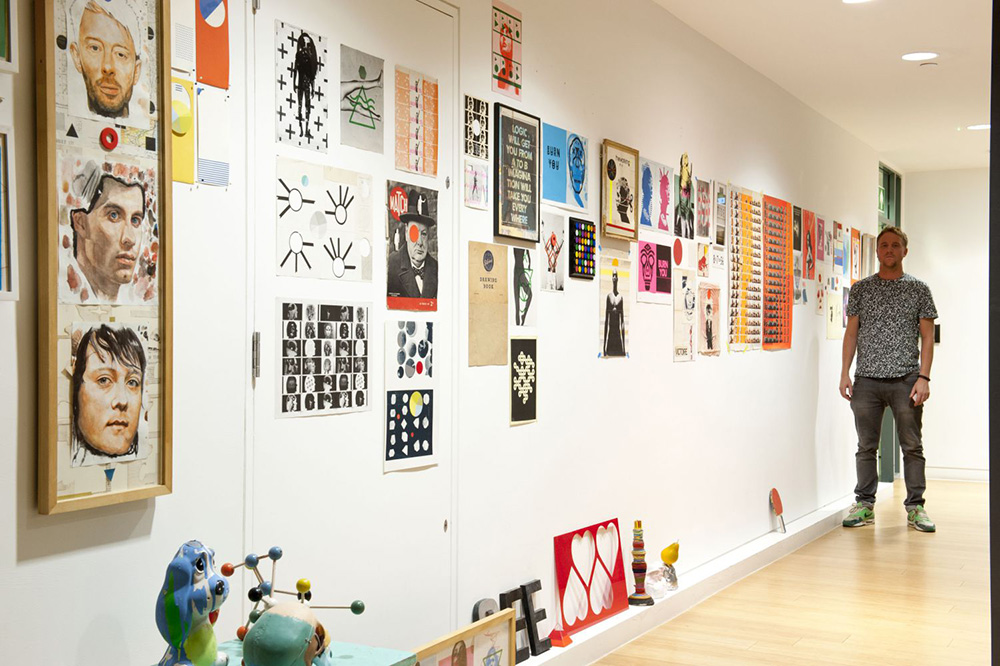
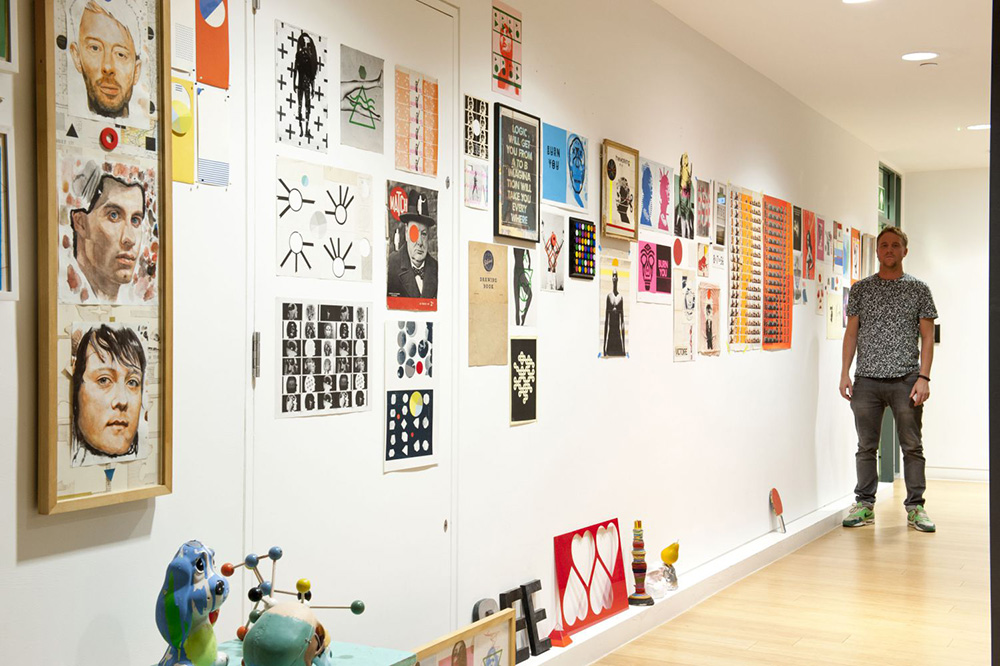 Bartle Bogle Hegarty Exhibition of Turrell’s work.
“I always make sure if I’m giving talks that I show the mistakes made as well as the
successes,” he said.
His own career has included lessons learned through difficult projects, navigating
clients and learning the business side of creative work. Underneath it all is an ethic
he learned growing up in Newcastle, what he calls “graft.”
“You have to keep making things, you have to have graft, you have to make it work,”
Turrell said.
Greenberg-Schneider said that persistence is a central reason she wanted students
to work alongside him, describing Turrell as someone who is “always studying, proposing,
thinking.”
For emerging artists, the result is a chance to encounter part of the creative practice
that rarely appears before the finished product: the cutting, experimenting and mistakes
that give something its meaning.