
The defendants were men who’d killed women and children.
Both were immigrants. Both fled after their crimes. Both used knives to murder their victims.
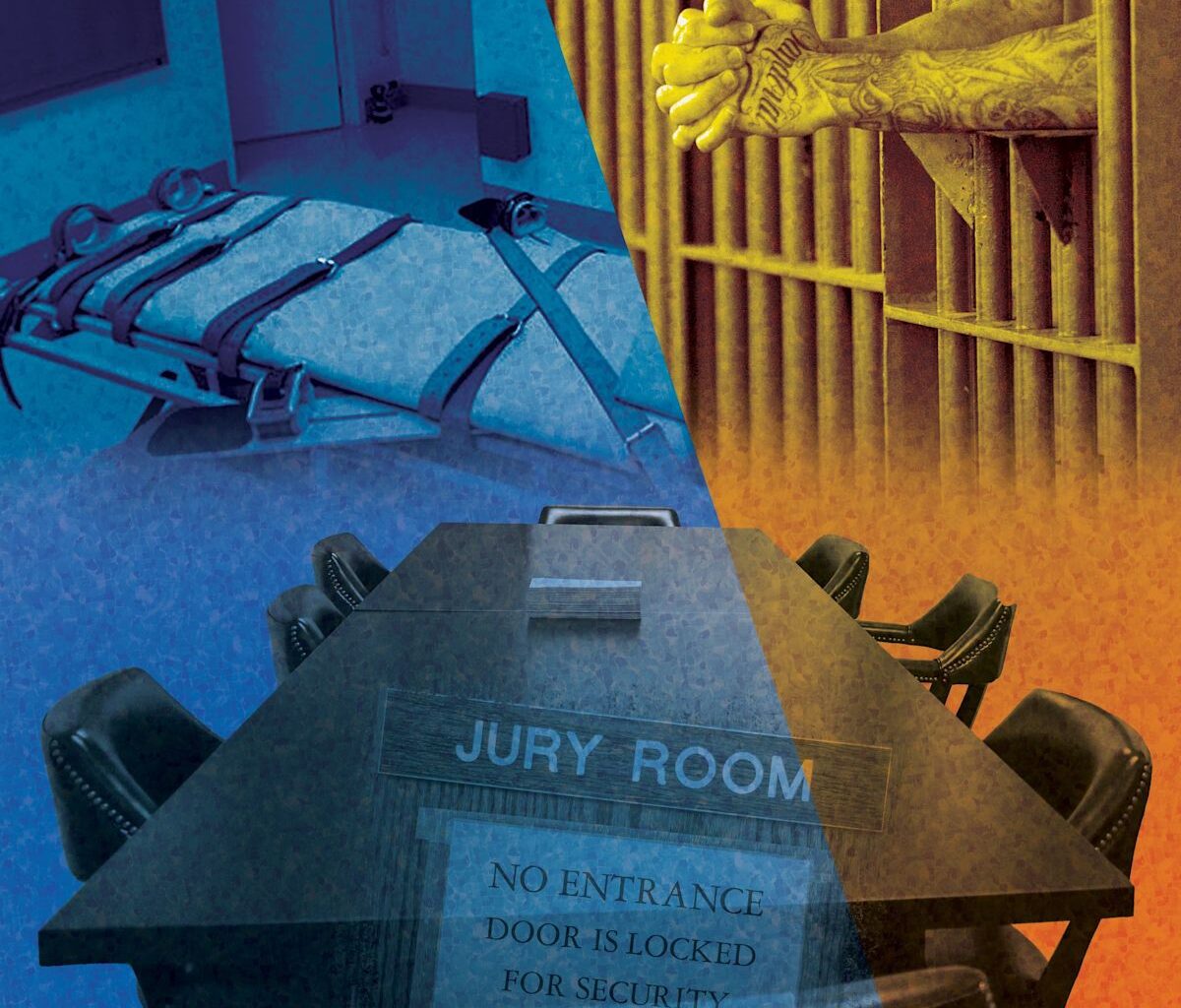
Both went to trial within the last year before separate juries that debated their respective fates in two cramped, windowless rooms in Tampa’s Courthouse Annex.
One jury chose the death penalty. The other chose life in prison.
How did the murder cases of Angel Cuz Choc and Jean Pierre Ojeda Salazar, so strikingly similar, end with such different outcomes? The Tampa Bay Times sought to answer that question by asking the jurors themselves.
In the weeks since Ojeda Salazar’s trial wrapped in June, the Times identified and tried to reach by email and phone each of the 24 people who decided the two cases.Eight— four from each jury — shared their recollections.
What they revealed was a glimpse at a solemn and sacred aspect of American jurisprudence, a seldom-seen double case study in how regular citizens approach the monumental task of deciding whether a person lives or dies.

A sign is seen on the door to the jury room for Courtroom 10 of the Hillsborough County Courthouse Annex on Aug. 11.
Their methods differed. So did the jurors themselves.
They were laborers, businesspeople, retirees, a teacher, a theme park employee. At least one was a lawyer. Many came from Tampa, though both juries saw representation from other areas, including Lutz, Brandon, Riverview and Plant City.
The Cuz Choc jury averaged in their 40s. The oldest was 67, the youngest 19. Ojeda Salazar’s jury skewed slightly younger, averaging in their late 30s. The oldest was 52, the youngest 24.
All went into their respective trials having told the court they could consider death or life as possible penalties, with no fixed opinion favoring one or the other.
When it came time to deliberate,one group tallied their votes by secret ballot. The other hashed out their votes in an open discussion, with opinions and questions noted on a whiteboard.
Their ultimate decision hingedas much on the facts as it did on their own life experiences. Their collective recollections show that as much as the law tries to ensure fairness and consistency on the death penalty, much depends on what individual jurors bring to each case.
Florida does not require a unanimous jury vote to recommend the death penalty. For a few years, it did, until lawmakers revised the law to make 8-4 the minimum vote required for a death sentence. The lack of a unanimity requirement has long been a source of legal debate and controversy.
The jurors who spoke with the Times were not sure if such a requirement would have changed the outcome of their cases. But they said it would have kept them talking.
A secret ballot leans toward death
Angel Cuz Choc glances toward the courtroom gallery during his murder trial last October in Tampa.
Angel Cuz Choc, 33, was convicted last October in the 2024 stabbings of his girlfriend, Amalia Coc Choc de Pec, and her 4-year-old daughter, Estrella Anastasia Pec Coc.
The crime was rooted in Cuz Choc’s jealousy and desire for control over his girlfriend after she spent the day with a friend. He stabbed her shortly after she returned to the east Hillsborough mobile home they shared, then attacked her daughter, cutting her throat as the girl readied fora bath.
The jury took about two hours to find him guilty.

Amalia Coc Choc de Pec and her daughter, Estrella Anastasia Pec Coc, appear in a photo shown in court.
In the jury room, a tower fan beside a watercooler made a light breeze. The light on a coffee maker was lit. The large hand on a clock above one doorway made 2½ circles as their discussion played out.
The group agreed that the crime was horrific and that death qualified as a possible punishment.
“The words issued by the prosecution — heinous, cruel and torture — resonated loudly,” juror Cindy Harbert, 64,wrote in an email to the Times. “The defense had a tall mountain to climb from the beginning, and I think they knew it.”

The jury room inside Courtroom 10 of the Hillsborough Courthouse Annex features a watercooler, a tower fan and a coffee maker. Jurors in Cuz Choc’s trial spent 2 1/2 hours in this room before voting to recommend the death penalty.
The jurors were respectful, though some were vocal. One man questioned whether the crime met the standard for “heinous,” recalled Allison Doucette, who served as the foreperson. She suggested they look again at the evidence.
They examined the crime scene and autopsy photos of the mother and daughter, and their grievous wounds. On an overhead TV screen, they replayed video from the security camera of a home near the crime scene. They saw again the footage of Coc Choc trying to flee,Cuz Choc grabbing her and forcing her back behind the mobile home. They heard again Coc Choc’sscreams and the muffled noise from within the walls as Estrella was attacked, too.
Doucette brought out the knife. The jurors looked at it. They noticed that the blade was bent.

On the overhead TV screen, jurors in Cuz Choc’s trial examined crime scene photos, autopsy photos and video footage from a home near the crime scene.
After about two hours of discussion, one woman suggested a vote by secret ballot. The method would allow each jurorto choose life or death without fear of judgment from the others.
“I think doing it that way was helpful because no one felt particularly pressured either way,” said Doucette, 41. “I thought it was totally genius.”
So the group tore a piece of paper into 12 sheets. They jotted their votes, folded the papers and placed them in a cup.
They tallied the ballots: two votes for life, 10 for death.
“After the vote was taken, there was no discussion as to why someone voted the way they did,” Harbert said.
The jurors were left to wonder about the reasoning for the two holdouts.
Those who spoke with the Times noted several points at which Cuz Choc’s defense seemed to falter.
One occurred during the trial’s guilt phase, when Cuz Choctook the witness stand. His testimony, the jurors agreed, did not help him.
He claimed not to remember the murders. He spoke of a “sickness” and an “evil spirit” that took hold of him just before thekillings.
His words struck the jurors as manipulative and unbelievable.
“I think he testified because he wanted to tell people he was mentally ill,” said Doucette, a civil attorney. “In so doing, it made it clear he was fully competent because he was trying to prove a point.”
His words were delivered through an interpreter of K’iche’, his native language. At least one juror felt the translation may have been a barrier to their understanding of what he tried to say. Another, who was hard of hearing, said the interpreter’s continuous drone, as it reverberated off the courtroom walls, hit his ear as an annoying whine.
The defense arguments emphasized the poverty and violence in Cuz Choc’s native Guatemala, but Doucette felt the attorneys failed to show how those explained his behavior. An academic expert testified about life in the poor Central American country, showing pictures of children there who were unrelated to Cuz Choc.
Cuz Choc’s jury was also unimpressed with the testimony of Aubrey Land, a prison consultant and former Florida corrections official. He’d detailed the experiences of prisoners sentenced to life, who must work and share cells with others, compared to those on death row, who have their own cells and few responsibilities.
One juror felt his testimony made death row sound cozy.
Other pieces of the defense’s case for a life sentence fell flat. The jury saw prerecorded testimony from Cuz Choc’s 13-year-old daughter.
Although she spoke of him with love and described him as a caring father, one part stood out. She was asked if she would visit her father in prison. Her answer: No, I do not want to go there. She said she needed to stay with her mother. It struck one juror as odd, as though the girl had no interest in being with her father.
Then there was Cuz Choc’s brother. He was asked a standard question about whether he could point out Cuz Choc in the courtroom. The man scanned the crowd but said he didn’t see his brother, who sat less than 20 feet away.
Jurors were unsure what to make of that. Did he not recognize Cuz Choc because he’d gained weight, had longer hair and wore a suit? Or was the brother trying to convey a deeper message?
“It appeared like that was more of a message to Angel,” said juror Tyler Lybbert, 36.”Like, ‘You messed up. You’re no longer my family.’ He didn’t value him anymore.”
The panelists who spoke with the Times generally agreed that the lack of a requirement for unanimity on the death penalty likely ended their discussion prematurely. With 10 votes in favor, they didn’t need to convince the remaining two.
An open discussion yields a split vote
Jean Pierre Ojeda Salazar is escorted into court during the penalty phase of his trial in June.
Jean Pierre Ojeda Salazar, 28, went to trial in June, about seven months after Cuz Choc. Prosecutors alleged that he stabbed to death Paula Cabrejo Molina in the northeast Tampa apartment they shared because he feared she was going to end their relationship. When her 14-year-old daughter, Mariana Cabrejo, tried to help her mother, Ojeda Salazar stabbed her to death, too.
Compared to Cuz Choc, his defense in the trial’s penalty phase was less robust. Only two witnesses testified for Ojeda Salazar — his brother and Land, the same prison expert who’d testified in Cuz Choc’s case.
His jury of seven women and five men took eight hours to find him guilty.The decision in the penalty phase took 90 minutes.

Jurors in Ojeda Salazar’s trial hashed out their thoughts by way of an open discussion, with votes and opinions and questions noted on a whiteboard.
The jurors convened in a slightly smaller room than the one where Cuz Choc’s jury met. They crowded around a small table, near filing cabinets and a snack cart, with tissues and hand sanitizer at the ready. A heaviness hung in the air. The mood was somber, the discussion at times passionate but respectful.
For ease of conversation, they called the defendant “J.P.”
Teri Johnson, a retired business consultant whose career included hosting problem-solving groups, was a natural facilitator. She had volunteered to be the foreperson.
She jotted questions and thoughts from the group on a whiteboard. Each person had a chance to share how they felt.
“As the foreperson, I didn’t want anybody to feel any ickiness about their experience,” said Johnson, 52.”I wanted everyone to feel like they came to their conclusion on their own.”
Beside each person’s juror number was their vote: “yes,” “no” or “maybe.”The initial tally: three or four votes for death; two or three for life. The rest fell somewhere in between.
“It was a mix at first,” Johnson said. “We just really got to talking about why we were mixed.”
As people spoke, Johnson made notes on the board about what they said and questions they had. They looked again at crime scene and autopsy photographs, the deep wounds that marked the victims’ bodies.
Juror Shannon O’Sullivan said she was particularly struck by the lead prosecutor. Assistant State Attorney Lindsey Hodges had emphasized the extreme pain and cruelty that the victims endured. In closing arguments, her voice at one point quavered.
“I could feel her passion,” saidO’Sullivan, 45. “She was emotional. She felt for this mother and daughter. She wanted this man punished with the death penalty.”
Nevertheless, O’Sullivan said she entered the jury room wanting to hear what her fellow jurors had to say.

Jurors in Ojeda Salazar’s trial crowded around a small table, near filing cabinets and a snack cart. With tissues and hand sanitizer at the ready, a heaviness hung in the air.
The four jurors who spoke with the Times said that some on the panel voiced religious concerns. Knowing the weighty decision they’d have to make, people said they’d prayed and turned to the Bible for guidance, juror Courtney Harris recalled. A few said they couldn’t do it.
Someone said they believed God would take him when he was ready, but that they could not make that decision, O’Sullivan recalled. Someone else asked rhetorically whether it was God’s plan for the woman and her daughter to die.
Two people said they thought the defendant was snarky, making faces or rolling his eyes, Johnsonsaid. Others saw him as expressionless and stoic. Some wondered why he never testified.
One woman broke into tears.
“None of us took our role lightly,” Johnson said.
Johnson considered herself among those on the fence when their discussion began. But as she weighed her decision, the words of one defense witness stuck in her mind.
It was Land, the prison expert who hadn’t impressed jurors in the Cuz Choc case,where he also testified for the defense. For Johnson, Land’s description of life in prison sounded like a just punishment.
Ojeda Salazar would be required to work a prison job until he physically could work no more. For possibly decades, he would have no privacy or personal space.
It sounded, Johnson thought, worse than death row, where prisoners get their own cells and TVs, and they don’t have to work.
She knew that the condemned often spend many years awaiting execution. It also helped, she said, to know that there was no possibility of parole if Ojeda Salazar received a life sentence.
“When I was weighing all of those things, I thought, ‘His life is going to be hell in general population,'” she said. “If it was me, and I knew I was going to die in prison, I’d rather, personally, be on death row.”
They tallied another vote. They were evenly divided — 6 and 6 — on the death penalty for the mother’s murder. For her daughter, there was a slight lean — 7-5 — toward death.
It wasn’t enough to recommend capital punishment.
A few people were asked if there was anything that could sway them the other way. Their decision was clear, though some seemed to walk away dissatisfied.
“Even for myself, it was one of those things where you always have that thought in the back of your head of ‘Am I making the right decision?'” said juror Marcus Kowitz, 40.”Even though there’s not one right answer.”

A sign on the door to the jury room for Courtroom 14 says jurors are in deliberations on Aug. 11.
An emotional toll
Neither jury knew about the other while the trials were underway. When told about the other case in recent weeks, several people identifieda key difference between the two: One involved a very young child.
Catherine Hattais, 62,a juror in the Cuz Choc case, had previously served on a death penalty jury in the 1990s. The panel in that case chose life.
The difference this time, she said, was Estrella. She remembered seeing photos of the wound to the girl’s neck — a wound she believed Cuz Choc inflicted to make her go quiet.
“To me,” Hattais said, “it all came down to the child.”
People from both panels remarked about the emotional toll — vicarious trauma from having been exposed to graphic images, videos and testimony.
While most regarded their experience as a meaningfulone, some voiced mixed feelings.
“This is the system we have,” said Harris, 39,who served on Ojeda Salazar’s jury. “So, unfortunately, even with two very similar cases, you can have different outcomes. Is it right? Is it wrong? IDK (I don’t know). I was just glad I was able to give a voice to the victims in this case and get some justice for their murders.”