
A Jacksonville man has been jailed on federal gun charges after being accused of selling 50 homemade machine gun conversion devices produced on a 3-D printer for $300.
Emani Rey Justavino, 19, was charged with illegally possessing machine guns and possessing unregistered weapons under policies that treat conversion devices as machine guns.
Justavino could be sentenced to as much as 10 years behind bars if he’s ultimately found guilty.
U.S. Magistrate Judge Paricia Barksdale ordered him temporarily detained on September 10.

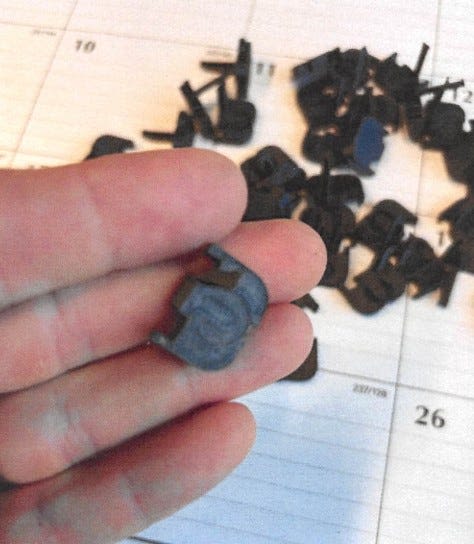
This photo, showing items the federal government considers 3-D-printed machine gun conversion devices, was included in a court document accusing Emani Rey Justavino of illegally possessing machine guns. Justavino was accused of selling 50 devices for $300.
More: ‘Society is pretty fragile,’ client says about buying machine-gun converter from Clay firm
The case highlights the increasing use of new technology to quickly make equipment that traditionally required a machinist’s skill.
Machine guns have been tightly regulated since the 1930s because of their use in violent crime. Black-market conversion devices can let buyers avoid restrictions on ownership as well as prices for legal machine guns which, in one gun website’s tally of recent sales, ranged from about $28,000 to $81,000.
A conversion device can remake a semiautomatic Glock pistol so the gun can fire about 1,200 bullets per minute by just pulling the trigger once, a September 3 criminal complaint against Justavino said.
“Installation of these devices is fast and simple, requires no technical expertise and is completed by removing the original polymer slide cover plate on a Glock … and replacing it with the device,” Bureau of Alcohol, Tobacco, Firearms and Explosives Special Agent Jeffrey Davis wrote in the complaint.
Justavino hasn’t been indicted but the complaint said investigators learned of him while looking into someone advertising a conversion device for sale over Instagram.
A source working with ATF contacted the Instagram seller, who said the devices were being made on a 3-D printer, and the source eventually arranged to buy four of the devices for $200, the complaint said.

This image showing items identified as machine gun conversion devices that a federal agent purchased from Emani Justavino was included in a court document charging Justavino with illegally possessing machine guns not registered to the owner in federal records.
The complaint said an undercover ATF agent and the source ― who was helping investigators in return for leniency from authorities on a relative’s legal trouble ― met Justavino at a northwest St. Johns County restaurant in August and arranged to buy the four devices from Justavino’s roommate at a home on a cul de sac off Lake Mandarin Circle.
A day later, a different undercover ATF agent called Justavino, said the complaint, which said “Justavino advised that he had printed 50 MCDs [machinegun conversions devices] the previous night and was out of material due to all the printing.”
The complaint said the agent arranged to meet to buy eight devices that day and that Justavino handed him a toaster pastry box holding all 50 devices when they met.
The agent started counting out his purchase, the report said, when “Justavino, however, stated that he would sell all 50 MCDs for $300,” and the agent paid him.
The case involving Justavino is uncommon locally, but not unprecedentd.
In 2023, Clay County resident Kristopher Ervin was sentenced to 68 months in prison for selling about 6,600 conversion devices that were advertised on a gun-focused YouTube channel. Ervin paid a machine shop to manufacture the card-shaped strips of stainless steel he marketed under the name Auto Key Card.
This article originally appeared on Florida Times-Union: 50 at a time, Jacksonville 3-D printed machine gun converters, say feds