
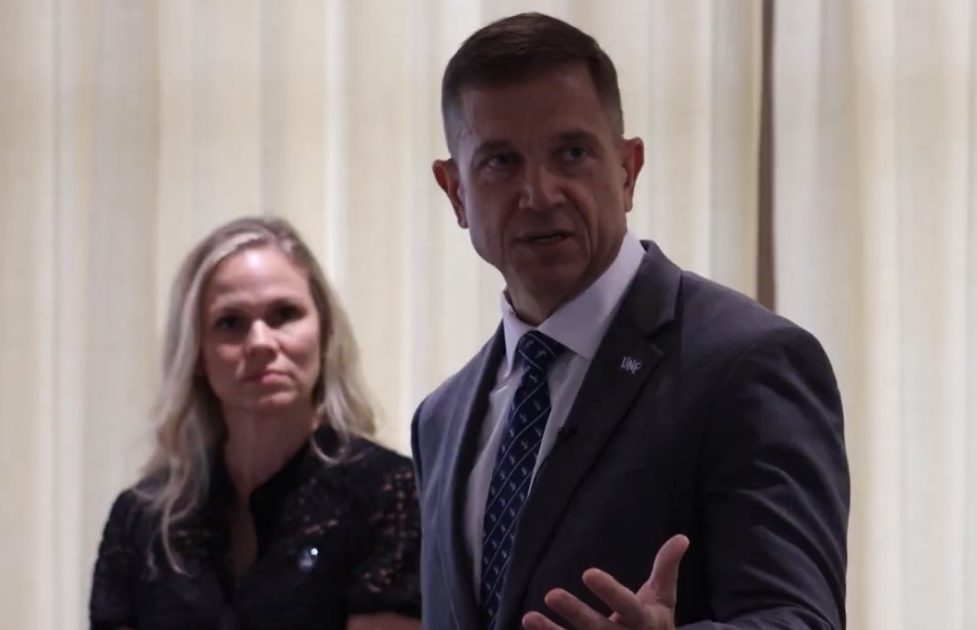
University of North Florida presidential sole finalist Michael Shannon addressed student concerns over student accessibility, diversity and university policies during an open forum on Sept. 10.
Shannon, the current president of the University of North Georgia, spoke on the fourth floor of Osprey Commons. The event was part of a series of campus forums, which included separate sessions for faculty and staff on Sept. 9 and 10.
Commitments to diversity and inclusion
Niko Harden, a senior ecology major, raised concerns about a reported lack of support for multicultural groups at UNG and asked how Shannon plans to support diverse student organizations at UNF, such as the Muslim Student Association, Black Student Union, and Pride Club.
Shannon said he needs to engage with more students to better understand campus organizations, emphasizing his commitment to working with all student groups.
“All of us are created equal; all of us show up differently. None of us decide the family we get to be born into,” Shannon said. “I care deeply about everybody, and I realize everybody’s interests and needs are a little different.”
The discussion comes at a time when university leaders across Florida are navigating shifting state policies regarding diversity, equity, and inclusion, particularly after Florida Senate Bill 266
and the Florida Board of Governors’ Regulation 9.016 were approved.
This legislation prohibits Florida public universities and colleges from spending state or federal funds on any programs, policies, or activities that promote or advocate for diversity, equity, and inclusion, or that engage in political or social activism.
UNF officially closed its Office of Diversity and Inclusion on May 1, 2024.
Campus immigration policies
Calvin Pell, a senior physics major, asked Shannon about UNF’s 287(g) agreement, a program that enables local police officers to receive training and authority from U.S. Immigration and Customs Enforcement to assist with federal immigration enforcement on campus.
Pell also asked how Shannon would ensure administrative transparency regarding such policies.
During Shannon’s tenure at UNG, the university did not maintain a 287(g) agreement with federal immigration authorities, according to Shannon.
Shannon said he didn’t know what the agreement was and that he would need to research the matter further, adding that he prefers to be honest when he lacks information on a topic.
“That’s how I roll,” said Shannon.
Addressing accessibility challenges
Fahad Amjad, a multimedia journalism major who is legally blind, shared his experiences with accessibility challenges on campus and asked if Shannon would collaborate with disabled students to improve campus infrastructure.
Shannon thanked Amjad for his questions and said that he would “get to the bottom of it.”
“I don’t know what’s going on; I need to understand it better. You have my commitment: we’re going to work on this together,” Shannon said.
Following the forum, Amjad spoke with Spinnaker to clarify that his primary concerns stem from physical infrastructure rather than the services provided by the Student Accessibility Center.
“My director has treated me well; I don’t have any ill will or anything to say that he could be doing things better. It really comes down to, at the end of the day, how the whole thing is built,” Amjad said.
UNF has ongoing obligations under the Americans with Disabilities Act to gradually modernize older campus buildings, walkways, and physical infrastructure to meet current accessibility standards, according to UNF’s ADA Compliance Vision and Mission website.
Amjad said that he felt Shannon was sincere in his pledge to consult with disabled students.
“I think that he was willing to have that conversation and he’s willing to understand our world,” said Amjad.
Value of experiential learning
Winter Slaughter, UNF Student Government pro-tempore, highlighted an upcoming experiential learning opportunity in Long Beach, California, and asked if Shannon would continue prioritizing experiential learning as previous administrations have at UNF.
Shannon congratulated Slaughter on the opportunity and reaffirmed his support for UNF’s strategic focus on experiential learning, noting that practical experiences build valuable skills for students after graduation.
“Experiential learning is key. I’m all in,” said Shannon. “Did you hear me telling stories? That’s experiential learning.”
Expanding hands-on opportunities aligns with UNF’s strategic plan goals, which aim to increase student participation in internships, undergraduate research, and study-abroad programs before graduation.
The UNF Board of Trustees is scheduled to interview Shannon on Wednesday at 2 p.m. in the Talon Room of Osprey Commons.
For more information or news tips, or if you see an error in this story or have any compliments or concerns, contact [email protected].