
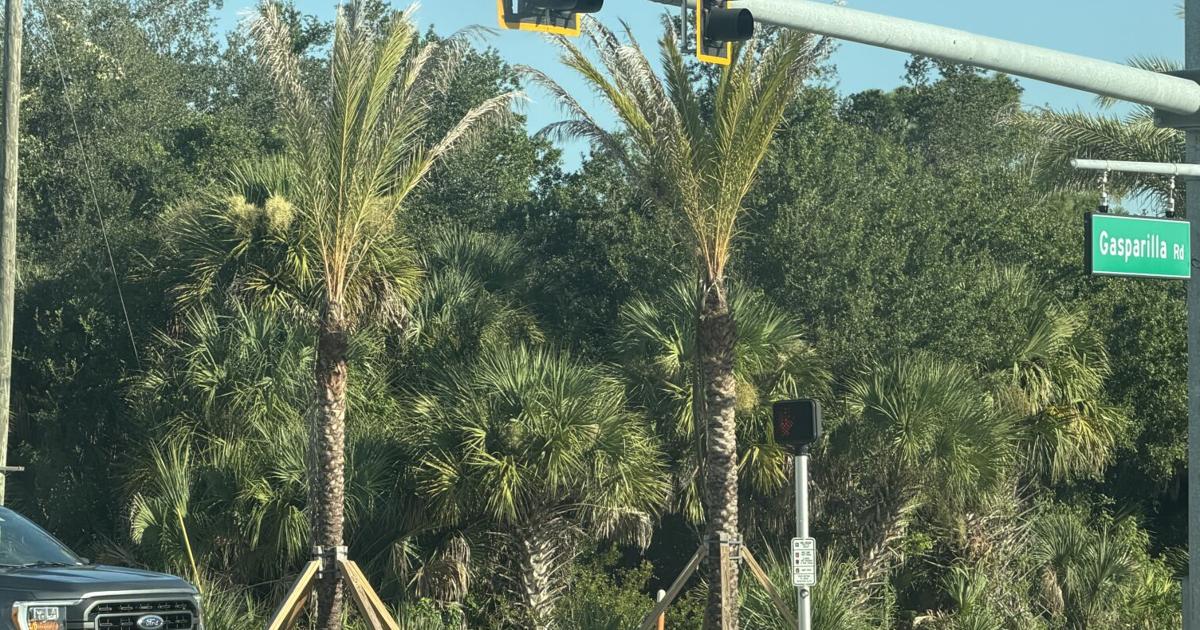

Staked palm trees near Gasparilla Road. A common practice to regrow and stabilize trees to withstand strong winds is staking. However, if kept stake for too long, trunk damage can lead to failed growth.
SUN PHOTO BY NICOLE DROEGER
PORT CHARLOTTE — A common practice to regrow and stabilize trees to withstand strong hurricane winds is staking.
Louise Raterman, a resident with a degree in environmental sciences, said she noticed a trend of trees on county property being staked for too long.
Failed tree growth along Harbor Boulevard.
PHOTO COURTESY OF LOUISE RATERMAN
Raterman started documenting failed trees in 2024, where a tree’s trunk along Harbor Boulevard split and fell despite being staked.
“When they buy these trees at hundreds of dollars a piece and they die, it’s an abuse of taxpayer money,” Raterman said.
In August 2025, Raterman noticed more tree saplings along the same road being staked, some even tied with ropes.
“Normally, these trees will bend in the wind,” Raterman said. “If roped up, they won’t move.”
According to chapter 11 of the University of Florida’s Institute of Food and Agricultural Sciences journal ENH1061, placing stakes may be needed to stabilize a tree’s root ball. Trunks with a diameter greater than 1.5 centimeters are not necessary, and if stakes are placed for larger trunks it may lead to a “lesser quality tree.”
In September 2025, Raterman documented the strain of staked palm and maple trees along Olean Boulevard.
Ralph Mitchell, director for the county’s extension of UF IFAS, said the initiative to stake the trees came after hurricanes.
“It’s one thing to set it up and another thing to remove it,” Mitchell said. “Much of this was well-meaning first aid after the hurricanes, but kept on too long or forgotten.”
The one remaining tree in front of the justice center before the straps were removed.
PHOTO COURTESY OF LOUISE RATERMAN
In August, Raterman sent an email to the Charlotte County Commissioners about a tree in front of the Charlotte County Justice Center in Punta Gorda.
“It is only alive because someone removed the strap which was strangling it,” Ratterman said.
Previous trees replanted in front of the Justice Center failed.
“It’s horrible only one remains,” Raterman said.
Hank Flores, a urban design manager with Punta Gorda told The Daily Sun that the maintenance of these trees falls under the county’s Facilities Management Department.
Mike Bonasera, Punta Gorda assistant city manager, said Flores and the urban design team drove to the Justice Center to investigate. Randy Cole, facilities operations and maintenance manager, gave The Daily Sun an update.
“This tree had previously been strapped for support, and those straps were later removed,” Cole stated in an email. “Following a subsequent windstorm, the tree fell over, so we had the installer reset it and reinstall the straps temporarily to determine if the tree could be saved.”
New tree saplings will be planted.
“Our team at the Justice Center is working with our contractors to replace the missing trees and have been making necessary repairs to the irrigation system for the planter boxes that suffered damages from the many storms,” Cole wrote.
Strapped trees along Tamiami Trail near a Walgreens.
PHOTO COURTESY OF LOUISE RATERMAN
Raterman noticed more staked and roped trees along Tamiami Trail on Sept. 1. These trees, which fall under the jurisdiction of Charlotte County Public Works, are under investigation.
“Our people that do the trees are going to go out and conduct a review,” Public Works Public Relations Manager Chad Ray said. “Hopefully, we’’ll get a work order in and get it fixed.”
Raterman hopes the county properly replants trees.
“People should care about where they live, about the plants and trees that belong here in Florida,” she said. “It’s important now because that’s what feeds wildlife. All the frogs, toads, salamanders and worms that birds take home lead to death without trees.”