
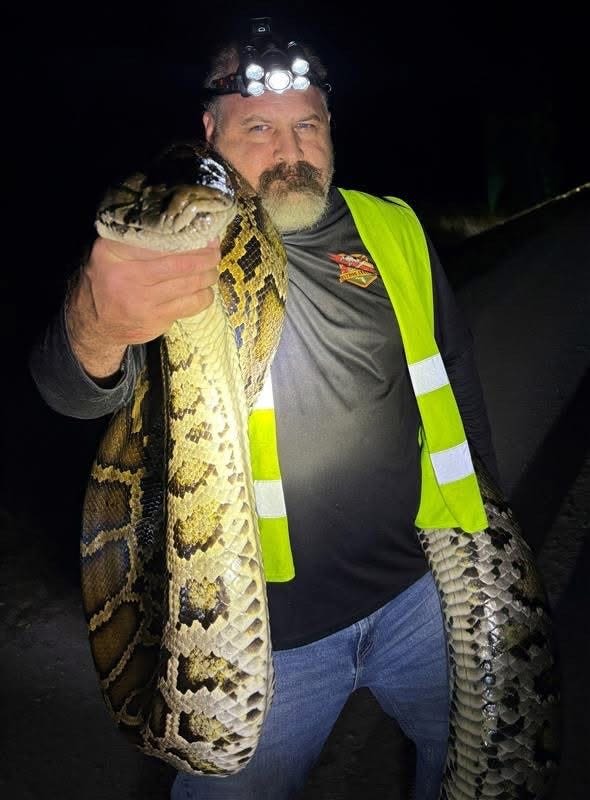
When it comes to eliminating invasive Burmese pythons in Florida, the hunters attempting to do that are significantly outnumbered.
With so many pythons slithering around Florida it can easily be classified as a full-blown invasion. No one is able to put a finger on a solid number for just how many pythons are in the Everglades. “Burmese pythons are hard to find due to their cryptic coloration and secretive behaviors, and their low detection probability is a major challenge to effective python control and research,” according to Florida Fish and Wildlife.
However, conservative estimates by the USGS put the Burmese python population in the Florida Everglades region in the tens of thousands.
More: There’s an invasive Burmese python in my backyard. Now what do I do?
What the experts do know is the python is altering the Everglades ecosystem in an unprecedented way, consuming everything from rabbits to fully grown deer and a variety of other mammals, birds and reptiles, in high volume, which is negatively impacting the native wildlife.
Despite the seemingly in surmountable odds, python hunters are doing their best to take on the task of eliminating pythons, even if it is just one at a time, and they are getting paid for their efforts by the Florida Fish and Wildlife Conservation Commission (FWC).
The FWC started paying certified, or contracted, hunters for eliminating pythons in the spring of 2017 with the launch of the Python Action Team Removing Invasive Constrictors (PATRIC) program.
Photos of South Florida Water Management District Python Elimination Program winners
1 of 19
Along with winning the 2026 Florida Python Challenge, Tom Rahill of Lutz, Florida, also won the South Florida Water Management District’s July Python Elimination Program competition by capturing 98 snakes. (Provided by FWC and South Florida Water Management District)
How much do contracted python hunters in Florida make?
Here is what to know, according to the FWC.
Contracted members with PATRIC are paid bi-weekly with an hourly wage and fixed rates for certain services:
$14-$30 an hour for surveys based on survey locations
$20 an hour for rapid response efforts, plus additional payment for constrictor if removed
$200 per each active python nest removal, plus more per egg
$50 per each removed python up to 4 feet and an extra $25 for every foot over 4 feet
The FWC said there’s additional monthly bonus compensation, including for most pythons and longest pythons removed.
What are surveys and survey locations?
According to the FWC, In the context of nonnative snake management, surveys are targeted searches used to locate and capture nonnative snakes such as Burmese pythons.
Surveys may be conducted on a variety of public conservation lands and may occur via foot, bicycle, vehicle, or watercraft.
Survey protocols must be followed for the effort to be considered official. This includes checking in through the approved survey phone application, which verifies both the survey location and duration.
What does rapid response mean for contracted python hunters?
The FWC said early Detection Rapid Response (EDRR) efforts take place when a contractor is dispatched by FWC staff to assist with a rapid response to locate and remove a python or pythons. These surveys are typically initiated following reports to the Invasive Species Hotline or website.
Competitive hunts: Another way to make money killing pythons
In the summer, the FWC and South Florida Water Management District (SFWD) run the Florida Python Challenge a 10-day competition where hunters compete in different categories with $25,000 in prize money, including a $10,000 grand prize for most pythons eliminated.
Separately, the SFWMD districts has its monthly Python Elimination Program competition, which was started in 2025 and also distribute bonus money in different categories like most pythons removed and longest python captured.
FWC teaches public how to find, catch and humanely kill Burmese pythons
FWC offers training to the public, free of charge, via its Python Patrol program.
Virtual classes are offered every third Thursday of the month.
The training covers:
Real-time audience Q & A
Information on Burmese pythons in Florida
How to search for pythons
Safe capture techniques
Reporting pythons to the FWC
Live instruction on techniques from a biologist
Class registration and a self-guided version of the training are available on the FWC website.

Kristine Bartish, center, caught the longest python in the July Python Elimination Program competition for the South Florida Water Management District. The python was measured at 17-feet, 1-inch long.
Here’s how you can get paid for hunting, killing Burmese pythons in Florida
The FWC’s Python Action Team – Removing Invasive Constrictors (PATRIC), in conjunction with South Florida Water Management District’s Python Elimination Program, contracts with qualified private individuals to remove pythons.
Contractors are paid hourly – $13 or $18, depending on the area – for removal efforts. Additionally, freelancers earn $50 for each python up to 4 feet long, plus $25 for each additional foot. They also receive $200 per nest removal field-verified by FWC.
Online applications are accepted year-round.
Hunters, anglers and outdoor recreationists with experience removing pythons or other large constrictors from the wild are encouraged to apply, with preference given to Florida residents and military veterans.
To gain experience, FWC recommends participating in the Florida Python Challenge or hunting on FWC-managed lands.
What to do if you see a Burmese python in Florida?
If you come across a Burmese python, avoid it and report the sighting to the Federal Fish and Wildlife Conservation Commission (FWC). Take a photo and note your location before reporting one of three ways:
Call the exotic Species Hotline at 888-Ive-Got1 (888-483-4681)
Use the free IveGot1 mobile app
Can you kill a Burmese python in Florida?
Burmese pythons are not protected in Florida except by anti-cruelty laws. Burmese pythons must be humanely euthanized, according to the FWC. These are the steps one should take:
Use deliberate, multi-directional movement, move the rod forward along the left and right sides of the brain and then toward the brainstem, ensuring substantial destruction of the brain.
Target the brain: The application of the tool should result in the python immediately losing consciousness.
Draw an imaginary line between each eye and the opposite jawbone.
The brain is located where the two lines intersect.
Apply the tool to the target area (brain) to achieve an immediate loss of consciousness.
Destroy the brain: Immediately and substantially destroy the python’s brain by manually “pithing,” which prevents the python from regaining consciousness.
Insert a small rod (a rigid, metal tool like a screwdriver, spike or pick of sufficient length) into the cranial cavity.
Mark H. Bickel is the Audience Development Director for The News-Press & Naples Daily News. Reach him by emailing mbickel@usatoday.com.
This article originally appeared on Naples Daily News: Florida’s python economy: How much cash do hunters make for their kills?